
Shared concerns over EU carbon scheme
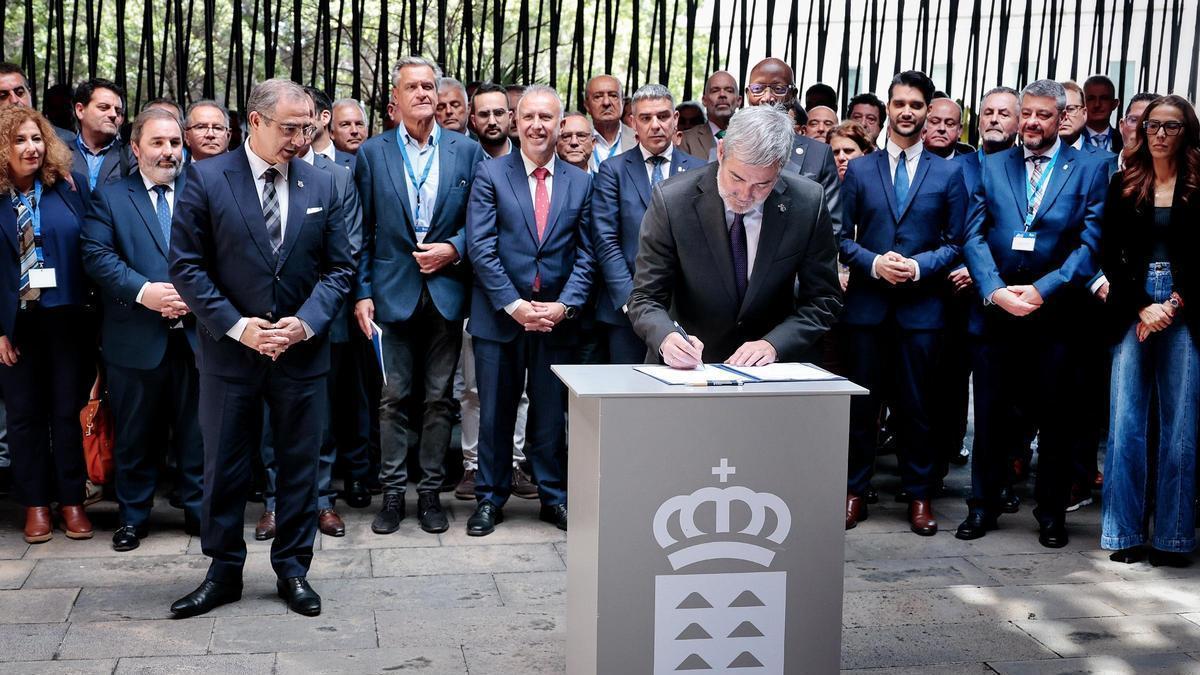
The president of the forum of EU Outermost Regions (ORs) and head of the Regional Council of Guadeloupe, Ary Chalus, has written to European Commission President Ursula von der Leyen with the same request that Canary Islands’ leader Fernando Clavijo put to the Spanish government in late May. In this new letter, the outermost regions close ranks with the Canary Islands, expressing shared concern over the “disproportionate” impact the Emissions Trading System (ETS) could have on the islands.
“Any restriction or significant increase in costs risks not only economic and social cohesion but also the fundamental principle of equal rights for EU citizens, weakening the full integration of the outermost regions into the Union,” Chalus argues in the letter, which was also sent to European Commission Vice-President Raffaele Fitto, Climate Commissioner Wopke Hoekstra, and Commissioner for Sustainable Transport and Tourism Apostolos Tzitzikostas.
Call to extend exemptions beyond 2030
The request now being made jointly by the outermost regions is the same one the Canary Islands has been pushing for months. “We consider it essential to guarantee the maintenance and extension beyond 2030 of the exemptions currently applicable to maritime and air transport, thereby ensuring the continuity of connectivity and the economic viability of our regions,” Chalus states. The approach matches the two key points Clavijo put to Spanish Prime Minister Pedro Sánchez ten days ago: keep the current exemptions in place and correct distortions that penalise ultra-peripheral ports and airports compared to operators from third countries.
Both the Canary Islands government and the Conference of Presidents of the Outermost Regions warn that fully applying the system could push up transport costs, weaken connectivity, and harm territories with no land-based alternatives.
A one-size-fits-all approach that doesn’t fit
The OR spokesman argues in the letter that emissions trading rules “cannot be applied in the same way” to mainland territories as to islands far from the European continent, insisting that the climate transition should not penalise connectivity in Europe’s most remote regions. In the letter, Chalus makes clear that this group of regions does not reject the EU’s climate goals, but warns that applying the “same rules” to mainland and ultra-peripheral territories could create inequalities.
The document also recalls that these territories face permanent structural limitations recognised under Article 349 of the Treaty on the Functioning of the European Union. Chalus stresses that remoteness, insularity and, in many cases, double insularity mean any cost increase has a “much greater” impact than in mainland territories.
What is at stake? Everything
According to the president of the Outermost Regions, the issue could affect transport, supplies, mobility, public services and economic activity across the regions. The letter warns that any significant rise in the cost of connections could directly impact the cost of living and the competitiveness of these territories. “Mobility, access to essential services, education, healthcare and employment opportunities all depend on efficient and sustainable air routes,” the text notes.
Shipping and aviation under threat
In the maritime sector, the outermost regions warn that applying emissions trading could make routes to Europe more expensive and encourage a shift of traffic towards nearby third-country ports subject to “fewer obligations”. According to the letter, this imbalance threatens the competitiveness of ultra-peripheral ports, could raise logistics costs, and reduce connectivity for territories that rely on ships to ensure their supply.
The OR spokesman also highlights the impact on air transport. He warns that applying the scheme could make connections to Europe more costly and leave ultra-peripheral airports—and the European airlines operating from them—at a disadvantage compared to operators in nearby third countries. The letter insists that for these territories, air travel is essential for mobility, access to basic services, and maintaining ties with their own member state.
Risk of unintended consequences for the climate
The letter also warns of a possible effect that runs counter to the EU’s climate policy goals. According to Chalus, if the application of emissions trading makes maritime routes to Europe more expensive and leads to a loss of connectivity at ultra-peripheral ports, these territories could be forced to source essential goods from other markets or supply points. That logistical detour would not only raise supply costs but could end up “generating new emissions”—precisely what the rules are intended to prevent.
What’s happening in the Canaries – straight to your phone
News, weather alerts and practical updates – direct from the islands, in English. We live here and know what’s going on – before the international media catch up. Everything lands on our WhatsApp channel – no middlemen, no algorithm. Curated for families, expats and travelers.
Friday: autumn-like skies and morning showers

Tenerife set for cooler weather after heat spell

Thursday: cooler air and more cloud on the islands

Earthquake felt in Gran Canaria’s Agaete

Canary Islands heat continues as calima persists

The underwater ‘grandmothers’ of the Canary Islands

Wednesday: heat eases slightly, but still hot

El Niño: What it means for the Canary Islands

Heatwave alert extended to more Canary Islands
