
Adeje’s historic passion play captivates Good Friday crowds
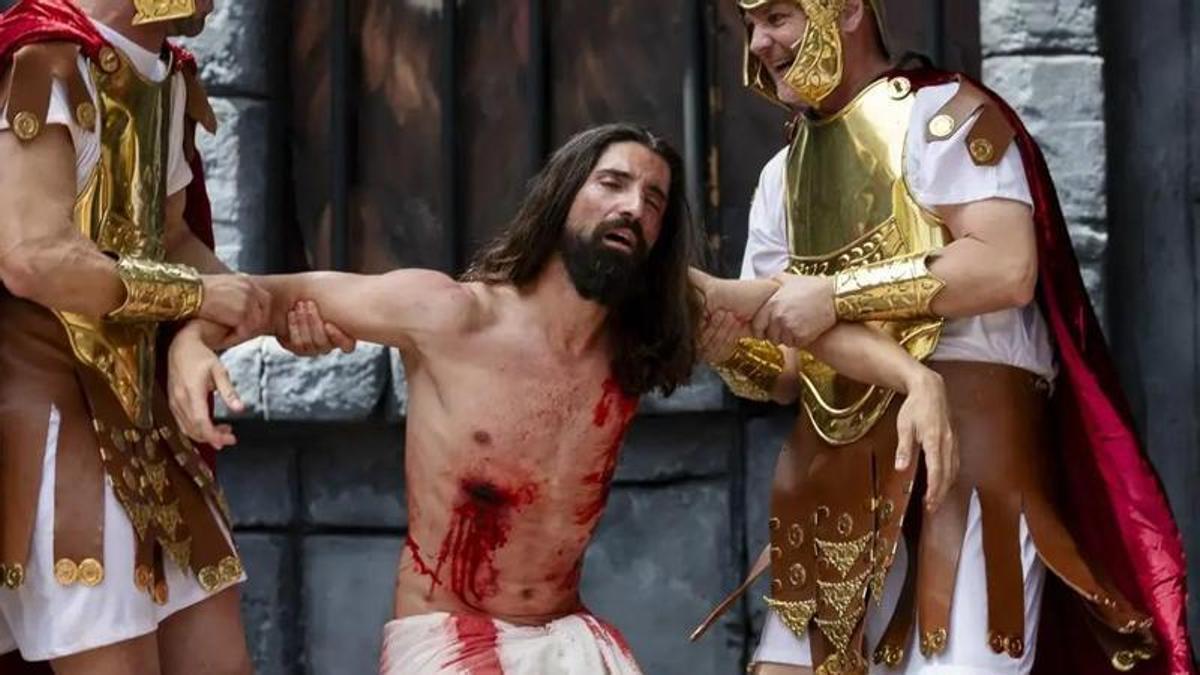
The Adeje Passion Play once again transformed the historic town centre into the stage for one of the most prominent events of Holy Week in the Canary Islands. It drew hundreds of people this Good Friday to Calle Grande. The production, organised by the Adeje Town Council’s Department of Culture, incorporated new theatrical proposals for its 2026 edition. These included a renewed aesthetic and scenography for the Last Supper scene, one of the most significant moments of the play.
New choreography and enhanced production values
“Immensely satisfied, moved, proud. Every year, The Passion reproduces a host of indescribable sensations. It has been an unrivalled performance, an act created by the people of Adeje, with a cultural impact that goes beyond our own expectations,” reflected Councillor Alonso Ferrera after the more than two-hour live broadcast. Alongside the aforementioned novelties, new choreography was added. This included a dance piece in the setting of the first scene of Pilate and Claudia, performed by students from the Adeje Municipal School of Music and Dance, as well as a symbolic intervention in the Garden of Gethsemane representing the struggle between good and evil.
The staging included improvements to the costumes, designed by Cristian Alayón, new props, and additions to the cast, strengthening community involvement. These innovations add to the evolution the Representation has undergone in recent years, with the incorporation of new stage spaces, previously unseen scenes, and an updated soundtrack.
A two-hour journey through emblematic streets
The two-hour performance began at midday with the parish priest’s blessing to the people of Adeje following the Procession of the Nazarene of Forgiveness. The play consists of 13 scenes and moved through emblematic spaces such as Calle Grande, Plaza de la Cruz del Llano, and Plaza de España. It depicted episodes including the Messianic entry into Jerusalem, the Last Supper, the trial before the Sanhedrin, the Via Crucis, and the Crucifixion.
The representation culminated with the procession of the dead Christ and a symbolic burial in the Church of Santa Úrsula, closing a performance that combines tradition, citizen participation, and theatrical staging. The security operation, composed of Local Police, Technical Security personnel, medical staff, and Civil Protection, allowed hundreds of people to attend without any notable incidents.
Wide-reaching broadcast and dedicated community effort
In addition to those who attended in person, thousands joined via the live broadcast on Televisión Canaria and the council’s digital platforms, with viewers tuning in from different parts of the world. Many more will be able to watch it on delay on regional television channels in the coming days. For this edition, under the theatrical direction of Laura Marrero and artistic direction of Freya Jaén and Conrado Díaz, around 200 amateur performers took part.
They were supported by a large technical and logistical team that contributes to the event being staged each year. This operation is bolstered by the work of the council department staff, municipal operatives, and the Adeje Municipal Services Company, responsible for props, scenography, costumes, hairdressing, and makeup. The communications team handling audiovisual production, copywriting, social media, the website, and Radio Sur Adeje also played a crucial role.
A growing cultural legacy
The Adeje Passion was broadcast live by Televisión Canaria and will be shown on delay nationally by 13 Televisión, and regionally by Mírame Televisión, Canal 4 TV, and Canal 10 TV. Furthermore, Radio Sur Adeje 107.9 FM and the Town Council’s official profiles on Facebook, TikTok, and YouTube extended the event’s coverage. Over the years, the Adeje representation has established itself as a cultural reference with international projection.
The Passion marks 28 years of history since its first edition in 1995. It could not be held on only two occasions, in 2020 and 2021, due to the pandemic. In 2022 it was developed in a hybrid format, combining an audiovisual production with the live staging of the Crucifixion. Throughout its trajectory, the performance has adapted to the times and new formats, always maintaining the biblical narrative as its foundation and a symbol of respect for traditions.
Principal cast members
The principal cast was formed by Yehosua Treviño as Jesus; Ana Oneida Borges as Mary; Ainhoa Aguilar portraying Mary Magdalene; Sergio Sosa as John; Gonza Delgado as Peter and Miguel Ángel Granados as Judas. The main roles were completed by Fernando Romero as Caiaphas, Pepe Damas as Annas, Abraham Alonso as Nicodemus, Elías González as Pilate and Silvia Méndez as Claudia.
Also participating were David Urbano as Herod, Daura Moreira as Herodias, Pedro Ruymán Pérez as James, Pepe Aquino as Thomas, Santi Cano as Andrew, Damián Fernández as Matthew, Santos García as Simon the Zealot, David Pérez as Jude Thaddeus, Felipe Neri Rodríguez as Philip, José Hernán Carvajal as James son of Alphaeus and Ricardo Torres as Bartholomew. The cast was completed by Rosi Bello as Mary of Clopas, Esther Pérez as Veronica, Santi Cano Jr. as the Centurion, Alfredo Zizzi, Yose Rodríguez and Jon Gómez as soldiers, Javier Moreno as Dimas, Guillermo López as Gestas, Víctor Herrera as Evil and Miriam Miguélez as Good.

Hotel facade fire in Las Palmas causes material damage

Tenerife comic salon returns with 40 exhibitions and 80 artists

Buenavista del Norte and Villa de Mazo compete for Christmas lights glory

Tourism overcrowding and its impact on Canary Islands healthcare

WOMEX 2026 closes in Gran Canaria as Tenerife named 2027 host

Five French sailors injured as yacht hits rocks off Lanzarote

Amaia Montero’s emotional tribute at Gran Canaria concert

Netflix begins filming new thriller in Tenerife

Loquillo and Amaia headline Tenerife Peñón Fest 2026
