Compiled with the help of artificial intelligence, based on Spanish-language information. Source below the article.
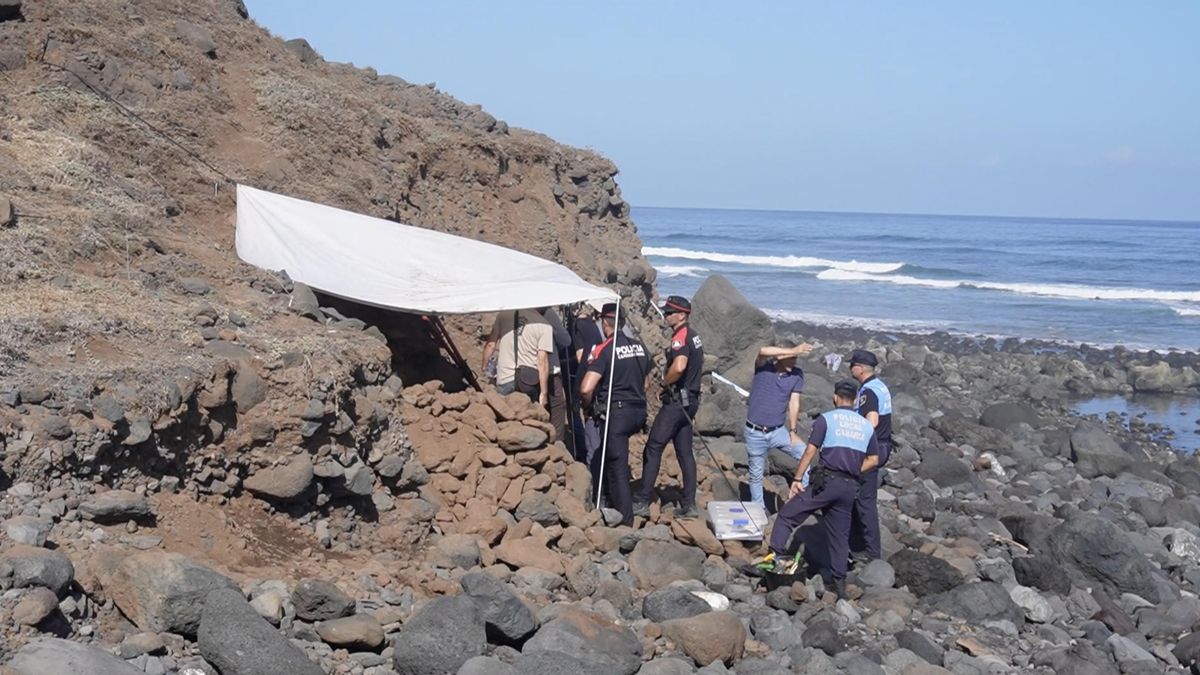
An emergency archaeological intervention has recovered human remains that were partially exposed by coastal erosion in an area close to Barranco Hondo beach, in Garachico, on the north coast of Tenerife.
Determining the nature and age of the remains
The next challenge facing the specialists is to determine the nature and chronology of the remains, as well as to gather information about the circumstances and the context in which they were deposited. The archaeologist Nuria Álvarez explains, in statements provided by the Directorate-General for Culture and Cultural Heritage of the Government of the Canary Islands, that several hypotheses are currently being considered.
One of them is that the remains belong to a victim of reprisals during the Civil War, which was the initial idea behind the work. However, as the excavation has progressed, new possibilities have emerged, such as the body being that of a victim of the Black Death or of the floods that struck Garachico at various points in history.
Human remains documented along the Isla Baja coastline for decades
The archaeological team involved in this operation also recalls that the presence of human remains at various points along the coastline of the Isla Baja — the north-west area of Tenerife — has been documented for decades. It will be the results of laboratory analyses that allow these aspects to be established scientifically and, based on the evidence obtained, their possible historical context to be assessed.
The work carried out on the ground has made it possible to document and extract the remains using archaeological procedures, preserving both the skeletal evidence and the information provided by the context in which they were found. The recovered material will now be the subject of specialised archaeological and bioanthropological studies.
The team behind the intervention
The research team that took part in the intervention is made up of Luana Studer Villazán, a specialist in contemporary history; Laura Bencomo Fernández and Nuria Álvarez Rodríguez, archaeologists; Sarah Delgado Luis, a specialist in bioanthropology; and Carlos García Ávila, a technician from the Directorate-General for Culture and Cultural Heritage and a specialist in photogrammetric documentation. The team will now continue with the study of the recovered materials and the analysis of the evidence obtained during the intervention.
What’s happening in the Canaries – straight to your phone
News, weather alerts and practical updates – direct from the islands, in English. We live here and know what’s going on – before the international media catch up. Everything lands on our WhatsApp channel – no middlemen, no algorithm. Curated for families, expats and travelers.

New Canary Islands foundation takes on climate change
Playa Jardín in Puerto de la Cruz closed over faecal bacteria
Invasive mosquito species detected in Gran Canaria
New planet born from dead star discovered
European Solar Telescope in La Palma wins major EU status
Telde fish kill: science points to emisario 222
Magnitude 3.2 earthquake shakes southwest Fuerteventura
Tiger mosquito detected in south of Gran Canaria
Quantum telescope network planned for La Palma