
Compiled with the help of artificial intelligence, based on Spanish-language information. Source below the article.
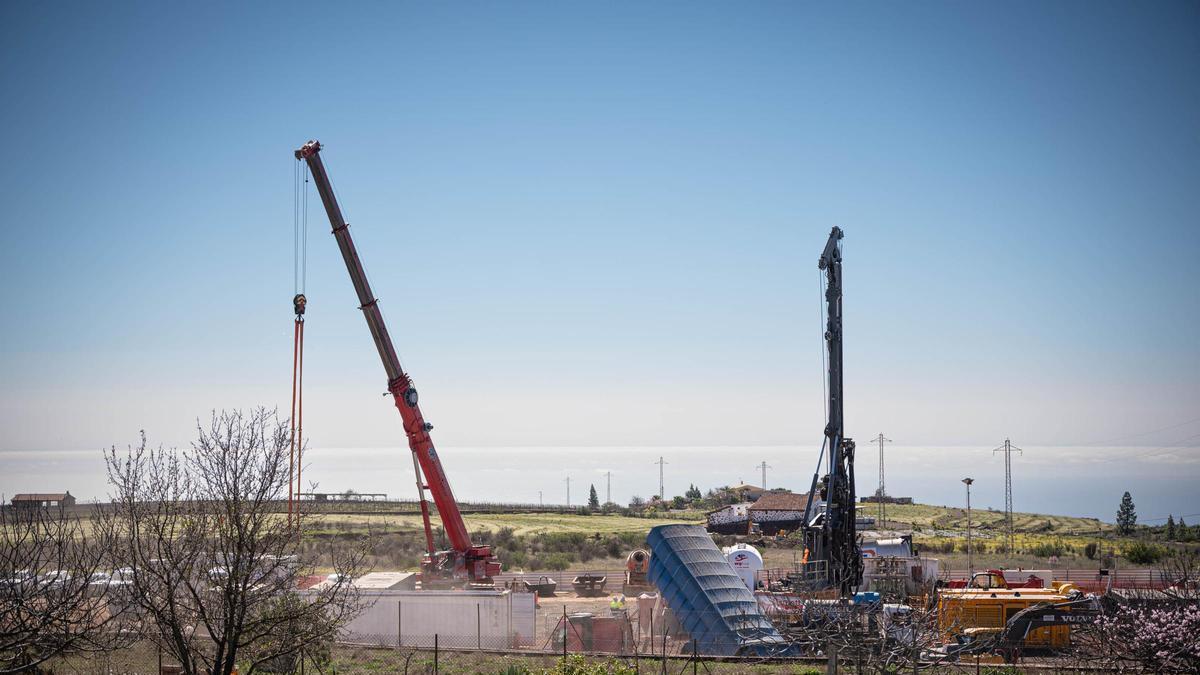
On a plot of rural land at Trevejos, among the pine forests of the municipality of Vilaflor de Chasna, specialists from more than 20 nationalities are working day and night to reach three kilometres underground in search of a geothermal resource substantial enough to exploit and feed into Tenerife’s energy system.
Engineers, drillers, geologists and technicians from other disciplines are taking part in a drilling operation that runs around the clock and which, by Friday 11 September 2026, had already taken the first of the boreholes to a depth of 2,870 metres. This is the team that has just achieved a milestone for both the Canary Islands and Spain: the first time a geothermal system suitable for energy use has been found.
A three-well campaign costing 28.8 million euros
The campaign involves three boreholes, two at the Trevejos site and a third at another location four kilometres to the east, at an overall cost of 28.8 million euros. The drilling is being carried out by the British company Marriott Drilling Group, which has brought 41 workers to Tenerife. They are joined by support teams from the Canarian company Disa and Iceland’s Reykjavik Geothermal, as well as researchers from the Technological Institute for Renewable Energy (ITER), which comes under the Cabildo de Tenerife.
Round-the-clock work through extremely hard rock
Despite the historic discovery, activity has not stopped. Teams rotate day and night under strict safety and occupational risk prevention measures. As they have advanced with the specialist machinery, they have cut through materials of extreme resistance, with a hardness of 7 on the Mohs scale, whose maximum of 10 corresponds to diamond. They will not stop until they have precisely determined the size of this reservoir and its exploitable capacity.
Two records broken at Trevejos
The Trevejos well has broken two records. No borehole of any kind had ever been drilled to such a depth in the Canary Islands, and it is also the deepest geothermal borehole ever drilled in Spain. Only oil exploration has gone deeper anywhere in the country. The campaign thus places Tenerife on virtually uncharted territory for Spanish energy research.
Heat, water above 150°C and permeable rock
The first results came once the drill passed 2,300 metres. There, specialists located heat, water at more than 150 degrees and permeability in the rocks — the three components needed for a geothermal system suitable for energy use. The machinery kept drilling and has since advanced a further 570 metres while specialists gather information about the reservoir.
What is happening in Vilaflor goes well beyond Tenerife and the Canary Islands. As well as the records set by the drilling, the island has laid the first stone of geothermal energy in Spain’s energy history. Electricity has never been generated in the country from the heat of the deep subsoil, and no geothermal project had ever reached the level of development and depth seen at Trevejos. Tenerife has moved from studying the existence of that resource on paper to drilling until it found the first favourable conditions to try to turn it into electricity.
A first for Spain, where geothermal use has been limited
Spain has known about and used geothermal energy for years, but on a completely different scale. Its use has been limited mainly to low or very low temperature resources for air conditioning, heat pumps, thermal waters and certain agricultural applications. No Spanish plant has ever generated electricity through deep geothermal energy. Tenerife is now opening that path and leading the biggest advance achieved in the country towards crossing that frontier.
Finding the right conditions is not the same as building a plant
Finding heat, water and permeability does not yet mean a plant can be built. Temperature, pressure and flow rate will have to be measured, the behaviour of the fluids studied and a check made on whether the resource can sustain sufficient production over the years. The other two boreholes will allow the data to be cross-checked and give a better picture of the extent of the geothermal system beneath this area of Vilaflor.
The work forms part of the Canary Islands Geothermal Energy project, a public-private partnership involving the Cabildo through ITER alongside Disa and Reykjavik Geothermal. Its aim is to verify directly something that for decades could only be estimated through geological, geophysical and geochemical studies. The archipelago’s geothermal potential has been under investigation for decades, and Tenerife had already been the subject of studies and experimental drilling. What has changed now is the scale: three deep wells, 28.8 million euros of investment in the drilling alone, total initial investment exceeding 43 million, and direct data obtained from almost three kilometres underground.
Tenerife pulls ahead of Gran Canaria and La Palma
Gran Canaria and La Palma are also developing research projects, but the results at Trevejos put Tenerife ahead. If the next tests confirm the viability of the exploration, geothermal energy would offer a particularly important advantage for the island’s electricity system: it can generate power 24 hours a day, 365 days a year. Unlike solar and wind, it does not depend on hours of sunshine or wind strength. It could provide stable renewable electricity and complement intermittent sources.
That characteristic is especially relevant on an island that still depends heavily on imported fossil fuels to produce electricity. A renewable source of its own that can be managed would allow part of that dependence to be reduced and provide continuous generation when solar photovoltaic or wind power cannot meet demand.
The next challenge: making the resource economically viable
Once the scientific phase is complete, another challenge would emerge: making the resource economically viable. The Canary Islands has specific electricity regulations because of its status as an isolated system. The Cabildo is calling on the Spanish government for a remuneration scheme for geothermal energy that would give certainty to investment in a future plant. That framework will be decisive, because much of the risk is concentrated before the first kilowatt is produced. Drilling several kilometres requires multi-million euro outlays without knowing in advance what will be found. The 28.8 million euros earmarked for the three boreholes gives a measure of that difficulty and explains why the high exploration risk has historically held back the development of deep geothermal energy in Spain.
What’s happening in the Canaries – straight to your phone
News, weather alerts and practical updates – direct from the islands, in English. We live here and know what’s going on – before the international media catch up. Everything lands on our WhatsApp channel – no middlemen, no algorithm. Curated for families, expats and travelers.

Iberdrola plans Tenerife’s biggest battery storage plant

The wild canary that gave its name to the Canary Islands

Canary Islands sea hits second-hottest year on record

Legal bid to halt tree felling in Santa Cruz’s La Salud

Fiesta del Charco: A journey through La Aldea’s past

Corralejo dunes power line set for removal

ULPGC launches 14 research projects at Las Canteras

TMT will never be built, says Canary Islands astrophysics chief

Pedro Duque: Canarias is the “ultimate dream” for rockets
