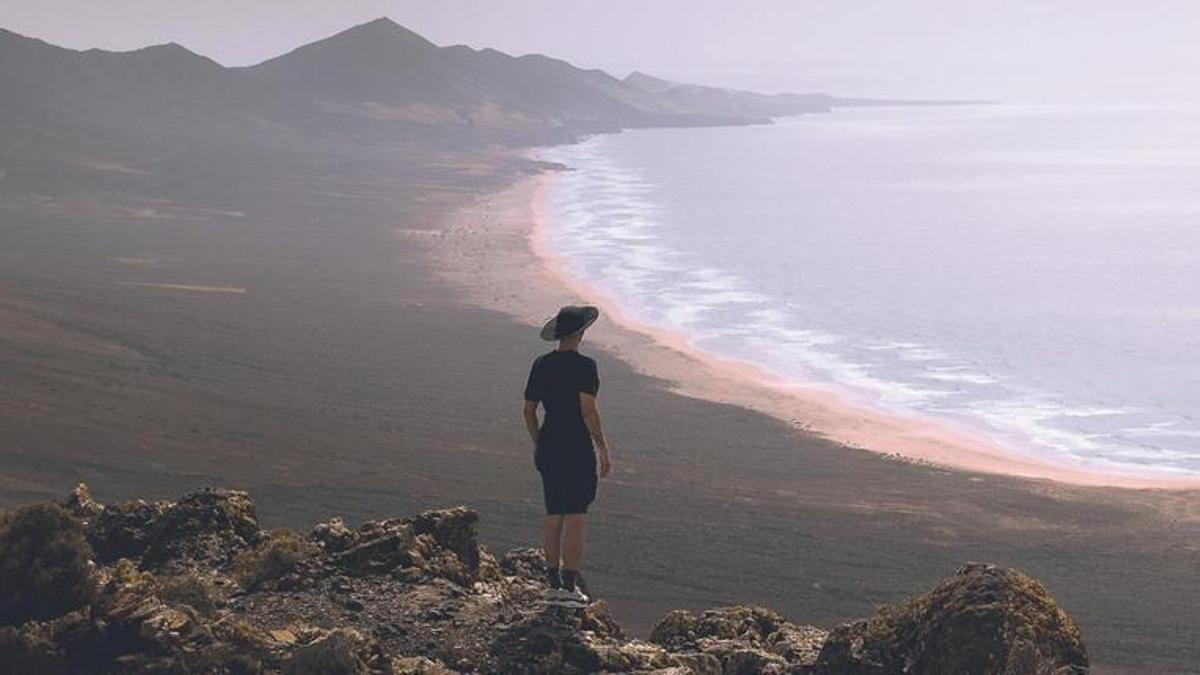
A wild jewel in the heart of Jandía
Spotting the sign, the road forces a turn to the right, and the tarmac soon begins to meander lazily. Suddenly, the journey becomes sinuous and winding, threading its way through the spiniest vertebrae of the Jandía heartland. Metre by metre, the hubbub of everyday life fades away, the comings and goings of locals and visitors left behind, swallowed up by the force of the wind and a landscape that grows rougher, more solitary and more awe-inspiring with every yard. The vegetation is sparse, rock predominates, and each bend confirms the purity of the territory. Some stop at the roadside, scanning the horizon with both hands shielding their eyes; others drive on slowly, savouring every metre; and a few get out of their vehicles entirely, transfixed by a landscape that seems to have been created just for them.
Dozens of kilometres later, a final bend opens up the space, drawing closer and revealing the natural treasure that remains out of reach for the impatient: Cofete beach. Located on the western coast of the Jandía peninsula, within the natural park of the same name in the south of the island, it is one of the most valuable protected areas in the Canary Islands. Sheltered by the mountain massif that runs through the park, its 12 kilometres of virgin terrain make it one of the most singular and best-preserved landscapes in the archipelago, thanks in part to its minimal urban development, its geological richness and the wild character of its habitat. Without a doubt, it is one of the best-kept tourist destinations in the whole of the Canary Islands.
Global recognition at last
It is an easy task to shower this legendary place with praise, given time and words. However, the latest recognition to reach its shores comes courtesy of The World’s 50 Best Beaches, the independent organisation that publishes an annual ranking – as its name suggests – of the fifty best beaches on the planet. This year, and for the first time, Cofete beach occupies 38th place, sharing the honour with coastlines from Mexico, Barbuda, the Dominican Republic, the United Arab Emirates and Curaçao. The decision was made by more than 1,000 experts: travel journalists, editors from numerous countries and tourism industry professionals. The opinions of the Beach Ambassadors also carried significant weight – a key figure in the compilation of the ranking, made up of travellers, specialist journalists and content creators. Notably, no representatives of institutions or tourist promotion bodies are among them, thereby guaranteeing the independence of the selection process.
Finally, as every year, the organisation carefully reviews each proposal and evaluates the specific parameters that come into play in the strict voting system. Here, popularity is not everything; in fact, it is a quality relegated to the background. The characteristics of the location are crucial when it comes to climbing the list, as are the local fauna and wildlife that remain in the place, the level of conservation of the surroundings (whether it remains virgin), the quality of the ambient sound and the ease of entering the water. When delivering a verdict, it is also essential to know whether the currents are calm most of the time, that the presence of visitors does not give rise to the usual crowded scenes, and the frequency of days on which weather conditions are as idyllic as possible. And Cofete beach has proven itself a paradise worthy of occupying one of the top fifty spots.
A symbol of freedom and purity
It comes as no surprise to discover that, when listening to its occasional or regular visitors talk about this place, they rarely refer to Cofete exclusively as a spot for swimming and leisure. “As a majorero citizen, I feel it is a symbol of freedom and purity. It is an endless expanse of sand, sea and yellow as far as the eye can see, which always guarantees a feeling of solitude and tranquillity,” says Rayco Cabrera, who was born in Fuerteventura. “In my case, I don’t go there regularly, but there is no doubt that it is a very special place for the people of Fuerteventura. That it has received this recognition doesn’t surprise me at all – it’s a special place.”
Lola García, president of the Cabildo of Fuerteventura, has also expressed her delight at the beach’s prominent position in the ranking: “It is always good to receive this kind of accolade, especially those that recognise the natural values of Fuerteventura. As a Biosphere Reserve island, it is a real honour that our home receives international recognition for the quality of its beaches and natural spaces, as is the case with Cofete, in the Jandía Natural Park, one of the most significant wild spaces not only on the island of Fuerteventura, but in the whole of the Canary Islands.”
The challenge of keeping Cofete pristine
Good news for one of the many noteworthy spaces in the archipelago that also brings another matter to the conversation: the importance of keeping this space clean, free from signs of human footprint. This is undoubtedly one of the main concerns for the island’s population and one of the challenges facing this iconic location. “A lot of rubbish can reach Cofete beach because it is situated on the windward side,” says Aceysele Chacón, a Fuerteventura native. “I remember one day I set off walking along the coast and came across more and more rubbish. Among it all, I found a plastic box which I used to put waste inside. I carried kilos that day. Although I haven’t gone much lately, when I do go I try to clean the beach of filth.”
However, J.M., who enjoyed this enclave for the first time two years ago, stresses the beauty and cleanliness of the spot: “When I visited, there was no trace of rubbish, quite the opposite. That afternoon, the beach, the horizon, the wind, the silence, the mountains… It seemed like an impeccable limbo, the last frontier of life itself.” In this regard, the island’s cabildo runs a service called ‘Fuerteventura, bonita por naturaleza’ (Fuerteventura, naturally beautiful), a programme that includes actions across the island’s territory for the conservation and maintenance of natural environments. “In the case of Cofete beach, this project works in collaboration with the Pájara town hall. However, the best measure is citizen awareness. It is essential that visitors are aware of the natural value of this place and take away the rubbish they generate,” adds Lola García.
Yet waste is not the only concern. Among the island’s population, a more palpable worry can be identified year after year: the possible tourist saturation. “The feeling of being ‘at the end of the world’, characteristic of places like this, ceases to make sense if everyone comes here,” argues Aceysele. An opinion shared by Rayco Cabrera: “Over the years, Cofete has become less virgin as a result of visitors. Am I worried? Yes. It’s true that I would tell anyone who hasn’t yet discovered this beach not to miss the opportunity to do so; but I would also ask them to keep the secret.”
For the island’s cabildo, with regard to the Jandía Natural Park, as with the rest of the island, tourist saturation is one of the main challenges. “We must care for and improve what we already have rather than continuing to grow. Its protection as a natural park already curbs urban pressure, for example,” says the president.
The invisible threat of climate change
But keeping an enclave like this intact depends not only on visitors and their actions. There are invisible dangers that could also condition Cofete’s future in the coming years: the rise in sea levels due to climate change. This matter was addressed last June in Fuerteventura during the first regional meeting of the scientific councils of the Canary Islands’ Biosphere Reserve network. There, Tony Gallardo, director of the Fuerteventura Biosphere Reserve, warned this outlet about the dangers facing various locations across the islands. Among them, as a result of satellite data, an increase of 7.94 centimetres in the surface of the water surrounding the archipelago over the last 27 years.
Despite this data, and unlike other locations such as Isla de Lobos, for the moment the Cofete coastline does not appear in any official study or report as one of the points in danger of disappearing as a consequence of the effects of global warming. Even in the worst-case scenarios, this fascinating place seems to remain on the margins of a threat that puts other natural enclaves in check.
Simply being Cofete
The recognition of this place comes at a time when it faces a sustained challenge: continuing to be Cofete. A virgin location, with no blue flag, no lifeguard towers or countless colourful towels strewn across the sand. This little corner of southern Fuerteventura continues to preserve its silent, imposing and natural atmosphere. A balance that depends, as it has until now, on the relevant institutions, but also on those who decide to venture along the winding road that leads to this treasure. Every piece of litter collected, every path respected and every cautious swim breathes life into this immense beach. Caring for it is not an option; it is the only obligation.
In a world where fewer and fewer places remain untouched by the human footprint, there are still spaces capable of moving us with their authenticity. Here, there are no large infrastructures or neon enticements seeking to charm visitors. There is a wild ocean, a mountain that hurls itself towards the sea, and a strip of sand where time passes at its own whim. Perhaps this is one of the countless reasons why people, when retracing their own footsteps on Cofete beach, do not speak of a swimming spot – no, they speak of the journey to reach it and what they felt upon arriving. Of a place that is, obviously, one of the best beaches in the world.
What’s happening in the Canaries – straight to your phone
News, weather alerts and practical updates – direct from the islands, in English. We live here and know what’s going on – before the international media catch up. Everything lands on our WhatsApp channel – no middlemen, no algorithm. Curated for families, expats and travelers.
El Bejeque in Las Canteras adds sea to its fire
Siam Park Gran Canaria must build its own desalination plant
Fuerteventura’s biggest resort to open on 1 November
Gran Canaria to teach tourism history in schools
Canary Islands see 0.3% rise in foreign tourists in August

Row over 368-bed hotel project in La Gomera
Spanish astronaut trains in Lanzarote for Moon mission

Tivoli La Caleta hosts first red tuna Kaitai in Canarias
La Laja natural pools reopen in Las Palmas