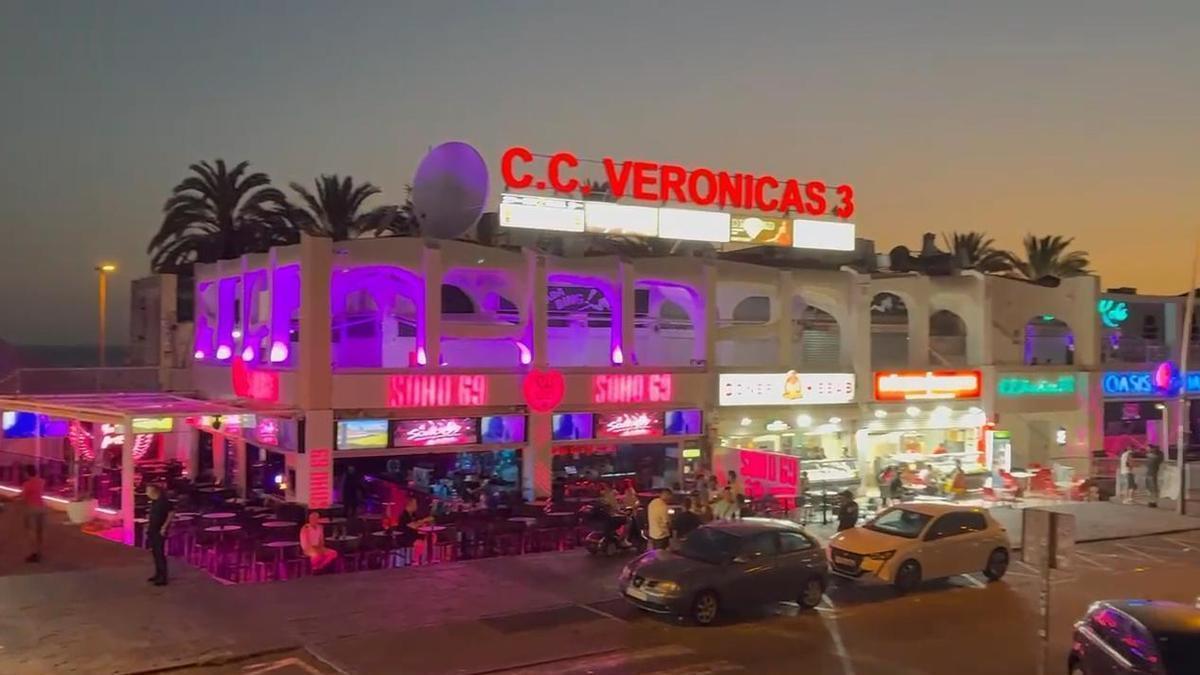
The Verónicas shopping centres in Playa de las Américas remain the epicentre of a delicate yet dangerous cocktail: excessive alcohol, a plentiful supply of recreational drugs and hordes of very young holidaymakers determined to have a good time at any cost. It is a mixture that is always destined to go badly wrong at some point. It has been this way for more than four decades at this spot on the border between Arona and Adeje.
A haven for hedonism
Many of those revellers arrive as tourists convinced that access to drink and illegal substances is far cheaper and easier than back home. For them, it is a paradise in which to let loose. There are even messages that reinforce this. Some people involved in pushing illegal wares openly tout the south of Tenerife and other tourist enclaves on the island as a kind of Amsterdam, where it is incredibly easy to get hold of all types of drugs. And many of those tourists looking for wild nights out believe it. When National Police officers stop them, carry out a search and find marijuana, they also ask how much it cost. The answers are invariably the same: they paid a “very good” price. This ease of access to narcotics has become a major draw compared with what they would have to pay in the countries where they live.
That all happens out on the street, but there are also places to buy. Adverts for cannabis clubs where marijuana can be acquired are everywhere on social media. That is why, in all such establishments dismantled by security forces, it is clear that many of their clients are foreign nationals, especially European holidaymakers. Some clubs, which hold licences allowing members to consume marijuana they have grown at home or on the premises, have drifted into outright illegality, turning into simple retail outlets for hashish and other cannabis derivatives.
A licence to print money
The inspector who heads the National Police Narcotics Group at the Southern Tenerife police station explains that for the owners it is a licence to print money. The officer, who prefers to remain anonymous, points out that in any square or street in a Tenerife neighbourhood, a gram of marijuana usually sells for five euros. But in a cannabis club aimed at tourists, that price can quadruple or even quintuple. Why? If the tourist has enough money, they are willing to pay more for the drug than on the street (at a price similar to what it costs in their home country) in exchange for a safe, quiet place to consume it. In this way, the profits of those running the venues increase exponentially in next to no time.
In this environment of drunken or euphoric individuals, it is hardly surprising that fights break out regularly, or that those same drunk or high tourists end up as victims of violent robberies or theft. They attract criminals who loiter around the Verónicas area to steal money, high-end mobile phones and other valuables. If a victim has lowered their defences, it is simply easier to approach them and relieve them of their prized possessions or wallet, explains the inspector in charge of the Narcotics Group.
From cannabis cakes to laughing gas
He clarifies that in an environment like Verónicas, a wide range of drugs is available. These include psychoactive substances (cocaine, amphetamines, MDMA, ketamine or tusi), depressants or opiate derivatives (heroin or crack), and those originating from cannabis (hashish, marijuana and laboratory-produced THC products, the active ingredient in the hemp leaf). In the latter category, there are even cakes with such ingredients, or standard gummy sweets into which the psychoactive substance has been injected with a syringe.
But in recent times, the officer adds, what is sweeping the board among young people heading out to party in Verónicas is nitrous oxide, or laughing gas. What factors have contributed to its success? First of all, it is very cheap. A party balloon filled with the product can cost five euros. And from a single capsule or small canister, four, five or six balloons can be filled. Secondly, the way it is consumed gives users a false perception that there is absolutely no risk involved. Moreover, it produces a very rapid high, although it does not last very long either. How is it taken? A capsule is pressed with a kind of siphon which fills the balloon. The balloon is then sealed and the user opens it to allow the gas to enter their mouth and go straight into the respiratory system. The mere possession of the gas is not illegal, as it has other uses, including medicinal ones. In dentistry, it is used as a painkiller or anaesthetic. That is where its danger lies, as it depresses the nervous system. Some users can lose consciousness. And if mixed with alcohol or other drugs, in some cases it can even prove fatal.
Security crackdown and tensions
Officers from the National Police in southern Tenerife have detected that it is sometimes sold by bar staff working in certain nightlife venues in Verónicas. But it can also be supplied by individuals walking the streets with the siphon and balloons. It has been noted that some street vendors of sub-Saharan origin, who previously focused on dealing cocaine and heroin, have now also expanded their business into nitrous oxide, commonly known as laughing gas. This substance does not create dependency. Young people only consume it when they are out partying, and that is another key factor contributing to the spread of its use.
The arrival of a new private security firm in Verónicas and the way it operates has generated conflict. Guards working for the company have ejected people from corridors, communal areas and underground zones who apparently considered those their territories for selling narcotics. And, as is evident, that process has led to tensions and brawls between the parties. In fact, some of those episodes have been shared on social media in recent months.
Same essence, different faces
The reality of the Verónicas shopping centres, in any case, has not changed all that much since the mid-1980s. The protagonists and the fashions for consuming particular drugs, drinks and the music played in the venues may have changed. But the essence is the same. The inspector from the Narcotics Group explains that fights are not a daily or even weekly occurrence. But it is true that with the spread of social media and news coverage, cases are magnified, he clarifies. A few weeks ago, a British man died during a fight with a fellow countryman. Such incidents inevitably generate a sense of insecurity among residents and business owners in the shopping centres themselves and their immediate surroundings.
Around 80 per cent of those young tourists letting their hair down come from the United Kingdom. And many of the owners of the nightlife venues are of the same origin. However, Spanish and Italian people, among other nationalities, can also be seen. At two in the morning on a Friday, the activity is intense. Young people stream in and out of the nightlife zone. The music can be heard hundreds of metres away. For anyone walking alone in the area closest to Avenida Rafael Puig, an insincere “hello, handsome” or similar calls for attention from women working as prostitutes, some of Latin American origin, are never far away.
Just a second later, a sub-Saharan man sitting nearby also calls out and asks “everything alright?” with the clear intention of offering some stimulant substance. There are the tourists and the club-goers. And opposite them, and all around, a legion of street vendors, clutching dozens of pairs of sunglasses in the dead of night. An excuse like any other. And balloons, lots of balloons. Two young tourists climb the stairs and reach the pavement of the avenue while inhaling nitrous oxide through them. Several young women seated on the street also have their inflated balloons in hand. And street vendors walk around with them ready for anyone who wants to buy. Nobody hides and it is all on show.
Two women with a somewhat dishevelled appearance, backpacks on their shoulders, lean against a railing overlooking the clientele of one of the busiest venues. Keeping an eye on what is happening around them, they do not allow any stranger to come within three metres of their patch. They retreat towards the street, annoyed by the intrusion. The main establishments, those facing the avenue, are almost all packed. Two drinks for ten euros is a good lure. The promoters are doing their job well. But not all businesses are doing equally well. There are some nightclubs where the clientele is predominantly local and which operate mainly at weekends. They are not on the front line and it shows.
One worker says he does not know how much longer they can hold on. He points out that 60 per cent of takings goes on taxes and fees, and from the remaining 40 per cent wages, social security, stock and supplies have to be paid. He laments that some customers do not appreciate the quality product and service on offer and think it is expensive. A drink with a well-known brand of spirit costs eight euros. Many workers in Verónicas cannot understand why Arona Council prevents them from parking nearby at weekends, between 10pm and 8am. And they are not prepared to pay the fines, so they have to leave their cars further away.
Keeping the peace
Security guards from one company monitor what is happening in the communal areas of the Verónicas 1, 3 and 4 centres. They know the different venues off by heart, and in order, in the busiest zone. They started their work three months ago. Their main objective is to prevent mass brawls in those areas, or, if they do break out, to stop them before they escalate or end in very serious consequences. In the early hours of a Friday, shortly after 2am, they had already broken up two fights. Sometimes they wade into the middle of an altercation to protect the person most affected from further kicks or punches. On some occasions, doormen from several nightclubs also help them stop the fighting. Naturally, they cooperate with the security forces in some interventions.
But their work also involves trying, as far as possible, to prevent vendors and consumers of nitrous oxide from getting into the spaces they control. In such cases, they burst the balloons and confiscate the siphons used to fill them. But it is difficult to put up fences around the problem. Vendors and buyers only have to cross the road to do their deal, almost without anyone trying to stop them.
What’s happening in the Canaries – straight to your phone
News, weather alerts and practical updates – direct from the islands, in English. We live here and know what’s going on – before the international media catch up. Everything lands on our WhatsApp channel – no middlemen, no algorithm. Curated for families, expats and travelers.

Canary Islands approves new €1.6bn development fund

Mogán mayor says her €65,000 salary is too low

Abandoned cars in Canary Islands: hundreds left to rot
Work resumes on 27 affordable rental homes in Las Palmas

Los Realejos residents fight on against propane gas plant

Canarias among Spain’s poorest regions as 36.2% live on low incomes

Canary Islands bananas lose ground to imported bananas
Canary Islands bottom of Spain’s social housing table

Three migrant boats reach Canary Islands in 24 hours