
El Hierro is the smallest, westernmost, and southernmost of the main Canary Islands, covering 268.7 square kilometers with a population of approximately 11,400 residents spread across Valverde, La Frontera, and El Pinar. Designated a UNESCO Biosphere Reserve in 2000 and a UNESCO Global Geopark in 2014, the island has deliberately avoided mass tourism development. You will not find high-rise resort complexes, crowded sandy beaches, or direct international charter flights here. Instead, the island attracts travelers seeking dramatic volcanic geography, natural rock swimming pools, and quiet mountain walking trails.
This evergreen guide delivers essential advice for El Hierro travel based on current local conditions. The terrain rewards independent visitors who plan around steep mountain topography, microclimates, and localized transport. If your ideal trip involves commercial nightlife, shopping centers, or sandy resort beaches, neighboring islands like Tenerife or Gran Canaria offer better fits. For clean air, uncrowded coastal access, and active marine reserves, the island provides a focused, unspoiled environment.
When to visit El Hierro
The island experiences a mild subtropical climate with sea-level temperatures averaging between 18°C in winter and 26°C in summer. However, local weather is defined by sharp microclimates. The northern coast and central highlands frequently catch incoming trade winds (vientos alisios), creating cool temperatures and fog blankets (mar de nubes) above 600 meters elevation. Meanwhile, the southern coast around the island’s southern tip remains dry, warm, and sunny for most of the year.
For ocean swimming and underwater visibility, September to November offers optimal conditions. Water temperatures peak between 23°C and 25°C, wind speeds drop, and underwater visibility extends up to 30 to 40 meters in southern bays. Spring (April to May) brings blooming endemic flora and comfortable hiking weather across high-altitude trails like the Camino de Jinama, with daytime mountain temperatures hovering around 16°C to 20°C.
Winter brings mild daytime coastal weather (18°C to 22°C), though mountain passes require warm layers and rain gear. Accommodation availability tightens and prices rise during Easter week, peak summer months (July and August), and during the quinquennial Bajada de la Virgen festival, held every four years on the first Saturday of July.
Weather and microclimates
Weather conditions vary drastically over short driving distances. You can consult our comprehensive island weather guide to plan your itinerary around regional temperature patterns. Southern coastal forecasts, such as La Restinga weather, show warm, sunny days sheltered by mountain ridges. In contrast, mountain capital weather like Valverde weather regularly features cloud cover, damp fog, and temperatures 5°C to 8°C cooler than the coast.
Best beaches on the island
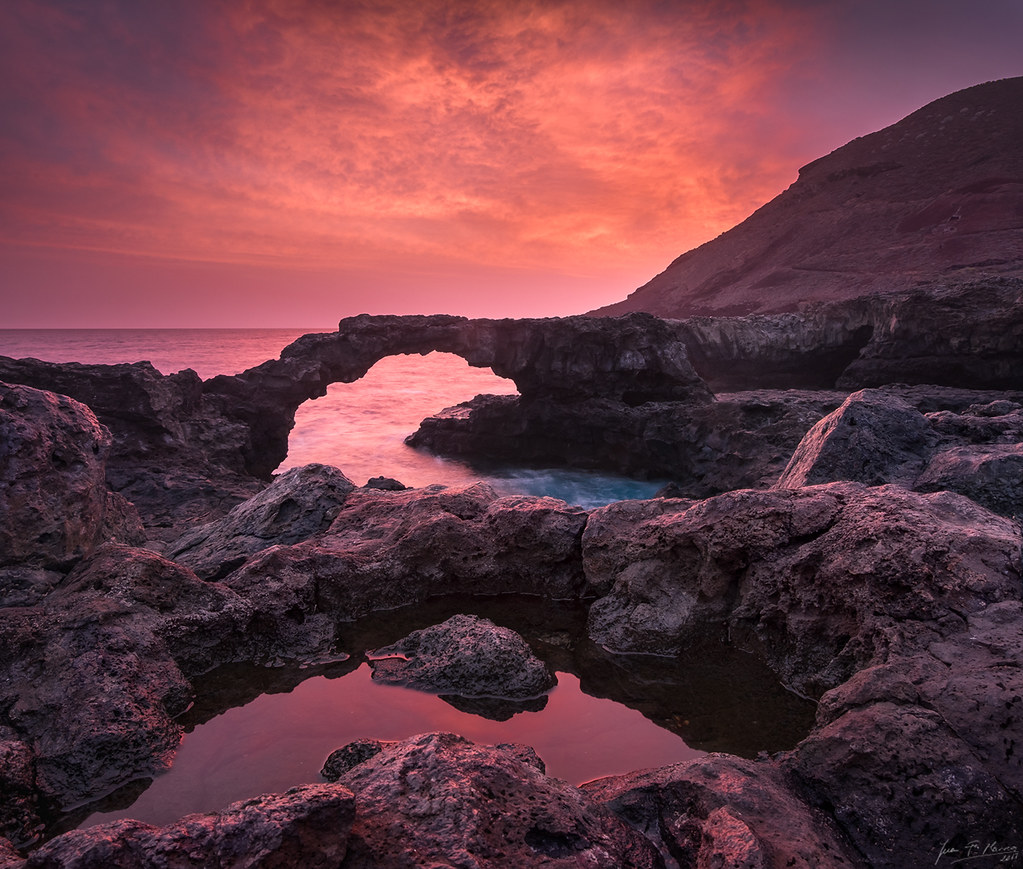
The coastline consists almost entirely of dark volcanic basalt cliffs and rocky ocean coves rather than wide sandy beaches. Swimming revolves around natural rock pools and sea basins protected from open Atlantic swells. For detailed locations and access, read our breakdown of the best beaches on the island. Along the northern coast, Charco Manso offers swimming in clear basalt basins framed by natural arches and blowholes. In the agricultural El Golfo valley, La Maceta features three concrete-enclosed volcanic pools complete with sunbathing platforms, stone steps, and protective ocean barriers.
Things to do in El Hierro
Scuba diving stands among the premier outdoor activities. The fishing village of La Restinga at the southern tip serves as the main base for the Reserva Marina del Mar de las Calmas, established in 1996. Over 10 licensed dive centers operate in the area, offering Zodiac RIB boat runs of 5 to 20 minutes to protected marine reserve sites. Experienced divers target El Bajón, an isolated underwater volcanic pinnacle whose twin peaks rise to 6 and 9 meters below the surface before plunging vertically past 100 meters. The site hosts groupers, barracudas, amberjacks, mobula rays, and occasional whale sharks. Marine life in the area expanded following the 2011 to 2012 submarine eruption of the Tagoro volcano 1.8 kilometers offshore. Dive centres in La Restinga run dedicated trips to these deep basalt formations, making diving El Hierro’s biggest draw.
Beyond diving, natural swimming pools line the western and southern shores. Charco Azul in the El Golfo valley features a turquoise pool beneath a collapsed volcanic lava arch, accessible via a steep paved footpath with handrails. On the southern coast, Cala de Tacorón offers calm waters sheltered by red and black lava rocks, equipped with wooden sunbathing decks and the Chiringuito Tacorón snack bar. Water shoes are necessary at all ocean access points to protect against sharp basalt rocks and sea urchins.
Landmark excursions include visiting El Sabinar on the La Dehesa plateau, where century-old Phoenician juniper trees (Juniperus turbinata) have been bent horizontally by trade winds. Accessible via the HI-500 road, these twisted trunks serve as the official botanical symbol. Nearby stands the Ermita de la Virgen de los Reyes, built in 1577, which houses the patron saint statue carried 28.7 kilometers to Valverde during the quadrennial Bajada de la Virgen festival. At the northern edge of El Golfo, Mirador de La Peña sits at 700 meters elevation near Guarazoca. Designed in 1989 by Lanzarote artist César Manrique, the stone complex features floor-to-ceiling glass windows overlooking the valley and the Roques de Salmor cliffs.
In the valley below, Las Puntas hosts Hotel Puntagrande, a lava-stone structure recognized by the Guinness Book of World Records as the world’s smallest hotel, containing 4 to 5 guest rooms on a narrow volcanic spit. Nearby, the Ecomuseo de Guinea & Lagartario features a restored volcanic stone village and a captive breeding center for the endangered giant endemic lizard, with guided entry tickets available for around €5. Hikers can tackle the demanding Camino de Jinama (PR EH-8), climbing 885 meters over 4.0 kilometers between El Golfo and San Andrés, or follow the 16-kilometer Ruta del Agua (PR EH-11) passing the Árbol Garoé visitor center (€2 entry), which explains how the native Bimbache people harvested fog water from a sacred stinkwood tree. Navigating volcanic pools is one of the top things to do in El Hierro during a multi-day trip.
Sustainability enthusiasts can examine the renewable energy infrastructure at Gorona del Viento, a wind-hydro hybrid power plant operational since 2014. The system combines five wind turbines at Los Valverde (11.5 MW capacity) with an upper reservoir inside the Cráter de La Caldereta (~150,000 cubic meters) and a lower sea-level reservoir at Puerto de la Estaca (~150,000 cubic meters). When wind output exceeds electrical demand, surplus power pumps water uphill to store energy. Technical guided tours of the pumping station and control center can be booked in advance by emailing [email protected] or calling +34 922 55 24 38.
Getting there and around
Reaching the island requires transit through Tenerife. As of July 2026, Binter Canarias operates up to 43 weekly flights using ATR 72 turboprop aircraft from Tenerife North Airport (TFN) to Valverde Airport (VDE), with a flight duration of 40 minutes. Canaryfly also runs regular daily services on this route. Air travel provides the fastest access, but luggage allowances are strictly enforced on inter-island aircraft. Smooth transport arrangements for El Hierro travel begin with choosing between air and ferry options based on your vehicle requirements.
Maritime transport is provided by Naviera Armas operating the Volcán de Tirajana high-speed ferry from the Port of Los Cristianos in Tenerife South to Puerto de la Estaca. The sea crossing takes 2 hours and 25 minutes, with daily sailings scheduled primarily in the late afternoon or evening. As of July 2026, standard non-resident adult ferry fares range from €45 to €60 one-way without a vehicle. Transporting a rental vehicle between islands requires advance confirmation with your car hire agency, as some companies restrict inter-island vehicle transport on ferry routes.
Once on the island, hiring a car is mandatory for practical sightseeing. Local car rental companies such as CICAR and AutoReisen maintain desks at both the airport terminal and Puerto de la Estaca port. Island roads are paved and maintained to high standards, but drivers must navigate narrow lanes, steep gradients, and hairpin bends. Public bus service, operated by Transhierro across 12 routes, connects main municipal centers like Valverde, Frontera, and El Pinar. However, bus schedules are limited and do not service major trailheads or natural attractions like El Sabinar, Mirador de La Peña, Tacorón, or Charco Azul. Essential considerations for island travel include securing vehicle reservations well before arrival, as local rental fleets are small.
Island news, updated daily
Our editorial team monitors daily weather advisories, ocean swell warnings, ferry timetable adjustments, and trail closures across Valverde, La Frontera, and El Pinar. Stay updated on current local conditions by checking our regular island news updates reported directly from local sources.
Frequently asked questions
Yes, the island is worth visiting for travelers seeking uncrowded volcanic landscapes, natural rock pools, and world-class marine diving without mass tourism. The island has roughly 11,400 residents, zero high-rise resorts, and no direct international charter flights. It offers dramatic sea cliffs, pristine lava swimming basins, and extensive hiking networks across UNESCO Biosphere Reserve terrain. As the quietest of the Canary Islands, El Hierro prioritizes sustainable eco-tourism over commercial resorts. Pack sturdy walking shoes and windproof outerwear, as coastal heat gives way to damp mountain mist in minutes.
By ferry from Tenerife South or by inter-island flight from Tenerife North. Naviera Armas operates the Volcán de Tirajana high-speed ferry from Los Cristianos to Puerto de la Estaca in 2 hours 25 minutes, with non-resident one-way fares between €45 and €60. Binter Canarias and Canaryfly run 40-minute flights into Valverde Airport (VDE), with up to 43 flights weekly. Book ferry or flight tickets several weeks in advance during summer to secure vehicle passage.
Scuba diving at La Restinga in the Mar de las Calmas marine reserve and its 100% renewable energy system at Gorona del Viento. The island is also known for El Sabinar, where trade winds bend ancient juniper trees horizontally, and the historic Árbol Garoé fog tree. Underwater, the 2011 eruption of the Tagoro submarine volcano created a nutrient-rich marine sanctuary that makes diving El Hierro famous worldwide. Schedule technical tours of the Gorona del Viento power plant by emailing [email protected] before your visit.
Yes, hiring a car is essential because public bus routes do not connect to major sightseeing locations or hiking trailheads. While Transhierro operates 12 bus lines between primary towns like Valverde and Frontera, service is infrequent and bypasses sites like El Sabinar, Mirador de La Peña, Tacorón, and Charco Azul. Local rental fleets like CICAR and AutoReisen operate directly at the airport and ferry port. Reserve your rental car at the same time as your travel tickets, as local vehicle fleets are small.
4 to 5 days is the minimum duration required to explore main sights without rushing. This timeframe allows two days for natural pools and scenic drives around El Golfo, one day for marine diving or swimming at La Restinga, one day for hiking trails like the Camino de Jinama, and time for El Sabinar and Mirador de La Peña. Navigating volcanic pools is a popular activity during a multi-day trip. Add an extra day if you schedule multiple scuba dives to satisfy surface interval requirements before high-altitude driving.
Latest from El Hierro

Calima pre-alert declared across all Canary Islands

Tuesday: calima and cloud as temperatures dip

Cruise to Canaries cancelled after collision in port

Civil Guard warns of digital skimming threat to online shoppers

Tourism overcrowding and its impact on Canary Islands healthcare

Monday: calima and 34C heat across the Islands

Canary Islands weather: Calima, storms and 34°C heat

The wild canary that gave its name to the Canary Islands

Sunday: calima and 30°C as alisio winds strengthen
