Project shelved after years of opposition
Nueva Pescanova S.L. has formally withdrawn its application to install a marine farm for breeding octopus at Las Palmas Port, prompting the port authority to close the file. In a written statement, the company argued that it was no longer appropriate to proceed with the application under the terms originally proposed, given the unforeseen circumstances that arose during the process and the new administrative requirements demanded by the Canary Islands Autonomous Environmental Assessment Commission.
The Las Palmas Port Authority confirmed on Thursday that it would archive the file, which had been opened in May 2021, bringing the project for an octopus farm at the port to an end. Nueva Pescanova said the decision was based solely on business and regulatory considerations arising from the evolution of the administrative process, and that it did not imply any admission regarding the future viability of other technical, environmental or locational alternatives that might be analysed in due course.
Environmental assessment highlighted concerns
The company clarified that the environmental processing of the application was conditional on obtaining the necessary environmental rulings, meaning the project’s environmental viability was an essential prerequisite for it to continue. This process revealed the need to address observations and conditions raised by various sectoral bodies, as well as subjecting the project to a full environmental impact assessment after the possible existence of environmental effects requiring further analysis was identified, the statement added.
According to Nueva Pescanova, while these circumstances do not affect the project’s environmental viability, they have led to a substantial change in the conditions, scope, timelines and regulatory requirements of the original plan, forcing the company to rethink its configuration and development strategy. For all these reasons, the company has expressly withdrawn the application for the public domain concession it had submitted to the port authority for the project’s development.
Farm would have covered 50,000 square metres
The planned facility was to occupy just over 50,000 square metres in the La Esfinge dock. The company had set aside €50 million for the farm’s construction, with the aim of producing around 3,000 tonnes of octopus annually — a figure equivalent to more than 10 per cent of Spain’s national production of the animal.
The project was first subjected to a simplified environmental assessment, in which “potentially significant adverse effects” were identified. These included the risk of bad odours affecting a passenger terminal and the potential deterioration of port water quality due to organic waste. Upon noting these possible impacts, the Canary Islands government decided to refer the project to a more thorough, full environmental assessment.
Scientists and campaigners rallied against the plan
In October last year, Compassion in World Farming published a report warning of the project’s enormous ecological cost. The international organisation calculated that up to 28,000 tonnes of wild fish would be needed to feed the octopus during just the first year of the marine farm’s operation.
Ever since Nueva Pescanova announced its plans, numerous scientists and groups opposed the project, pointing out that the octopus is a highly sentient, solitary species apparently unsuited to captive breeding. Opposition to the project grew to the point where more than 42,000 messages were sent to the email address of Las Palmas Port Authority president Beatriz Calzada, demanding the file be closed.
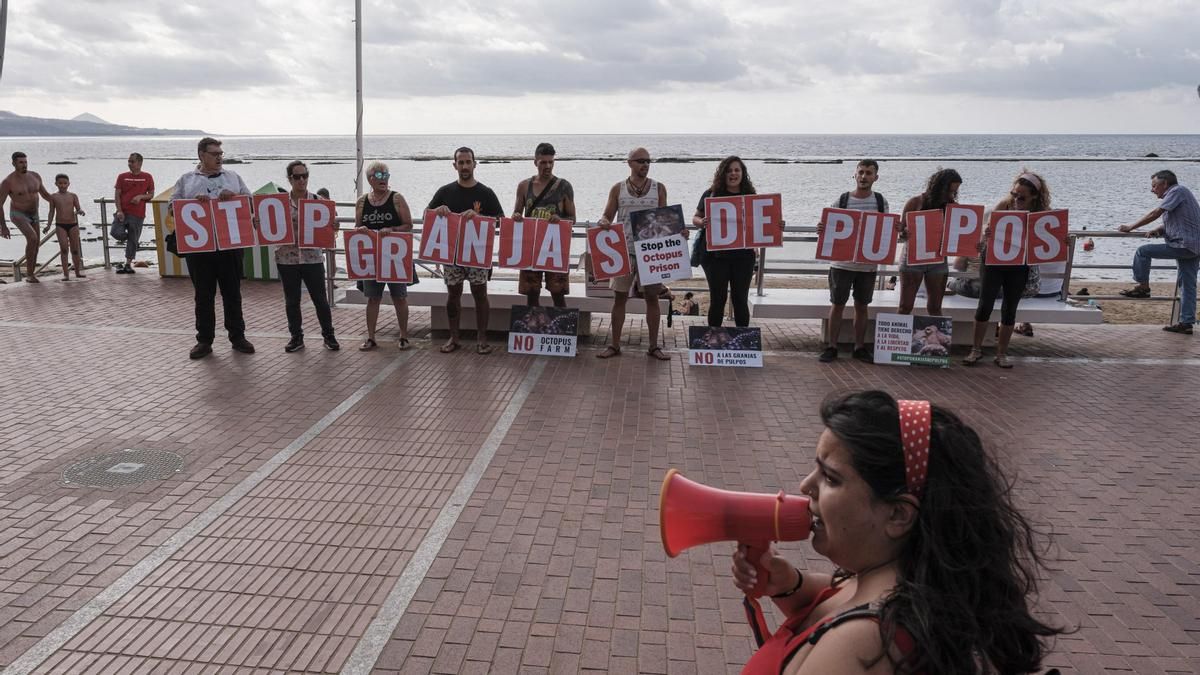
Organisations AnimaNaturalis and Compassion in World Farming had called a protest against the octopus farm for this Saturday, 25 July. The aim was precisely to urge the port authority to permanently archive the file — which has now happened. The protest had the backing of Eko, Ecologists in Action, Ocean Action, We The Free, Raíces y Brotes, Turcón, WeMove Europe, Aquatic Animal Alliance, Aquatic Life Institute and Eurogroup for Animals.
What’s happening in the Canaries – straight to your phone
News, weather alerts and practical updates – direct from the islands, in English. We live here and know what’s going on – before the international media catch up. Everything lands on our WhatsApp channel – no middlemen, no algorithm. Curated for families, expats and travelers.

Tenerife’s Char Fuego y Brasas named 13th best steak restaurant in Europe

Gran Hotel Taoro: a foodie destination in Puerto de la Cruz

Canary Islands hotel prices rise 4.11% in September

Icod de los Vinos launches twelve self-guided routes
Four new openings shaking up Las Palmas dining scene

Tenerife faces huge tourism expansion despite moratorium calls
El Bejeque in Las Canteras adds sea to its fire

Siam Park Gran Canaria must build its own desalination plant
Fuerteventura’s biggest resort to open on 1 November