New bus controls spark chaos at Tenerife South airport
A new access control system restricting bus entry at Tenerife South airport has triggered a wave of criticism from public authorities, business leaders, and transport operators following major disruptions in recent days. The situation came to a head this past weekend when tourists were left waiting for their transport for more than half an hour under the blazing sun. While Aena, the public-private company that manages Spain’s airport network, insists this was an “isolated incident”, the delays and lengthy queues have reopened the debate over a measure that professionals and associations consider “insufficiently planned” and damaging to Tenerife’s tourism image.
How the new system works
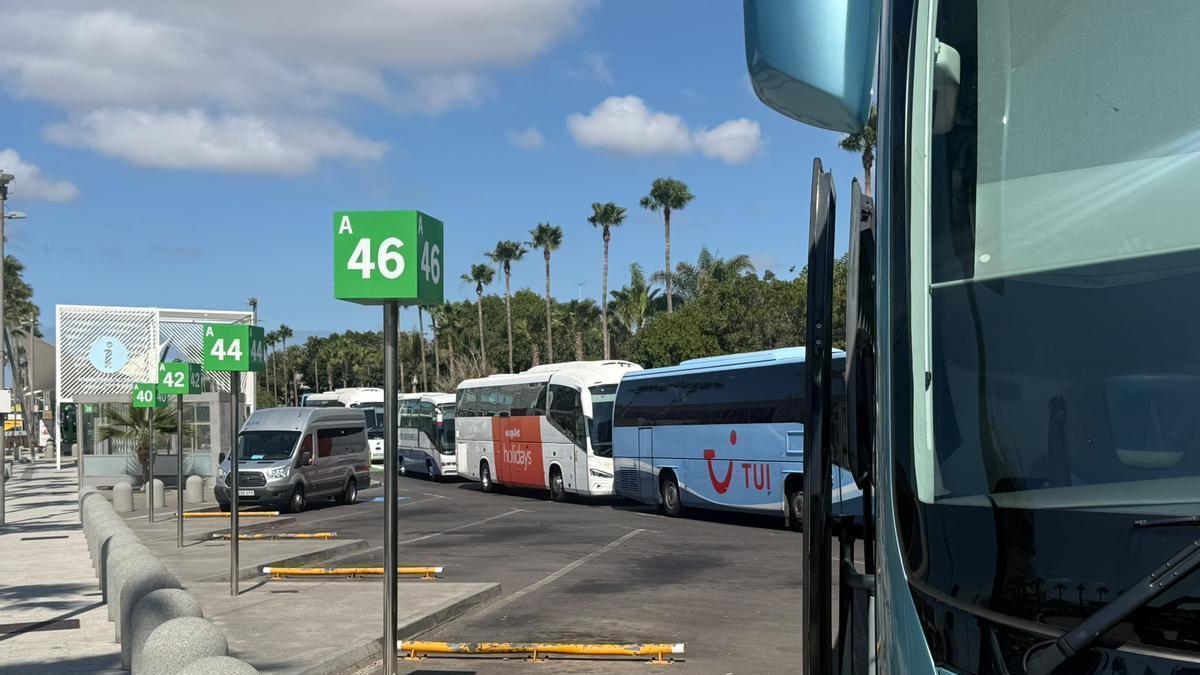
At the heart of the conflict is the access model introduced by Aena last January, dubbed the “bus tax” by the sector, although its consequences have become particularly evident in recent days following the disruptions caused by its implementation. Using barriers and proximity cards, Aena regulates the entry and exit of buses and other private hire vehicles, which must now pay to access the passenger pick-up area. Transport operators complain that any problem with the barriers or a simple hold-up can bring the rest of the traffic to a standstill, as happened this weekend when some vehicles were stuck for more than half an hour each.
‘A cash grab’ say transport firms
But the discontent goes far beyond traffic jams. Transport companies estimate the financial impact of the system at around 6,000 euros per month per operator and also denounce the removal of parking areas for loading and unloading, as well as waiting conditions they describe as “appalling”. Drivers are forced to take their breaks in a lay-by with no shade, toilets, or other basic facilities. This has ratcheted up tensions, with transport operators even threatening to call a strike if Aena does not back down.
Anger boiled over after images were shared by transport operators this Saturday showing dozens of vehicles stationary and sounding their horns as they tried to exit the airport facilities in the municipality of Granadilla de Abona. A manoeuvre that, until 15 January this year when the barriers were installed, took just a few minutes, but now causes long waits that clog up the roads.
Tourism bosses and politicians unite in criticism
For the tourism industry body, “this scene is just another consequence of the policy the company has been applying at Canary Islands airports for some time, a strategy that is purely revenue-driven and does not correspond to the provision of new services or the improvement of existing ones.” Jorge Marichal, president of the Ashotel hotel association, commented: “It is a constant campaign of harassment and demolition, a lack of adequate investment, a constant lack of coordination.”
The president of the Cabildo of Tenerife, Rosa Dávila, faced with the weekend’s chaos, is demanding that the airport operator reverse the restrictions, which she describes as “unilateral”, “unacceptable”, and adopted “without a prior mobility study”. She argues it is “causing operational problems, delays, and harm to both passengers and the transport operators who use this infrastructure daily.” Although she acknowledges that airport management is Aena’s responsibility, the island’s president insists the operator should “rectify immediately” and “restore normality” to operations.
In the same vein, the island’s councillor for Mobility, Eulalia García, has already requested a meeting with Aena to analyse the incidents and address the potential effects these restrictions may be having on the island’s public transport.
Canary Islands government weighs in
The Canary Islands government’s Minister for Mobility, Pablo Rodríguez, also weighed in, saying the situation at the airport projects a “terrible” image of chaos that cannot be allowed to happen again. He also questioned the revenue-raising nature of the new measures introduced by Aena, arguing they are difficult to justify at an infrastructure that is among the most profitable in the Spanish network. Tenerife South airport closed its last financial year with close to 14 million passengers and is facing a remodelling project with an investment of more than 553 million euros.
Aena defends its system
In response to the criticism, Aena clarifies that the episode this weekend was “isolated” and assures that “at no point was it caused by a technical error in the system or installation.” According to the operator, the jam occurred because “a bus, instead of using the proximity card it has, which automatically opens the exit barrier, used another access method.” It also states that “within nine minutes, the user carried out the necessary procedures to allow its exit.”
Transport federation rejects ‘isolated incident’ claim
However, the Federation of Transport Companies of the Canary Islands (FET) considers what happened to be no isolated event. Its secretary general, José Ángel Hernández, says that “the sector’s worst fears are confirmed” with the introduction of access barriers for buses at Aena sites and warns that “several episodes of traffic gridlock have already occurred,” caused “either by a failure of the access system or by the need for the bus to validate entry and exit to the site.” Hernández notes that “the result is a traffic jam at Tenerife South airport that no longer only affects tourist buses, but also public buses,” something which, he claims, “is very worrying because of the negative effects it could have on the island’s mobility.”
In short, transport operators equally reject Aena’s version of events and maintain that the problem is not an isolated case, but one that has been recurring since the new system was introduced. Francisco Reyes, a driver and member of the Canarios Union Movement, sums it up: “The problem was not, and is not, an isolated incident.”
What’s happening in the Canaries – straight to your phone
News, weather alerts and practical updates – direct from the islands, in English. We live here and know what’s going on – before the international media catch up. Everything lands on our WhatsApp channel – no middlemen, no algorithm. Curated for families, expats and travelers.

Work on TF-5 third lane between Guamasa and Los Rodeos to start in November
Canary Islands international air arrivals fall 1.3% in September

Helicopter evacuates US cruise passenger near Tenerife
El Hierro airport sees 3.6% rise in September passengers

Gran Canaria approves €509k works to shore up GC-200 slope
Canary Islands gets €47.5m for free public transport in 2026
Canary Islands airports see 0.9% fall in September passengers
El Rejo road in La Gomera to close for six hours on Tuesday
Man, 65, seriously injured in GC-1 crash in Agüimes