Life thrives in the depths
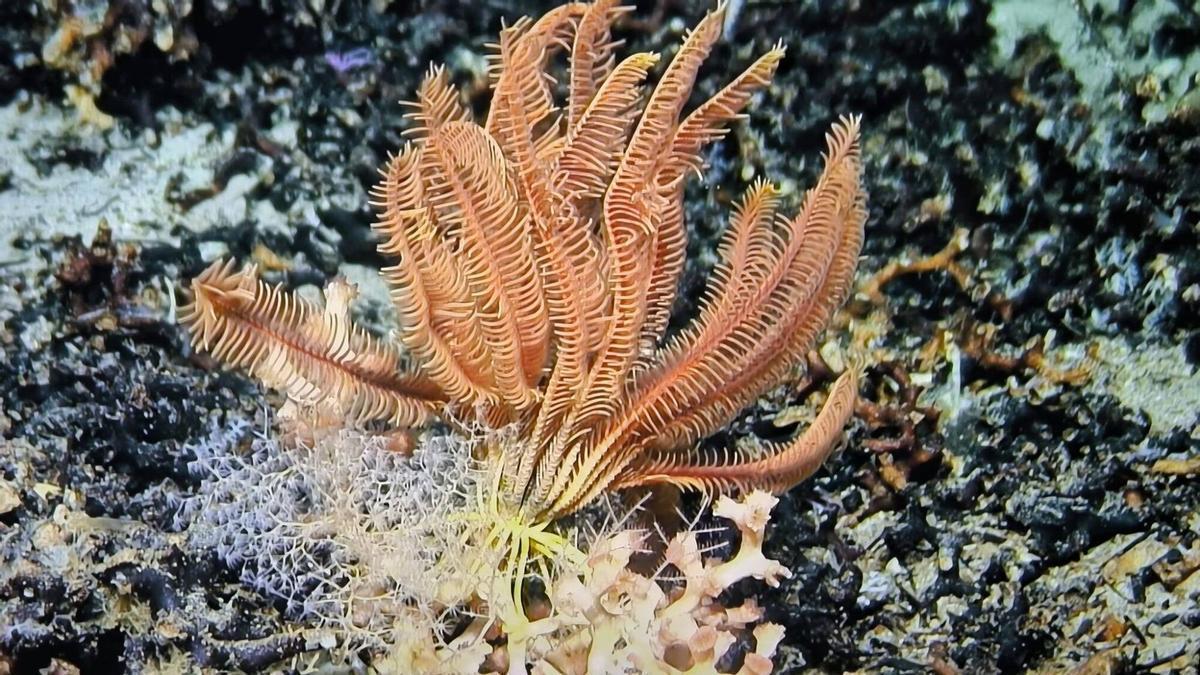
Life finds a way, even in the most remote, dark and cold places on the planet. Between 1,000 and 2,000 metres down, making the most of the rugged terrain formed by underwater mountains, a colourful and “complete and complex” ecosystem has emerged, providing a refuge for hundreds of marine species around the Canary Islands. It is an oasis in the middle of the desert of the seabed, and researchers from the Spanish Institute of Oceanography (IEO) have only just begun to uncover its secrets.
Rich and pristine habitats
Although all the data collected by researchers aboard the oceanographic vessel Odón de Buen has yet to be analysed, preliminary findings – including a prolific photographic gallery – show that at great depths there live at least several species of sponges and corals. Pablo Martín-Sosa, researcher at the Canary Islands Oceanographic Centre and chief scientist on the campaign, describes it as “a very rich ecosystem”, one that rivals those closer to the surface which, consequently, receive more light. In fact, it is a rather “spectacular” find for science, as it remains pristine and untouched by human contact.
“Being at such a depth, they have not been subjected to human pressure, and that shows in the ecosystems,” explains the scientist, who believes this peculiarity makes the oasis an exceptional place.
Exploring Canarian waters
For 21 days of work aboard the Odón de Buen, the team of Canarian researchers from the Cansemos campaign has been sailing the southwest and northeast of the Canary Islands to see, for the first time, the secrets hidden beneath the seabed. “Two years ago we tried to do it, but the limitations of the vessel Ángeles Alvariño prevented us from surveying those deeper seabeds,” reveals Martín-Sosa.
Back then, they realised that the area – declared a Site of Community Importance (SCI) by the Spanish Ministry for Ecological Transition – could not be sampled because their equipment could not descend to such depths safely.
Mountains of marine life
Among the areas investigated are the Rybin, Ancor, Dacia and Nico Sur seamounts, located a few kilometres north of La Graciosa and Lanzarote in what is called the northeast sector. Also studied were Drago, The Paps, Echo and Bimbache, which lie several kilometres south of El Hierro, in the southwest sector. All of these small submarine islands are marine protected areas within the Natura 2000 network, harbouring marine habitats of special conservation interest.
“We have a commission from the Ministry to study this area, map it and understand the ecosystems that have formed in the depths,” he insists.
Basis for protection
Thanks to work carried out between 2023 and 2026, the geomorphological and sedimentary characterisation of these areas has been completed, along with mapping of their benthic habitats and an inventory of their main biological communities. This provides the scientific basis needed to assess their conservation status and advance the management and protection of these ecologically valuable sites.
This scientific information is particularly valuable and sensitive, as these seamounts are among the sites marked as potential for rare earth mining. “That is precisely why it was declared a protected area,” insists the researcher, who believes the results of this analysis could settle the debate. “In principle, the existence of these sensitive communities is not compatible with extractive use,” argues Martín-Sosa.
Future conservation plans
In theory, if all goes well, within three years a management and monitoring plan should be implemented for these underwater archipelagos so that they become Special Areas of Conservation (SAC). “This is not a matter of taking a snapshot; it requires monitoring over time,” insists the researcher, stressing that such a study would focus especially on the biological side.
What’s happening in the Canaries – straight to your phone
News, weather alerts and practical updates – direct from the islands, in English. We live here and know what’s going on – before the international media catch up. Everything lands on our WhatsApp channel – no middlemen, no algorithm. Curated for families, expats and travelers.

Earthquake felt in Tenerife and Gran Canaria

Rare deep-sea codlet confirmed in Canary waters for first time

Tenerife faces summer with just two campsites amid outdoor tourism boom

Canary Islands to get first dedicated biodiversity law

Tenerife seismic activity: 550 events recorded in 24 hours

Contigo La Palma slams ‘unethical’ banana aid compensation
Canary Islands observatories get major data network boost
Energy storage framework finally approved for Canary Islands

US military hub near Canaries: what it means for Spain