
The tinderbox beneath the trees
The Canary Islands are home to more than 578,000 hectares of forest – nearly 78 per cent of the total land area – and over 30 per cent of that woodland is at significant risk of fire. A combination of agricultural abandonment, the unbroken spread of forest cover and the effects of climate change have stretched the danger window well beyond its traditional bounds. And despite what one might assume, the fact that this winter was unusually wet does little to lower the threat.
Rising temperatures driven by climate change, together with the drought that has gripped the archipelago in recent years, have upset the natural balance of the forests. “The layers that help retain moisture in the soil are drying out,” explains Marcos Lorenzo, Deputy Minister for Emergencies of the Government of the Canary Islands. He warns that even though “some islands have received the equivalent of three winters’ worth of rain in just two weeks,” moisture levels are not recovering. The result is a persistent water stress that has turned the land into a powder keg.
After those intense, concentrated downpours – brought by low-pressure systems ‘Emilia’ and ‘Therese’ – there is more vegetation, but also more fuel. “There is a greater quantity of tinder,” the deputy minister stresses, adding that the ground “is not as damp as it looks.” The changing pattern of rainfall, he says, means the alert must remain in place.
A campaign built on prevention
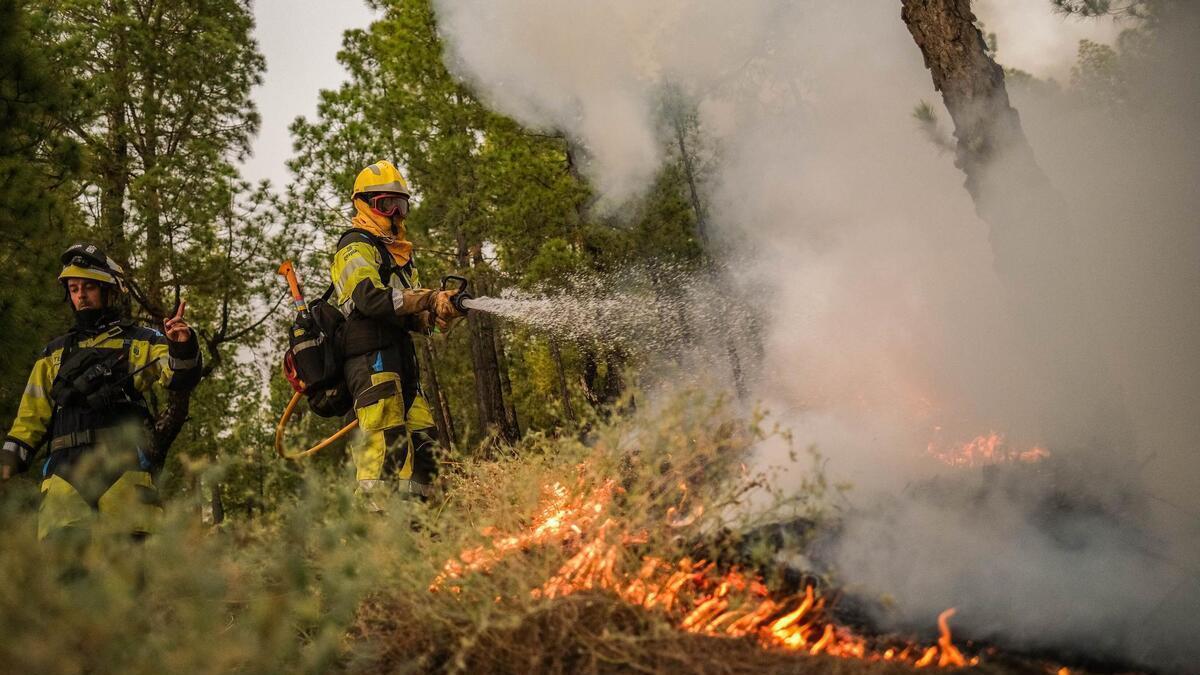
The high-risk wildfire season has now officially begun across the archipelago, a regional campaign that launches under a principle the authorities repeat as non-negotiable: the best way to fight fire is still to stop it from starting in the first place. The regional firefighting campaign for 2026 gets under way with a large-scale response system, designed to act quickly across a fragmented territory marked by difficult terrain and highly sensitive forest areas on several islands.
In total, the operation will involve 1,929 personnel, 208 ground vehicles and 18 aircraft – a mobilisation that confirms the fight against wildfires has become one of the top priorities in emergency planning for the Canary Islands. The main burden of the response falls on the island councils (cabildos), which are the first authorities to raise the alarm and deploy personnel and equipment on the ground.
Tenerife and Gran Canaria lead the response
Tenerife concentrates the largest share of resources contributed to the regional government – 88 personnel, 54 items of equipment and two aircraft – on an island where the sheer extent of forest cover and the complexity of the terrain demand especially close vigilance. What is more, on 14 April the Tenerife Cabildo signed an agreement with the Ministry of Defence under which around 2,500 members of the armed forces will be deployed on the island alone.
Gran Canaria – which will make 178 personnel, 25 items of equipment and two aircraft available to the government – will devote the €5 million it expects to raise from the ‘green cent’ fuel tax exclusively to wildfire prevention. La Palma adds 237 personnel and 37 items of equipment to the regional operation, should they be needed. Completing the picture are El Hierro, with 115 personnel and 33 items of equipment, and La Gomera, with 112 personnel and six ground vehicles.
Regional reinforcements and state backup
When a fire exceeds the initial response capability and requires extraordinary reinforcement, the regional system steps in. At this second operational level sit the Eirif (Intervention and Reinforcement Teams for Forest Fires), with 140 personnel, 15 items of equipment and three aircraft. Added to this is the role of the Government of the Canary Islands’ Emergency and Rescue Group (GES), which will contribute 43 professionals and six aircraft.
Also forming part of the surveillance and response network are teams linked to specially protected natural areas, such as the Caldera de Taburiente on La Palma, with 36 personnel, and the Garajonay National Park on La Gomera, with 65. The system is rounded out by state-level support. The Military Emergency Unit (UME) will provide 150 personnel and 24 items of equipment from its bases at Gando and El Rosario, while the Ministry for Ecological Transition will reinforce the operation with 65 personnel, five items of equipment and five further aircraft.
Coordination between all these bodies is once again a key factor in a campaign that demands not only resources, but also speed in decision-making and the ability to act in synchronised fashion when every minute counts.
What’s happening in the Canaries – straight to your phone
News, weather alerts and practical updates – direct from the islands, in English. We live here and know what’s going on – before the international media catch up. Everything lands on our WhatsApp channel – no middlemen, no algorithm. Curated for families, expats and travelers.

Iberdrola plans Tenerife’s biggest battery storage plant

The wild canary that gave its name to the Canary Islands

Canary Islands sea hits second-hottest year on record

Legal bid to halt tree felling in Santa Cruz’s La Salud

Fiesta del Charco: A journey through La Aldea’s past

Corralejo dunes power line set for removal

ULPGC launches 14 research projects at Las Canteras

TMT will never be built, says Canary Islands astrophysics chief

Pedro Duque: Canarias is the “ultimate dream” for rockets
