
A temperature puzzle that has baffled science for decades
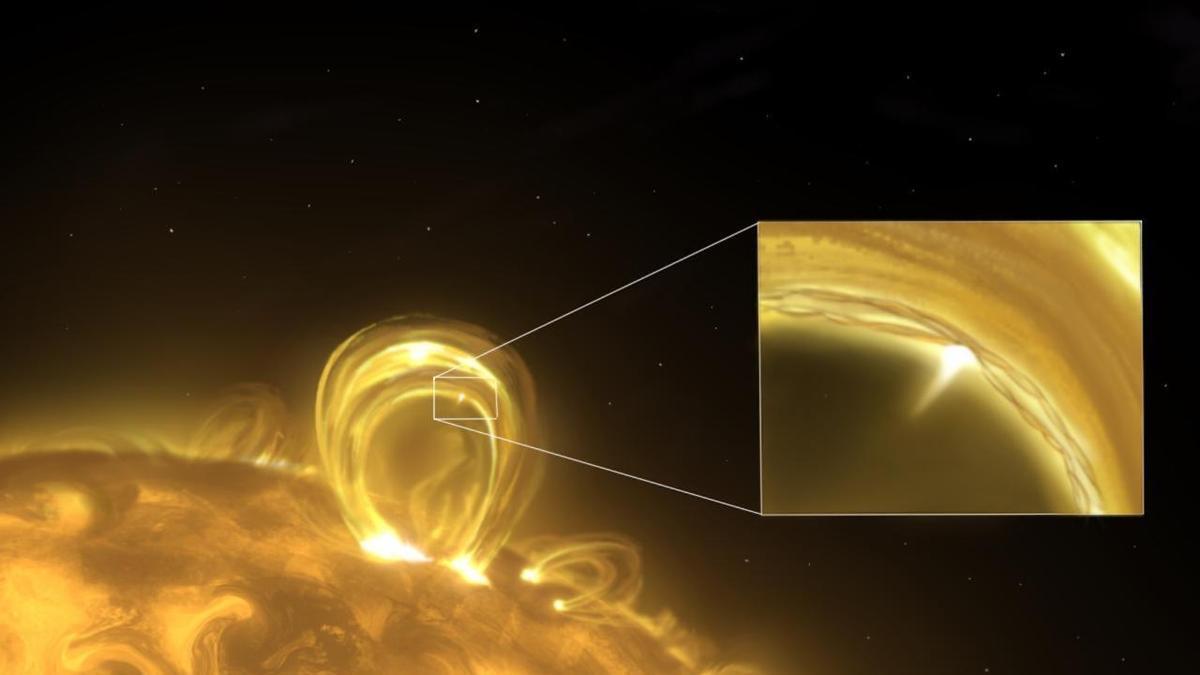
The atmosphere surrounding the Sun reaches temperatures of millions of degrees. This figure stands in stark contrast to the heat accumulated on its surface, which barely reaches 6,000 degrees. This disparity remains one of the great enigmas of solar physics and may be linked to tiny, elusive plasma ejections—known as nanojets—that occur continuously in the solar corona. Until now, however, catching the Sun in the act of spitting out these small, rapid bursts of energy has been a major challenge for science. A challenge that the Instituto de Astrofísica de Canarias (IAC) may have solved by applying a little imagination.
The mystery of the million-degree corona
The mystery of the temperature difference between the Sun’s two layers was first raised in the mid-20th century, when it was discovered that the solar corona reaches temperatures of millions of degrees. Since then, scientists have proposed various mechanisms to explain it, including the release of energy across the corona in small events known as nanoflares—an idea formulated several decades ago by astrophysicist Eugene Parker. In recent years, thanks to space missions such as IRIS (NASA) and Solar Orbiter (ESA/NASA), events resembling this type of small-scale phenomenon have been observed.
A new problem: detection on a grand scale
This discovery created a fresh problem: how to detect them en masse. Because they are so small and fast, many still evade detection. Although current capabilities allow scientists to identify the most prominent events, it is far more difficult to detect all those that, according to theory, should be distributed across the solar corona. “The theory tells us that for the solar atmosphere to be at such a temperature, these nanojets must be occurring across the entire solar surface at the same time,” explains Daniel Nobrega, a researcher at the IAC and one of the authors of the paper announcing this breakthrough. On the one hand, current space satellites do not always have the resolution needed to detect them—something expected to improve with future missions such as MUSE (NASA), scheduled for launch in 2027. On the other hand, scientists are not entirely sure what signals to look for in the data, especially when these nanojets are so small and fleeting that they barely leave a visible trace.
“These nanojets are very small and short-lived, which makes them difficult to observe, and they probably occur in many more places than have been detected so far,” says Samrat Sen, an IAC researcher and lead author of the study.
Two key breakthroughs from the IAC team
After analysing the problem, a group of researchers from the IAC and the University of La Laguna (ULL) have contributed two key pieces to solving it. On the one hand, they have proposed a physical mechanism that could explain how these nanojets are born, and on the other, they have developed predictions that could help identify them in future observations. For Nóbrega-Siverio, the most important thing “is knowing where to look.” “We wanted to create a model that would allow us to understand how they are produced and, from there, identify what signals we should be observing,” he explains.
Magnetic reconnection: the engine behind the jets
As the scientists explain, these energy explosions are produced by a process called “magnetic reconnection.” This occurs when two magnetic fields with opposite directions meet, breaking their configuration and releasing immense amounts of stored energy. This energy propels plasma outwards in narrow jets (approximately 100 kilometres wide) at high speed (around 100 km/s), lasting only a few seconds. Although it is not possible to directly observe the magnetic reconnection process itself, its effects on the plasma can be detected. “Plasma follows the lines of the magnetic field, and our model shows what kind of signals should appear in future observations, such as those that MUSE will enable,” the team explains.
A new path for solar physics
“This work opens a new avenue for studying small-scale dynamics on the Sun,” says the lead author. “By better understanding how magnetic structures interact to generate these nanojets, we are taking an important step towards understanding the heating of the solar corona and, more broadly, how magnetic energy is released in astrophysical plasmas,” he concludes.
What’s happening in the Canaries – straight to your phone
News, weather alerts and practical updates – direct from the islands, in English. We live here and know what’s going on – before the international media catch up. Everything lands on our WhatsApp channel – no middlemen, no algorithm. Curated for families, expats and travelers.

Iberdrola plans Tenerife’s biggest battery storage plant

The wild canary that gave its name to the Canary Islands

Canary Islands sea hits second-hottest year on record

Legal bid to halt tree felling in Santa Cruz’s La Salud

Fiesta del Charco: A journey through La Aldea’s past

Corralejo dunes power line set for removal

ULPGC launches 14 research projects at Las Canteras

TMT will never be built, says Canary Islands astrophysics chief

Pedro Duque: Canarias is the “ultimate dream” for rockets
