
‘All interests are legitimate’: landscape congress gets under way in Gran Canaria
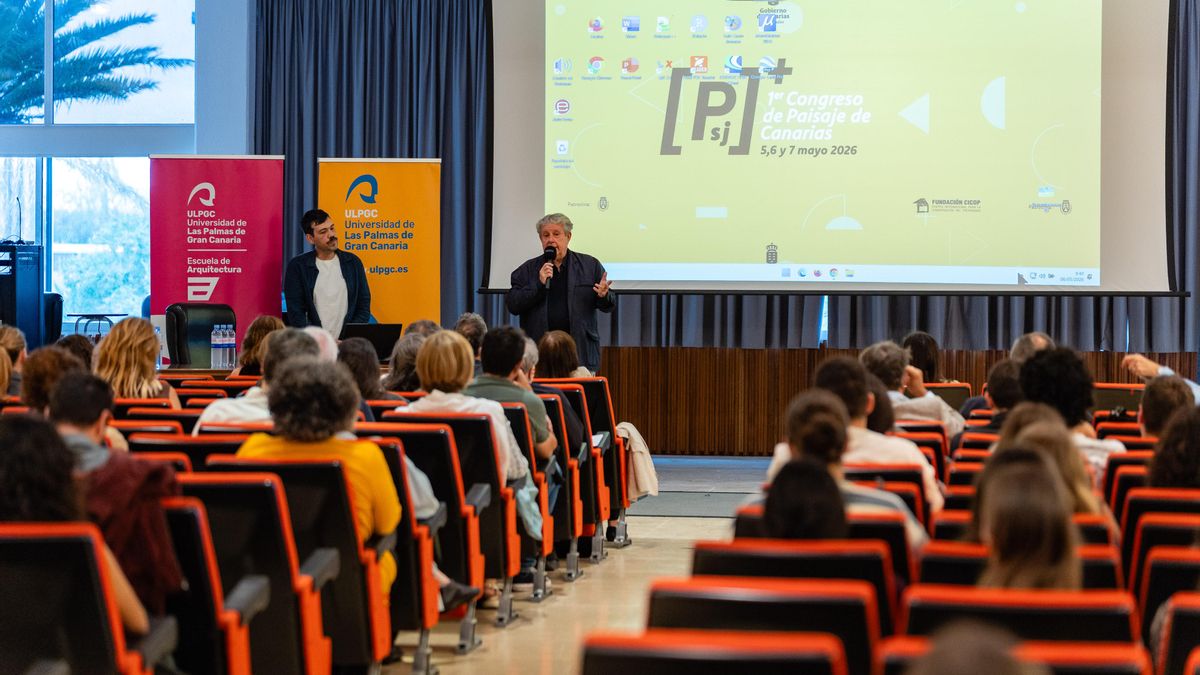
Conflict must be normalised in landscape management, because all interests are legitimate. That was the message delivered on Wednesday by Manuel Bodorio, director of the Galician Coastal Territory Plan, during his talk at the second day of the inaugural Canary Islands Landscape Congress. “Landscape management cannot be understood without the people who inhabit it, and all the interests that converge in the landscape are legitimate,” Bodorio insisted.
From imposition to proposal
The director of Galicia’s coastal territory plan believes that society is witnessing a shift in how we view the landscape. “We are moving from form to function, from technique to ethics, from reason to intuition, from rule to agreement, and above all, from imposition to proposal,” he said. Paraphrasing the Spanish saying, he added: “We are the landscape we inhabit.” Planning, he argued, is about avoiding uncertainty, but it must be based on a deep understanding of the environment.
In the case of the Galician coast, the process began with a team of a hundred people walking its 2,555 kilometres of coastline to identify what needs to be protected (25 per cent), managed (62 per cent), and rethought (13 per cent). This formed the basis for the planning framework.
Old vs new: the paradox of heritage
The president of the Spanish Association of Geography, Asunción Blanco, highlighted what her discipline can contribute to landscape management. She focused her talk on analysing which human traces should be protected, which managed, and which removed. This, she noted, leads to a paradox: we appreciate what is old, but not what is merely aged, even though the latter may hold value for future generations.
“The importance of some environments lies in interventions carried out without regard for their visual impact,” Blanco said. “These are structures that would be unthinkable to build today, yet they have become iconic and hugely attractive landmarks.” She cited the impressive 18th-century Puente Nuevo in Ronda and Las Médulas in León – the largest open-pit gold mine from the Roman era – which, though it looks like a natural geological formation, is actually the result of mountain destruction for mineral extraction.
Ugly landscapes and industrial scars
The same cannot be said for infrastructure built in recent decades. France has its “ugliest landscape” competition, but Spain has its own catalogue, compiled in a book by photographer Andrés Rubio. Its cover features the abandoned Algarrobico hotel on Carboneras beach, symbolising the impact of tourism – an industry that both feeds on and affects the landscape.
Blanco posed a key question: which industrial remains should be moved from rubble to heritage? “You can decide to hide scars, reinterpret them, or even allow nature to reclaim them, but it all depends on the specific case,” she explained. “Just because an infrastructure dates from recent decades does not mean it necessarily has to be demolished.”
Wind turbines and solar farms: future landmarks?
Unanswered questions remain. The public is currently debating the installation of wind farms and solar parks, but there is no way of knowing whether today’s wind turbines might become emblematic in the future. Nevertheless, Blanco believes that tourism and landscape can coexist, provided there is proper planning and criteria that emerge from dialogue and the integration of disciplines as diverse as geology and architecture.
A multifaceted approach
This multidisciplinary profile has also shaped the design of the congress itself, organised by the International Centre for Heritage Conservation (CICOP) with support from the regional government and the Canary Islands’ public universities. The event has been taking place since Tuesday at the School of Architecture of the University of Las Palmas de Gran Canaria.
What’s happening in the Canaries – straight to your phone
News, weather alerts and practical updates – direct from the islands, in English. We live here and know what’s going on – before the international media catch up. Everything lands on our WhatsApp channel – no middlemen, no algorithm. Curated for families, expats and travelers.

Iberdrola plans Tenerife’s biggest battery storage plant

The wild canary that gave its name to the Canary Islands

Canary Islands sea hits second-hottest year on record

Legal bid to halt tree felling in Santa Cruz’s La Salud

Fiesta del Charco: A journey through La Aldea’s past

Corralejo dunes power line set for removal

ULPGC launches 14 research projects at Las Canteras

TMT will never be built, says Canary Islands astrophysics chief

Pedro Duque: Canarias is the “ultimate dream” for rockets
