
Major Restoration Underway for Las Palmas’s Museo Néstor
The City Council of Las Palmas de Gran Canaria detailed on Monday the extensive restoration works for the Museo Néstor, which has been closed for eight years. The project revolves around three core objectives: conserving the building, improving accessibility, and a comprehensive update of its facilities. The aim is to reinforce its role as a cultural reference point for the city and consolidate its integration within the ‘Pueblo Canario’ complex, the council highlighted in a statement.
High-Level Visit to the Historic Site
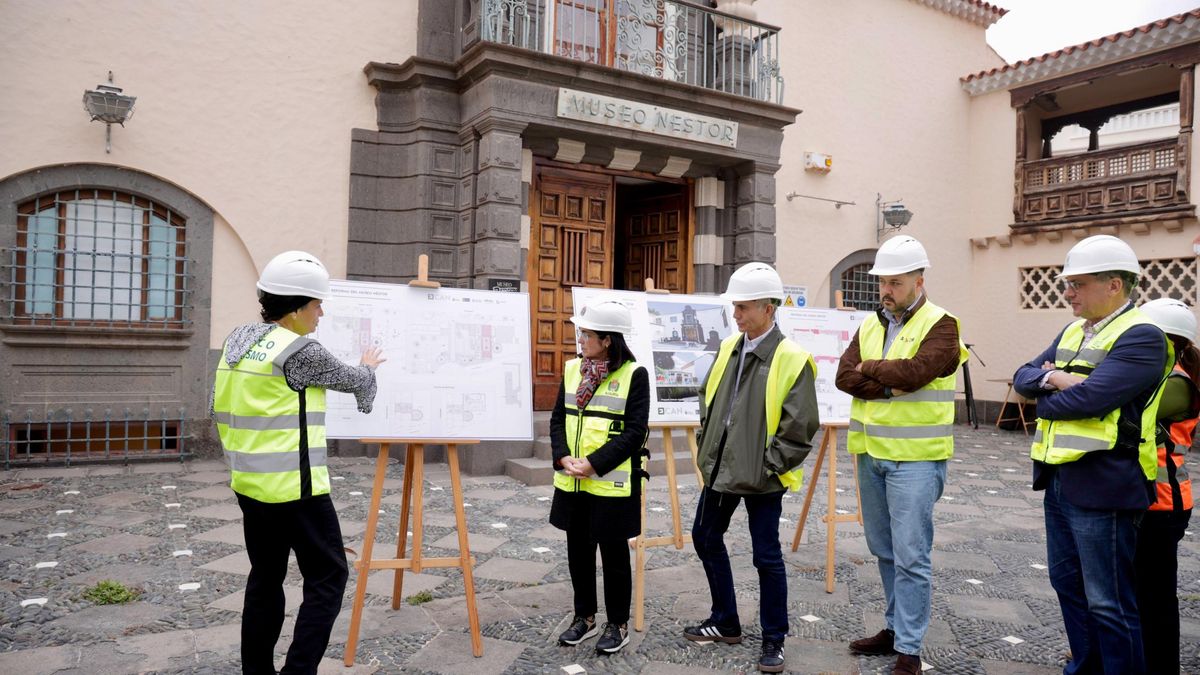
The Mayor, Carolina Darias, visited the works at the museum, described as one of the capital’s most unique heritage sites. She was accompanied by the Deputy Minister of Culture and Cultural Heritage of the Canary Islands Government, Horacio Umpiérrez, along with councillors for Planning, Urban Development and Housing, Mauricio Roque, and for Culture, Josué Íñiguez. Also present were the general coordinator for Planning, Nieves Martín, and the museum’s director, Daniel Montesdeoca.
Ambitious Funding and Project Management
The local authority detailed that the intervention involves an investment of €4,049,583.46, financed through the Canary Islands Development Funds (FDCAN). The funding is split 50% from the City Council, with the remaining 50% co-financed by the Canary Islands Government and the Gran Canaria Island Council. The project is being carried out by the Planning, Urban Development and Housing department, with technical direction from the Municipal Urban Management Society of Las Palmas de Gran Canaria, S.A. (GEURSA).
Addressing Structural Conservation
Regarding conservation, the works will resolve existing structural issues, particularly water leaks that have affected roofs, woodwork, and the ground floor, where rising damp has been detected. The intervention includes the complete waterproofing of roofs, restoration of original woodwork, and recovery of construction elements, while preserving existing flooring to maintain the building’s authenticity.
Transforming Accessibility and Space
On accessibility, the initiative incorporates a significant transformation of the building. The main entrance will be improved with a ramp and adaptation of the stairs to current regulations. Furthermore, a lift will be installed to guarantee universal accessibility throughout the interior. To accommodate the lift, a discreet extension has been designed at the rear of the building, intended to integrate with the existing structure. This will also allow for an expansion of the museum’s usable spaces.
The works also include enlarging the semi-basement and increasing its ceiling height by excavating approximately one metre, achieving a usable height of nearly three metres. This space will house new accessible toilets, storage areas for the works of Néstor Martín-Fernández de la Torre, and essential building systems such as air conditioning and lift machinery. In total, the expansion will increase the floor area by over 240 square metres, from 1,605 to 1,851 square metres.
Complete Overhaul of Obsolete Systems
The third focus is the complete renewal of the installations, which are currently obsolete and non-compliant with regulations. The work will equip the museum with new systems for air conditioning, fire protection, telecommunications, electricity, sanitation, and plumbing. These are fundamental to guaranteeing the correct conservation of the artworks and the proper functioning of the cultural facility.
A Collaborative Cultural Investment
During the visit, the mayor stated that these works, long demanded by citizens, are now a reality and respond to an intervention structured around three fundamental pillars. Mayor Darias specified it is a “very ambitious” project, financed through FDCAN funds via a co-financing scheme between administrations, and highlighted the institutional collaboration to advance the recovery of the entire Pueblo Canario complex.
She added that the goal is to intervene so the museum is in the best possible condition, allowing the work of Néstor Martín-Fernández de la Torre to shine in such a unique space, thereby reinforcing the cultural and identity value of this landmark for the city. The work is being carried out with maximum heritage sensitivity for a Site of Cultural Interest, prioritising the conservation of original elements and the harmonious integration of new interventions. This continues work carried out in recent years on the ‘Bodegón’ and the Hermitage of Santa Catalina.
The Legacy of Museo Néstor
The Museo Néstor houses the work of artist Néstor Martín-Fernández de la Torre (1887-1938), one of the most relevant figures of European Modernism and Symbolism in the Canaries. His artistic production, closely linked to the cultural identity of the archipelago, encompasses painting, stage design, and applied arts, creating a unique creative universe that has helped define recognisable elements of Canarian culture. The building, integrated into the Pueblo Canario complex and constructed in the mid-20th century, reflects the ‘Neo-Canarian’ aesthetic promoted by the artist together with his brother, the architect Miguel Martín-Fernández de la Torre.

Hotel facade fire in Las Palmas causes material damage

Tenerife comic salon returns with 40 exhibitions and 80 artists

Buenavista del Norte and Villa de Mazo compete for Christmas lights glory

Tourism overcrowding and its impact on Canary Islands healthcare

WOMEX 2026 closes in Gran Canaria as Tenerife named 2027 host

Five French sailors injured as yacht hits rocks off Lanzarote

Amaia Montero’s emotional tribute at Gran Canaria concert

Netflix begins filming new thriller in Tenerife

Loquillo and Amaia headline Tenerife Peñón Fest 2026
