
Radical Transport Shift for the Canary Islands
The Canary Islands are planning a fundamental change in how people get around. The new Sustainable Mobility Law outlines a high-impact shift: fewer private cars, more public transport, new ways to reach poorly connected areas, and a Mobility Laboratory to trial solutions on the ground before rolling them out across the archipelago. The proposal, which the Director General of Transport, María Fernández, aims to register in Parliament in July for processing, opens the door to on-demand transport in low-density areas. This formula is designed to connect neighbourhoods, mid-altitude regions, and remote towns with urban centres, hospitals, schools, and essential services when regular bus lines are insufficient or inefficient.
A New Mobility Laboratory to Pilot Solutions
For Fernández, the idea is clear: in a fragmented territory with difficult topography and a heavy reliance on private vehicles, the system must innovate or it will remain inadequate. “This law has involved two years of intense public participation, and we have incorporated a large part of the proposals sent to us. That is why when we presented the draft to the island councils and town halls, it was approved unanimously, with only Las Palmas de Gran Canaria abstaining,” states Fernández. The major political and operational novelty is the creation of the Mobility Laboratory, a specific body tasked with studying, researching, promoting, and driving pilot projects to make transport more sustainable, accessible, and efficient. The idea is to test first, measure afterwards, and correct before scaling up—from technological solutions to new models of intermodal connection or shared mobility.
Tackling Emissions and Congestion Head-On
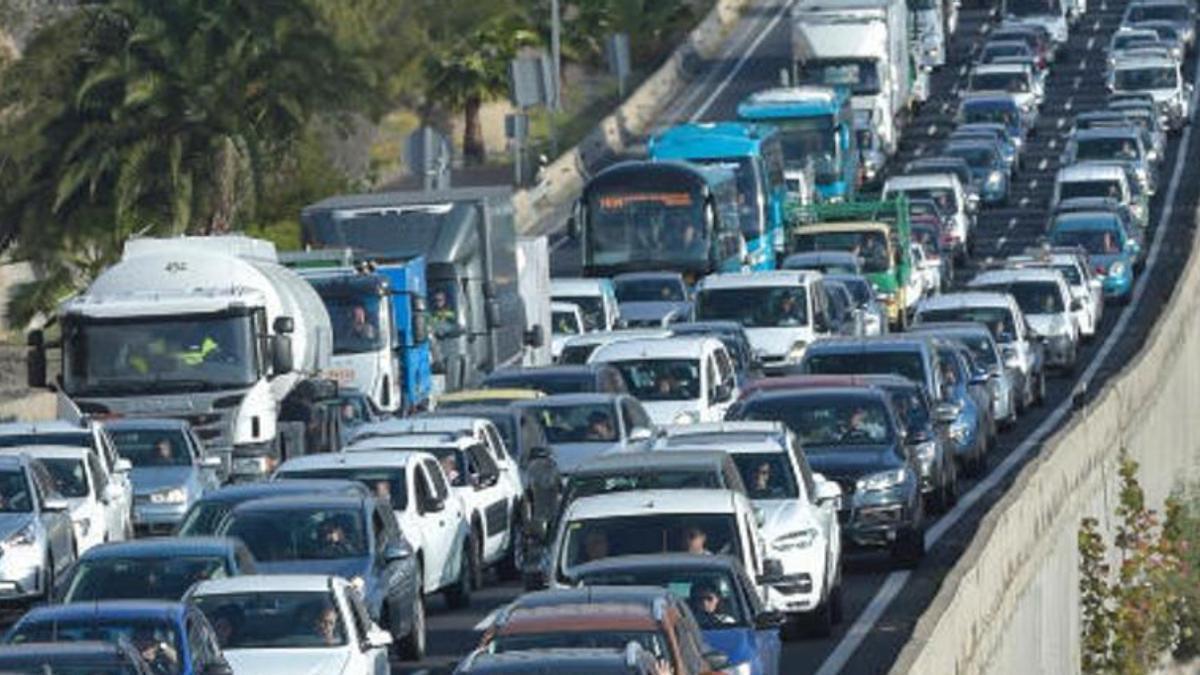
The text unflinchingly acknowledges the scale of the problem. Transport accounts for the largest share of greenhouse gas emissions in the Canaries—up to 40%—and the law is born with the intention of reducing that environmental cost while combating the congestion that plagues the islands, especially in metropolitan areas. Therefore, the legislation prioritises so-called ‘soft modes’ (walking and cycling), electrification, integration between buses, ports, and airports, and mandatory planning so that municipalities with over 20,000 inhabitants stop improvising their mobility strategies. The philosophy of the text is unequivocal: mobility is no longer just a matter of roads and traffic but becomes a right linked to quality of life, access to services, and territorial equality. The challenge is no longer merely to get from A to B, but to do so in a clean, effective, and affordable way.
Cross-Border Planning for Integrated Transport
One of the most interesting advances of the future law is its commitment to overcoming traditional administrative boundaries. In the Canaries, many daily journeys—for work, study, or services—do not respect municipal borders. Therefore, the law promotes the creation of sustainable urban mobility plans on a supra-municipal or regional level. In practice, this means several municipalities can—and in many cases must—coordinate to jointly design how to organise transport, traffic, and pedestrian spaces. This approach responds to an obvious reality: metropolitan and regional areas function as a single system. Improving transport in one municipality is of little use if its neighbour maintains structural problems.
“Often, municipalities, especially smaller ones, do not have sufficient staff or the necessary structure to implement their urban mobility plans. What we have done is make it easier for those in the same region to join forces to carry them out,” explains Fernández. The law states that these plans will be drawn up when there is significant interaction between municipalities—such as dormitory towns and employment areas—which allows for reduced costs and administrative duplication by sharing resources and assessments. It also fosters an integrated vision of the territory, aligned with island plans and regional strategy. In other words, mobility ceases to be an add-on and becomes a central element in how cities are designed.
Promoting a Culture of Responsible Mobility
Finally, as no system functions without rules or consequences for non-compliance, the law dedicates an entire section to a penalty regime. This is conceived as a tool for control, but also for awareness-raising, as it is not intended to be solely a punitive mechanism. Instead, it aims to foster a culture of responsible mobility, where compliance with the rules helps reduce congestion, improve road safety, decrease environmental impact, and guarantee equitable use of public space.
The future law, which the regional government will shortly approve, therefore does not merely seek to improve transport. It proposes a deeper change: understanding mobility as a collective right linked to “quality of life, sustainability, and territorial cohesion,” concludes the Director General.
What’s happening in the Canaries – straight to your phone
News, weather alerts and practical updates – direct from the islands, in English. We live here and know what’s going on – before the international media catch up. Everything lands on our WhatsApp channel – no middlemen, no algorithm. Curated for families, expats and travelers.

Vueling plane lands with landing gear fault at Los Rodeos

Ferry contract to Canary Islands declared void

Bomb threat on Vueling flight triggers Gran Canaria airport security operation

Cruise to Canaries cancelled after collision in port

Tenerife tram delays worsen amid staff shortages

Titsa adjusts night bus times for clock change on Tenerife

Night roadworks to disrupt TF-1 traffic from Sunday

Public service obligation for Canary inter-island flights announced

Iberia accused of ejecting passengers from paid seats
