
Compiled with the help of artificial intelligence, based on Spanish-language information. Source below the article.
A Welcome Change in Fortunes
Tenerife is approaching this year’s grape harvest with a palpable sense of optimism, thanks to the abundant rains of the past winter. After seven long years of drought, the island’s wine industry is buoyed by positive expectations for both the volume and quality of the grapes. Some producers are even looking beyond this year, predicting that the 2027 harvest will be even better, given the strength the vines have gained from the recent rainfall.
This improvement is already translating into tangible figures, particularly on the southern side of the island. The Valle de Güímar Denomination of Origin (D.O.) expects its yield to increase from 125,000 kilos in 2025 to around 180,000 kilos this year, while the Abona D.O. anticipates a rise of between 50% and 60% compared to the last harvest. In the north, wineries like Viñátigo are projecting they will double their production. Meanwhile, at Tajinaste, the emphasis is less on quantity and more on the exceptional quality of the grapes, which are already being picked and are displaying excellent levels of acidity and alcohol content. However, there are still some concerns. Wineries such as El Lomo, within the Tacoronte-Acentejo D.O., are warning of significant drops in yields for some red grape varieties.
A Unique Harvest Season
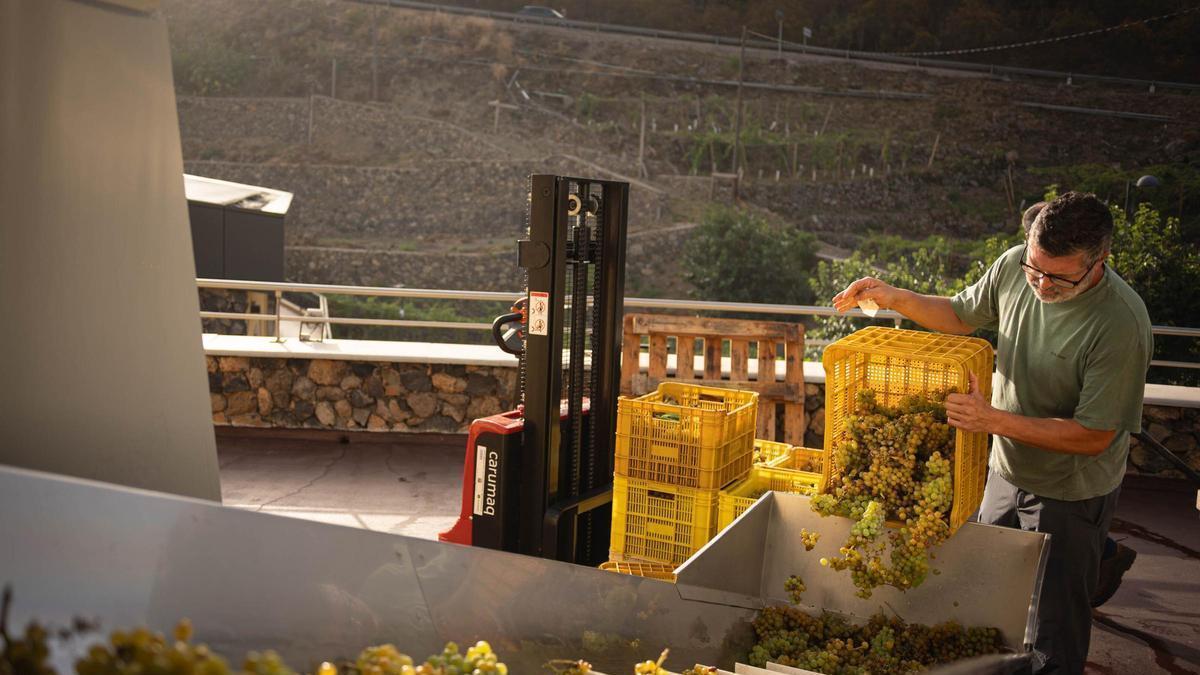
On Tenerife’s southern slopes, the harvest is beginning in the lower-lying areas with white grape varieties like Marmajuelo, with very positive forecasts. Several denominations and producers started picking at the beginning of August and will continue into October, depending on altitude, zone, and grape variety. This staggered approach is one of the greatest singularities of the wine sector in Tenerife; the harvest is not a homogeneous, uniform process with a fixed duration, as is the case in other wine-producing regions of the country. The island’s remarkable diversity of microclimates, altitudes, orientations, and grape varieties all demand their own specific timings.
The Spectre of Phylloxera
However, the spectre of phylloxera looms over the 2026 campaign. The insect was first detected last summer within the Tacoronte-Acentejo D.O. Although protocols and measures remain in force, particularly in that denomination, producers admit that vigilance has been somewhat relaxed. The identified outbreak sites remain under control with buffer zones—a security perimeter of around two kilometres—and restrictions on the movement of grapes and plant material are still in place. Borja de Mesa, manager of Bodega El Lomo, explains that “the measures we have in place right now are manageable and easy for producers to follow.” Manuel Marrero, president of the Cumbres de Abona cooperative, is more bullish, proudly stating that “phylloxera doesn’t seem to want to live here.” For now, the positive sentiment is leaning towards Tenerife’s southern side.
Early Starts Across the Island
Tajinaste, a winery originally from La Perdoma in La Orotava, began its harvest on 4 August at a vineyard in Bebederos, near the Malpaís de Rasca in Arona, with the Marmajuelo variety. “We already have must fermenting, but we’ll continue the process until the end of October because many areas run on a more traditional schedule. We’re keeping our fingers crossed that the summer weather continues to be as helpful as it has been so far,” says the winery’s owner, Agustín García Farráis. Bodegas Monje, in the Tacoronte-Acentejo D.O., has been harvesting for 15 days, but as owner Felipe Monje points out, “the main period will be the classic one: the whole of September and part of October.” He is impressed by the vines’ vitality: “The plants are quite strong. I’d even go so far as to say that next year should be even better. The vines have taken in a good amount of water, and the land has been able to recover somewhat after the prolonged drought.” Marrero from the Abona D.O. shares this premonitory view. “The new canes are four or five metres long. We had vines that were practically lost, and this year they’re already producing bunches of grapes,” he says enthusiastically. Cumbres de Abona has only received a small amount of grapes so far, but Marrero notes, “next week we’ll have a good quantity in the winery. We’ve started harvesting in Granadilla de Abona.”
Despite the widespread optimism, Marrero, as president of the regional cooperative, laments “all the water we lose in Tenerife. We send it straight to the sea. We’re calling for an end to this waste and for the repair of infrastructure like the El Río dam. We could be storing thousands of barrels’ worth of water,” he insists. José Bruno Albertos Pérez, president of the Valle de Güímar D.O., believes August and September are the ideal months for the harvest. “We always start on plots located around 500 metres above sea level. As the grapes ripen, we move higher, finishing with the last pickings at 1,200 or 1,300 metres, in areas like Los Pelados,” he explains. The reason for starting at that altitude is that this first grape harvest is “for our cava, sparkling wines, and frizzante. The grapes have an alcohol level of between nine and ten degrees,” he comments.
Juan Jesús Siverio, owner of the Viñátigo winery in the Ycoden-Daute-Isora D.O., began harvesting a month ago on islands like Lanzarote and Fuerteventura. “We started in Tenerife a little over a week ago, in the areas closest to the sea and with the earliest white grape varieties like Marmajuelo,” he states. His forecast is to double production compared to last year, “with very good parameters for acidity and alcohol.” He acknowledges that the vineyards “were badly affected after seven straight years of drought.”
A Cloud on the Horizon
The harvest is one of the most crucial moments for the wine sector anywhere in the Canary Islands. But some producers are concerned about a factor that transcends time and place: the abandonment of farmland and the lack of generational renewal. This is dampening hopes for the future and tempering the optimism brought by this year’s rains. Borja de Mesa, from Bodega El Lomo, highlights the immense amount of work involved in maintaining a vineyard all year round. “It’s increasingly difficult to find people who know how to handle a harvest. The task ends up falling to the winery staff and the families who run them. We must value the human aspect because it’s a completely manual process, very similar to how it was done 200 years ago,” he reflects. Felipe Monje of Bodegas Monje is also worried about “the neglect of the countryside. There’s a problem of generational renewal, which means that every year we lose more vineyard acreage because there’s no one to continue working it.”
What’s happening in the Canaries – straight to your phone
News, weather alerts and practical updates – direct from the islands, in English. We live here and know what’s going on – before the international media catch up. Everything lands on our WhatsApp channel – no middlemen, no algorithm. Curated for families, expats and travelers.

Canary Islands sea hits second-hottest year on record

Legal bid to halt tree felling in Santa Cruz’s La Salud

Fiesta del Charco: A journey through La Aldea’s past

Corralejo dunes power line set for removal

ULPGC launches 14 research projects at Las Canteras

TMT will never be built, says Canary Islands astrophysics chief

Pedro Duque: Canarias is the “ultimate dream” for rockets

Court blow to Tenerife motor circuit project
La Palma faces new volcanic risk planning deadline
