
Inside Tenerife’s giant waste hub
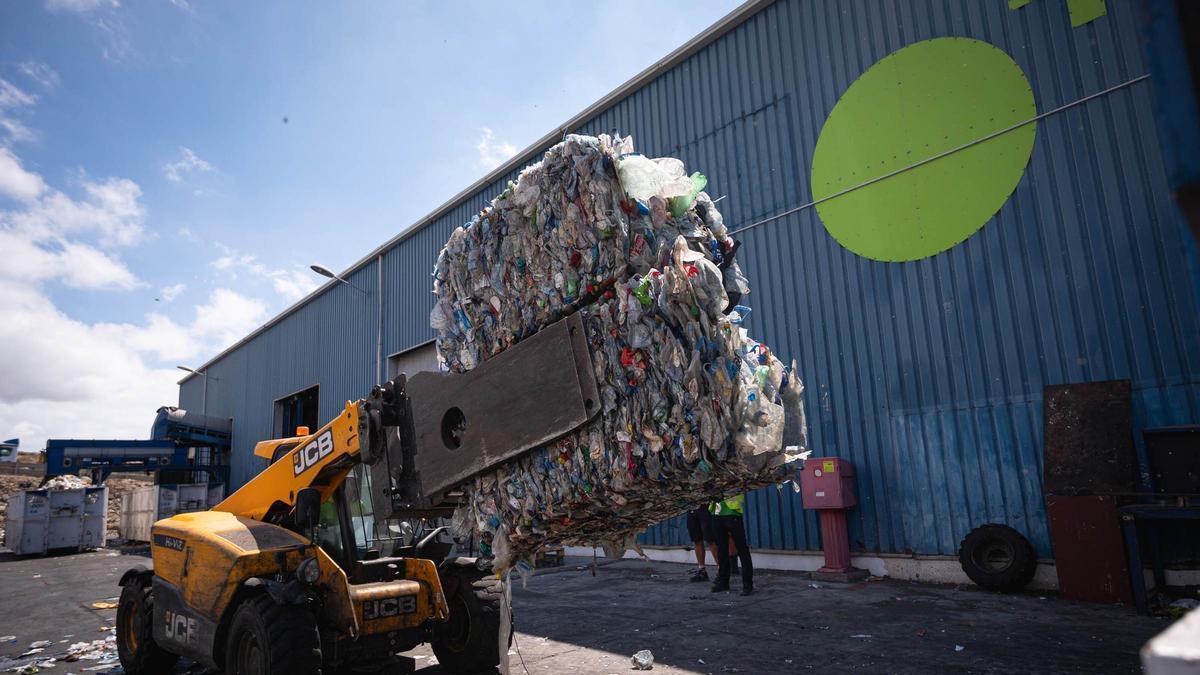
Every day, around a hundred lorries laden with all kinds of waste roll into the Tenerife Environmental Complex in the municipality of Arico. This is the nerve centre of the island’s waste management system – a site that, in recent years, has undergone a profound transformation driven by the modernisation of its facilities and the adoption of new technologies. The Cabildo (Tenerife’s island government), through its Department of Natural Environment and the Island Directorate of Waste, has spearheaded a series of projects aimed at boosting performance, operational efficiency and innovation across the island’s entire waste treatment network. All of this is being carried out in coordination with the company UTE Nivaria, which holds a contract worth 474 million euros.
No expansion, just smarter use of space
Alejandro Molowny, the Island Director of Waste, stresses that “the idea is to incorporate cutting-edge technology to maximise material recovery rates within the existing footprint.” He explains that this “will extend the complex’s useful life without needing to expand it” – a significant point given the facility covers roughly 443 hectares, or more than four square kilometres, the equivalent of 400 football pitches. The Cabildo has no plans to increase the complex’s surface area. Instead, the aim is to consolidate it as a central hub within a network of coordinated infrastructure that makes up Tenerife’s current island-wide waste management model.
“Daily management,” Molowny summarises, “pursues three major goals: increasing energy efficiency, optimising transport, and improving material recovery to keep moving towards an ever more sustainable model.” He adds that “we are in a moment of very significant change, working intensely and with great enthusiasm to improve the island-wide waste management network as it currently stands in Tenerife.”
Over €55m in upgrades: from toxic liquids to solar-dried sludge
Key projects, representing over 55 million euros of Cabildo investment, include several innovative facilities: a leachate treatment plant to purify the toxic liquids released by decomposing rubbish, and a solar sludge drying facility to treat and reduce moisture content from wastewater treatment by-products. A new recycling centre (punto limpio) is also being built within the complex itself.
At the same time, the commitment to energy efficiency has been reinforced through the installation of biogas capture systems and the modernisation of the mechanical treatment plant, where waste is automatically separated and sorted.
Turning rubbish into renewable energy: biogas powers 8,000 homes
The pursuit of energy efficiency finds its main expression in biogas valorisation. This is a natural gas, almost 100% renewable, produced by the decomposition of organic matter in the absence of oxygen. Once deposited and sealed in completely watertight cells, this organic matter naturally generates a methane-rich fuel. Capture rates have increased by around 20%, thanks in part to improved extraction systems and channelling the gas to new, state-of-the-art engines and turbines. As a result, the facility now generates 3.6 megawatts of electricity, of which 2.4 megawatts are fed into the island’s grid, while the remaining 1.2 megawatts cover the complex’s own internal consumption.
This energy, produced through a process called cogeneration, is enough to power all of the site’s industrial processes, with any surplus providing electricity for the equivalent of around 8,000 homes. “To stop the gases escaping,” Molowny explains, “we have safety flares – pipes that burn the biogas – and we permanently seal each cell once it reaches the end of its useful life.” He adds that they are now using horizontal capping, which is usually done vertically, “allowing us to capture more gas from the very start and increase how much we can use.” This prevents methane from being released into the atmosphere, thereby reducing the greenhouse effect and slowing climate change.
A network of logistics hubs, not just one site
Meanwhile, the transfer stations in the north (such as La Guancha) and the south (in Arona) have evolved into full-blown logistics centres designed to optimise the flow of waste around the island. There, materials are sorted, shredded, compacted and organised on a massive scale before being moved on, thanks to 56 new vehicles and 130 containers, all feeding “the heart of Tenerife’s waste system.” As Molowny puts it, “the Arico Environmental Complex is the soul of the structure,” but he insists it is not a single facility: it is “a network spread across the whole of Tenerife.”
He emphasises that “the model’s success doesn’t depend on any one specific project or facility, but on the whole system,” because it is the coordination between them that keeps things running day to day. The system also requires constant transport planning, “organising journeys to avoid, whenever possible, the busiest traffic periods,” given that around 100 lorries and nearly 500 workers are needed to manage the more than 500,000 tonnes of waste the island generates each year. “If one of these facilities fails, we don’t have an immediate plan B,” he warns, which forces a closed-loop model where everything must be resolved within the island’s own system. Molowny compares its operation to that of “an aircraft carrier or a big ship,” where everything must be fully integrated, and notes that the system has taken a leap in performance, efficiency and innovation thanks to the coordinated modernisation of infrastructure.
A living laboratory: drones, solar farms and fertilisers from waste
With its island-wide waste collection model, Tenerife is positioning itself at the cutting edge of waste management and sustainability innovation, backed by pioneering investment of more than 10 million euros in research, development and innovation projects. “We can’t just take a snapshot and stay there; our facilities have to evolve too. We don’t want to just wait for the market to develop solutions; we want to drive that innovation ourselves through our own projects,” Molowny says. Indeed, the island now functions as a real-world laboratory on an international scale.
Key research strands include: collaboration with the Institute of Technology and Renewable Energy to design photovoltaic plants adapted to local conditions; developing drone-based emissions control systems with the Canary Islands Volcanological Institute; creating smart waste sorting solutions for the hotel sector with the University of La Laguna; and investigating high-value fertilisers for agriculture with the Canary Islands Institute of Agricultural Research.
Public participation: a record year for recycling
As if that weren’t enough, this technological model is also backed by the involvement of Tenerife’s residents. The island-wide “Tenerife+Sostenible” strategy, designed to promote best practice, places environmental awareness at its core and seeks to foster responsible habits in coordination with local councils, schools and community groups. Public participation is already showing significant results. The network of recycling centres has recorded record figures, with nearly 339,000 users and more than 63,000 tonnes of waste collected separately. Separate collection of organic waste has also risen, from 162 tonnes in 2020 to over 2,500 tonnes in the last year. Tools like the “Truec@” app, which promotes the reuse of good-quality items to extend their useful life, are also making a difference.
Finally, on the education front, the Cabildo is driving environmental awareness programmes such as “Aulas+Sostenibles” and the mobile classroom “S’ Lab,” which bring environmental education to schoolchildren and municipalities, strengthening the culture of recycling from an early age. This activity has already reached 739 participants in just one year.
Following the European waste hierarchy
From there, Molowny explains, the system is structured around the European waste hierarchy: “minimisation, reuse, recycling, separate collection, and finally, waste management.” It is a chain where each phase plays a specific role, and which also includes initiatives such as object reuse and expanding separate collection, alongside specific projects like textile treatment – a scheme in which only five environmental complexes across the whole of Spain take part, Tenerife’s among them. “The important thing is to turn that rubbish into a resource, into raw material for new recycling industries,” he concludes. The work aims to intervene even before waste reaches the system, following a clear hierarchy that prioritises reduction and leaves final disposal as a last resort. As Molowny puts it: “The best waste is the waste that is never produced.”
What’s happening in the Canaries – straight to your phone
News, weather alerts and practical updates – direct from the islands, in English. We live here and know what’s going on – before the international media catch up. Everything lands on our WhatsApp channel – no middlemen, no algorithm. Curated for families, expats and travelers.

Canary Islands sea hits second-hottest year on record

Legal bid to halt tree felling in Santa Cruz’s La Salud

Fiesta del Charco: A journey through La Aldea’s past

Corralejo dunes power line set for removal

ULPGC launches 14 research projects at Las Canteras

TMT will never be built, says Canary Islands astrophysics chief

Pedro Duque: Canarias is the “ultimate dream” for rockets

Court blow to Tenerife motor circuit project
La Palma faces new volcanic risk planning deadline
