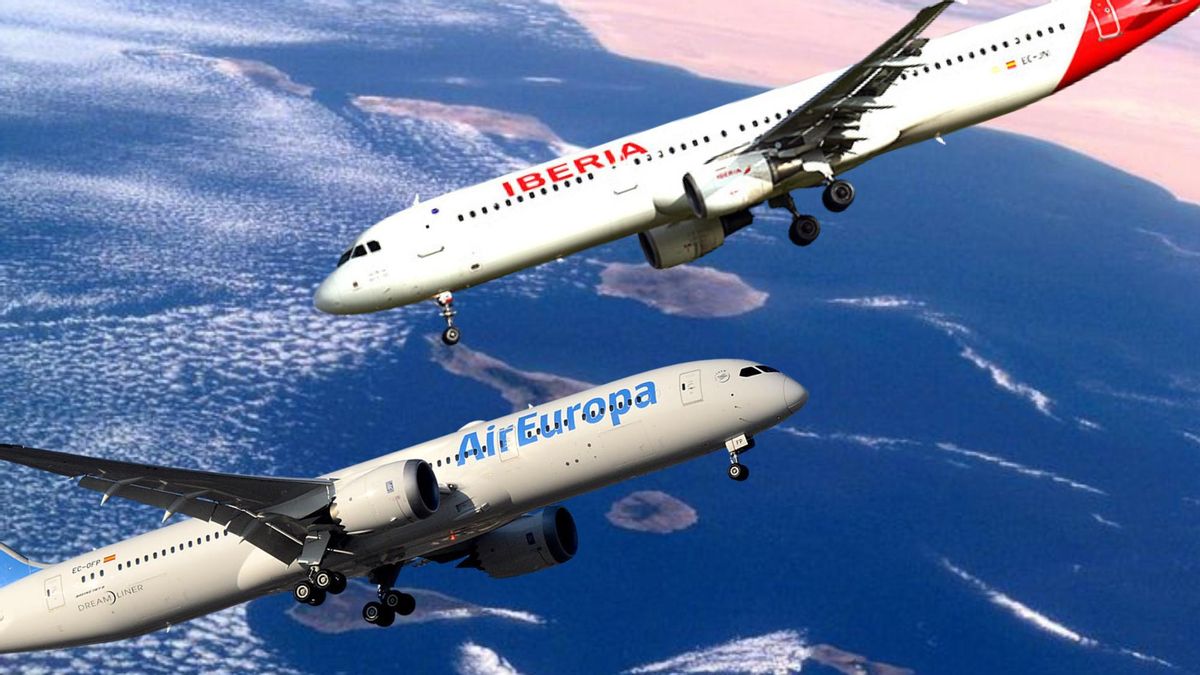
Close call over the Atlantic
Two passenger jets – an Iberia Airbus A321 and an Air Europa Boeing 787-9 – came perilously close to colliding while flying over the Canary Islands on 10 July. According to the air traffic controllers’ union SIPCA, the potential disaster was averted only because the onboard Traffic Collision Avoidance System (TCAS), the last line of defence when all other safety measures have failed, did its job. Both flight crews followed the system’s instructions, manoeuvred accordingly, and the conflict was resolved without any injuries or damage.
What happened in the cockpit
In a statement published on its website, SIPCA explained that on 10 July 2026 at 01:23 UTC, the Iberia Airbus A321 (operating flight IBE0140) was cruising along airway N857 at flight level FL360 (36,000 feet, or approximately 10,970 metres) on a north-easterly heading between the reporting points ETIBA and BIPET. This is in the oceanic sector of the Canary Islands FIR/UIR (Flight Information Region / Upper Flight Information Region), managed by ENAIRE.
At that point, a Traffic Advisory (TCAS TA) warning was activated in the cockpit, immediately followed by a TCAS Resolution Advisory (RA) instructing the pilots to descend. The reason for the alert was the proximity of another aircraft: an Air Europa Boeing 787-9, which was flying along the same airway, at the same flight level, and in the opposite direction.
The Resolution Advisory is an instruction from the airborne anti-collision system ordering the pilots to descend immediately to avoid a collision. The TCAS system automatically coordinates this manoeuvre with the other nearby aircraft, issuing the opposite command to its crew. While the Iberia plane received its descent order, a complementary warning – TCAS RA climb – sounded in the Air Europa cockpit, instructing those pilots to climb immediately to avoid a mid-air collision.
Evasive action and outcome
SIPCA detailed that the Iberia A321 descended 500 feet in response to the system’s instructions until it received a LEVEL OFF command, while the Air Europa 787-9 climbed 400 feet until it received a CLEAR OF CONFLICT alert. Both aircraft then continued their flights without further incident, and no injuries or damage were reported.
Fresh concerns about oceanic airspace
The incident, recorded under reference IN-017/2026, has once again raised questions about operational safety in oceanic sectors, SIPCA said. In these areas, surveillance and communications are more limited than over continental airspace, leaving less margin for error and increasing reliance on systems such as TCAS as the ultimate safety net.
What’s happening in the Canaries – straight to your phone
News, weather alerts and practical updates – direct from the islands, in English. We live here and know what’s going on – before the international media catch up. Everything lands on our WhatsApp channel – no middlemen, no algorithm. Curated for families, expats and travelers.

Work on TF-5 third lane between Guamasa and Los Rodeos to start in November
Canary Islands international air arrivals fall 1.3% in September
Helicopter evacuates US cruise passenger near Tenerife
El Hierro airport sees 3.6% rise in September passengers
Gran Canaria approves €509k works to shore up GC-200 slope

Canary Islands gets €47.5m for free public transport in 2026
Canary Islands airports see 0.9% fall in September passengers
El Rejo road in La Gomera to close for six hours on Tuesday

Man, 65, seriously injured in GC-1 crash in Agüimes