Motorhome protest on Tenerife’s TF-1
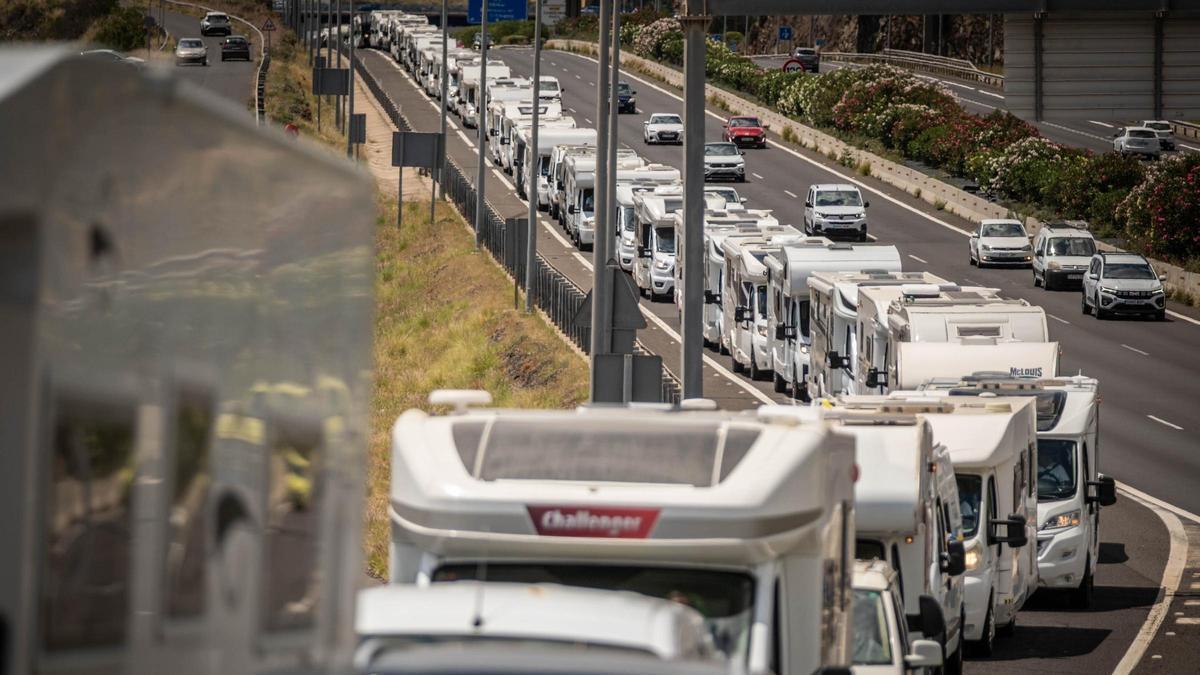
Around 400 motorhomes and approved campervans brought traffic to a standstill on Tenerife’s TF-1 motorway on Saturday morning, as part of a demonstration to highlight what members describe as discriminatory restrictions.
The Costa Adeje-Tenerife Ecologist Club Association (ACAT) organised the rally, which resulted in a miles-long queue of vehicles. It was the sight that greeted anyone heading south on the motorway on Saturday morning.
After 1pm, the convoy was moving past Santa María del Mar in the direction of Santa Cruz, having set off at 11am from the El Gomero service station in Las Chafiras.
‘Discriminatory’ restrictions
ACAT president Juan Martín explained that the aim was to once again demonstrate the group’s frustration with the restrictions its members face, which they consider discriminatory. These include parking bans, signs limiting access to cars only, height barriers, 24-hour time limits, and a lack of adequate facilities for emptying grey and black water tanks.
Speaking in the midst of the protest, Martín said everything was going “quite well”. He acknowledged that there were delays in areas such as the Rambla de los Menceyes in Candelaria, but said these were expected given the usual volume of traffic. “We have not obstructed the traffic in any way,” the association’s head stressed, highlighting the coordination with the security forces.
Hundreds gather for the cause
Forecasts for the turnout had been promising since Friday night. “255 motorhomes and they’re still coming in. Please, those arriving, make your way to the Xanadú car park,” the group wrote on social media, referring to the fact that the car park closest to the El Gomero service station had already filled up. Members spent the night there, and at 11am between 360 and 370 motorhomes and campervans began the route.
By 1pm, while already travelling along the TF-1, Martín estimated the number could reach around 400, as more participants gradually joined in areas such as Arico and Barranco Hondo. Abades and Candelaria were two of the towns the convoy passed through before reaching the capital.
The group aimed to give visibility to a message they have been trying to spread for years. Once in Santa Cruz, they planned to head up towards the Las Chumberas area, take the TF-2 link road back south, and return to the starting point.
Environmental concerns and lack of facilities
Addressing the group’s demands, Martín referred to the lack of ecological service points where motorhomes can empty and fill their tanks. “There are practically none,” he said. “That is not something we want. Firstly, because it is counterproductive, and secondly, because it is an attack on the environment.”
The absence of these facilities has a significant impact on visiting motorhomers, who naturally have less attachment to the local area. “They will empty their tanks wherever they see fit; they don’t care, and the whole community gets the blame,” Martín explained.
In his view, the authorities “do not want to see the problem or tackle it head-on”. He added: “In other words, and in Canarian parlance, they don’t want to take the bull by the horns.”
Proposals ignored and parking spaces shrinking
Martín said the association had not only complained but also proposed solutions, which had been ignored. “What they are doing now is reducing the spaces so that we cannot park,” he lamented. He explained that parking bays are currently painted at 1.8 metres wide by 4.5 metres long, while a motorhome measures 2.2 metres by 6 metres. “It is discriminatory, ugly and mean; it is a contemptible thing they are doing to the motorhome community,” he complained.
He also highlighted that the sector generates income and stimulates the local economy. He invited those opposed to motorhome enthusiasts to “go out into the street, visit the places motorhomes usually go, and ask small and medium-sized businesses.” He cited the example of Oroteanda and the eve of the latest mobilisation. “The El Gomero service station was stripped bare,” he said. “Restaurants were asking us when we would be back.”
February rally set the tone
The demonstration called by motorhome owners in February last year was similarly large, with around 350 vehicles driving along the island’s main roads to express their discontent. This Saturday’s protest was of a similar or slightly larger scale. However, their impression is that, far from improving, the situation is becoming increasingly complex and further restricting their activity.
What’s happening in the Canaries – straight to your phone
News, weather alerts and practical updates – direct from the islands, in English. We live here and know what’s going on – before the international media catch up. Everything lands on our WhatsApp channel – no middlemen, no algorithm. Curated for families, expats and travelers.

Tenerife’s Char Fuego y Brasas named 13th best steak restaurant in Europe

Gran Hotel Taoro: a foodie destination in Puerto de la Cruz

Canary Islands hotel prices rise 4.11% in September

Icod de los Vinos launches twelve self-guided routes
Four new openings shaking up Las Palmas dining scene

Tenerife faces huge tourism expansion despite moratorium calls

El Bejeque in Las Canteras adds sea to its fire

Siam Park Gran Canaria must build its own desalination plant
Fuerteventura’s biggest resort to open on 1 November