Japan sees Canary Islands as key strategic partner
The Canary Islands are increasingly finding themselves at the centre of global strategies. Japan has turned its attention to economic diversification, and within that picture, the strategic position of the archipelago has not gone unnoticed. The islands’ proximity to Africa, their historical ties with Latin America, and their status as European territory make the Canary Islands a particularly attractive platform for international outreach and economic relations.
‘Enviable geographical conditions’
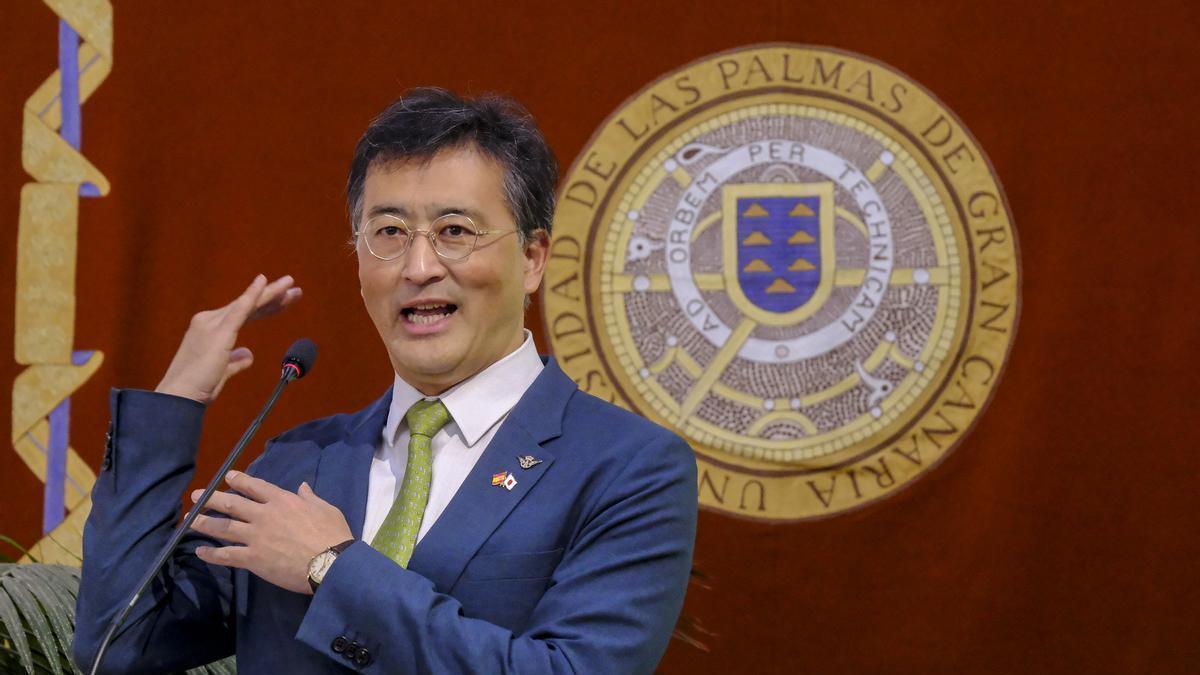
“The Canary Islands have enviable geographical conditions,” said Shinichi Sato, Minister at the Embassy of Japan in Spain, during the talk Japan facing global challenges, held this Wednesday at the University of Las Palmas de Gran Canaria. Japan’s stance on this is clear. “We are aware that the Canary Islands have significant characteristics,” the minister acknowledged.
The archipelago’s position in the mid-Atlantic, against a backdrop of growing geopolitical competition, international trade tensions, and strategic interest in West Africa, makes the islands a particularly interesting hub for economic, logistical, and diplomatic connections. Added to this is their capacity to serve as a platform for business and technology operations targeting emerging markets.
Decades-old ties
Beyond the cultural dimension and institutional relations, Japan is also seeking to reinforce this strategic vision of the Canary Islands and project the geopolitical value the archipelago can play on the current international stage. The relationship between Japan and Spain in general – and the Canary Islands in particular – goes back decades. The Japanese community has left an “indelible” mark on the islands and has helped strengthen historical ties that are now regaining relevance. Japan has established itself as one of the key players on the global chessboard.
Global security concerns
During the conference, the minister focused on issues such as international security, the role of Japanese policy in the new global landscape, Tokyo’s relationship with the United States and Europe, and the Asian country’s positioning on current international challenges. The growing weight of China and the United States on the new geopolitical chessboard is a source of “concern” for Tokyo. While Beijing accelerates its military expansion and reinforces its global influence, Japan is keeping a close eye on economic security and regional stability.
In this context, the minister explained that the Japanese government aims to build a “mutually beneficial” relationship with China, recognising the importance of the Asian giant as a trading partner and a key player in the global economy. Japan’s strategy also involves strengthening alliances with like-minded countries and deepening cooperation with the so-called Global South – a region that is increasingly gaining weight in the contest for international influence, and where territories like the Canary Islands are gaining relevance due to their strategic position.
North Korea and global security
Another major concern for Tokyo is North Korea. The nuclear and long-range missile programmes of the North Korean regime keep Japan on alert. In this context, Shinichi Sato called on Spain to reinforce international cooperation in the face of challenges which, he stressed, “are a global issue.” The diplomat also warned of the worsening international security environment and defended the idea of the “indivisibility” of security between Asia and Europe, pointing out that what happens in the European sphere can have direct “ramifications” in the Indo-Pacific region.
Japan’s historic leadership
Japan is also advancing a process of internal transformation. Prime Minister Sanae Takaichi has become the first woman to reach such a prominent position in the country – a development which, according to the minister at the Embassy of Japan in Spain, is “an unprecedented event that deserves attention.” Her motto, Making Japan prosperous and strong, sets the tone for her term and comes against a backdrop of strengthening international relations, including with Spain. Both countries are holding talks focused on technological exchange and defence cooperation.
Energy security challenge
Tokyo now faces one of its main challenges: around 90% of the oil the country consumes passes through the Strait of Hormuz, a critical point for global energy security. Faced with this dependency, Japan is seeking to strengthen its understanding with the United States: “Washington remains an important partner for Japan,” the minister stressed, referring to the need to maintain solid alliances in a context of high geopolitical uncertainty.
What’s happening in the Canaries – straight to your phone
News, weather alerts and practical updates – direct from the islands, in English. We live here and know what’s going on – before the international media catch up. Everything lands on our WhatsApp channel – no middlemen, no algorithm. Curated for families, expats and travelers.

Tenerife faces huge tourism expansion despite moratorium calls

El Bejeque in Las Canteras adds sea to its fire

Siam Park Gran Canaria must build its own desalination plant

Fuerteventura’s biggest resort to open on 1 November

Gran Canaria to teach tourism history in schools
Canary Islands see 0.3% rise in foreign tourists in August

Row over 368-bed hotel project in La Gomera

Spanish astronaut trains in Lanzarote for Moon mission

Tivoli La Caleta hosts first red tuna Kaitai in Canarias