Compiled with the help of artificial intelligence, based on Spanish-language information. Source below the article.
Safety first: new campaign for Lanzarote’s coastline
The Security and Emergencies Consortium of Lanzarote and La Graciosa has launched a new communications campaign aimed at improving safety for people on the coastlines of both islands. Produced in five languages – Spanish, English, German, French and Italian – the initiative is designed to reach both the resident population and visitors alike.
The island corporation announced the initiative in a statement, explaining that the project, officially titled Preventive communications and public awareness actions for coastal safety, self-protection and civil protection in Lanzarote and La Graciosa, brings together a series of topic-specific recommendations for prevention and response. Its aim is to reinforce the safety of people in the coastal environment of both islands.
Thirty videos for a global audience
The campaign, designed and produced by the association Adacis in close coordination with the Consortium, forms part of the wider initiative The sea unites us, give it life (El mar nos une, dale vida). It consists of 30 audiovisual spots in video format for YouTube and social media, produced and subtitled in Spanish, English, German, French and Italian. This ensures the message reaches both the resident population and people visiting the islands from around the world throughout the 12 months of the year.
The spots can be viewed on the websites of the Emergencies Consortium and Adacis, as well as via a QR code. Their distribution will be reinforced through the social media channels of the Canary Islands’ public administrations and various organisations linked to coastal and maritime activities, in addition to the tourism sector. The Spanish-language spots will also be broadcast on local television channels in Lanzarote from this August.
Six scenarios, six key safety messages
The audiovisual materials comprise six spots per language and feature recreations of a range of scenarios: beaches with signalling flags indicating sea conditions and lifeguard services; rocky coasts without flags; swimming pools, to prevent accidents involving children; and motorboat navigation, highlighting the importance of avoiding collisions with swimmers and respecting distances and speed limits.
Additional scenes are dedicated to keeping a close eye on children using inflatable floats in the sea, which can easily be carried away from the shore by the wind. The design, filming and content planning were carried out by Adacis technical staff, with supervision and cooperation from the Consortium’s manager, Enrique Espinosa, and the fire service, several of whose members took an active part in the recordings along the Lanzarote coastline.
Posters and praise from local leaders
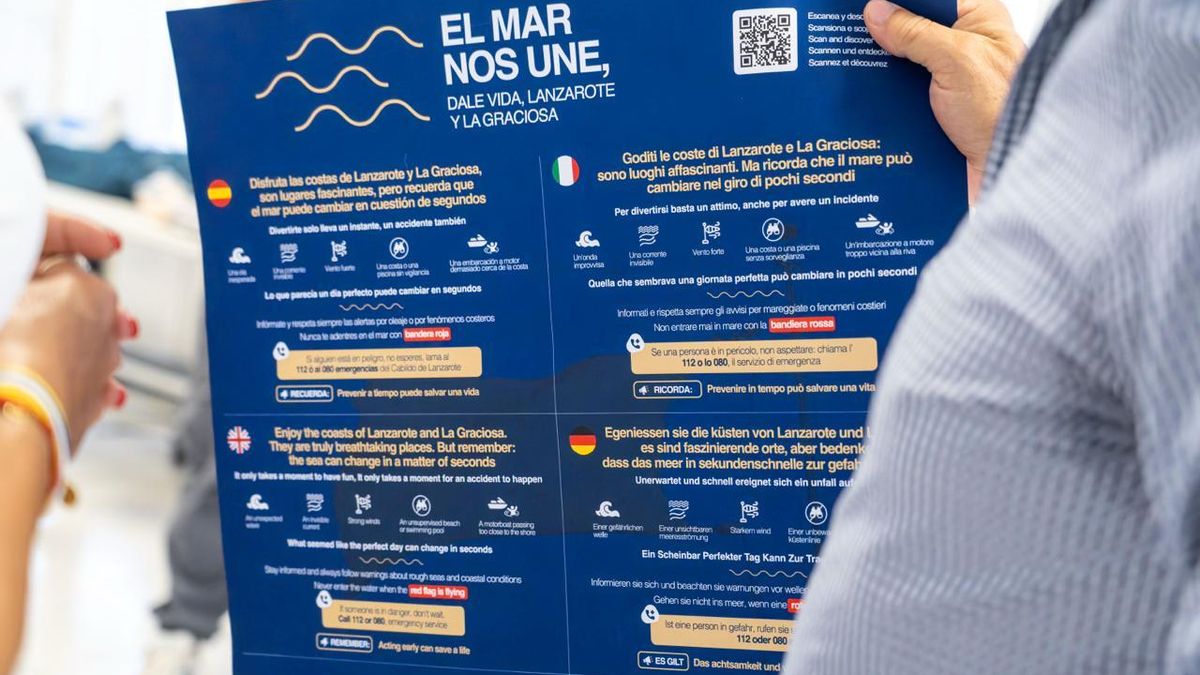
The campaign also includes a poster, likewise produced in five languages, which will be distributed in printed form at sports, cultural, educational and tourist centres across Lanzarote and La Graciosa, as well as on social media.
María Jesús Tovar, vice-president and head of the Area for Planning and Project Coordination at the Cabildo of Lanzarote, which funds the campaign through the Canary Islands Development Fund (FDCAN), highlighted the value of the initiative: “All preventive measures aimed at avoiding and reducing accidents to save lives are essential and a priority, and we will continue to work actively towards this purpose.”
Francisco J. Aparicio, president of the Security and Emergencies Consortium, noted that “Lanzarote has a highly qualified fire service of international standing, capable of carrying out rescues on the coast and at sea in adverse conditions. But, without any doubt, the most valuable and safest measure for preventing accidents is the prudence of the people themselves who come to the coast. This new campaign is precisely aimed at fostering prudence, knowledge and safety for people on the shores and in the waters of the islands.”
What’s happening in the Canaries – straight to your phone
News, weather alerts and practical updates – direct from the islands, in English. We live here and know what’s going on – before the international media catch up. Everything lands on our WhatsApp channel – no middlemen, no algorithm. Curated for families, expats and travelers.
El Bejeque in Las Canteras adds sea to its fire

Siam Park Gran Canaria must build its own desalination plant
Fuerteventura’s biggest resort to open on 1 November
Gran Canaria to teach tourism history in schools
Canary Islands see 0.3% rise in foreign tourists in August

Row over 368-bed hotel project in La Gomera
Spanish astronaut trains in Lanzarote for Moon mission

Tivoli La Caleta hosts first red tuna Kaitai in Canarias
La Laja natural pools reopen in Las Palmas