
Compiled with the help of artificial intelligence, based on Spanish-language information. Source below the article.
Renewables still a minority in Canary Islands
Some progress has been made over the past three years (2023-2025), but it is so minimal and scant that it is barely worth acknowledging. The Canary Islands continue to fall short of the long-promised revolution in electricity generation from renewable or green energy sources – namely wind, solar photovoltaic and pumped hydro – that public institutions have repeatedly heralded. Indeed, the reality remains stark: of all the electricity consumed in the archipelago last year (2025), only 21% came from green or renewable systems. The national average, by contrast, stands at 55.5%, with Spain reaching an all-time high of 56.8% in 2024.
This means that the remaining 79% of the Canary Islands’ total electricity demand – an essential and indispensable service in any society – had to be met by burning vast quantities of fossil fuels, namely diesel and gas. A clear indication of this reliance can be found in the greenhouse gas emissions attributable to this activity: the carbon footprint left behind amounted to 4.9 million tonnes of CO2 equivalent (MtCO2) in the Canary Islands last year. The equivalent figure for the whole of Spain reached 29.5 million tonnes, according to Red Eléctrica, meaning the Canary Islands accounts for 16.6% of the country’s emissions – a disproportionately high share given its population and economic potential – due to the structure of its electricity generation system, which remains far too outdated.
All of this is happening despite the substantial volume of European funds made available to the islands under the EU’s Next Generation programme. More than €1.7 billion in total has been allocated, with a very significant portion earmarked specifically for the ecological transition. These funds, received from 2021 onwards in the wake of the COVID-19 pandemic, were intended to boost, among other things, economic recovery measures and the fight against climate change in the Canary Islands. However, they have been managed with low levels of execution by the regional government, and projects financed with these EU funds (Next Generation, Recovery and Resilience Mechanism, or MRR) must be completed and justified by 31 August.
Diesel dependence on three islands
The above indicators for the Canary Islands region are contained in the annual report “El sistema eléctrico en las Islas Canarias 2025” (The electricity system in the Canary Islands 2025), published by Red Eléctrica, part of the Redeia group. The same study also reveals that three of the seven island electricity systems in the Canaries (two are interconnected: Lanzarote-Fuerteventura and, very recently, Tenerife-La Gomera) meet their demand almost entirely through massive diesel generator use, with this source covering more than 89% of final consumption on those three islands in 2025, the latest year for which data is available.
Ranked from worst to least bad, those islands were: La Palma, with 92.2% of generation from diesel; La Gomera, with 89.2%; and Lanzarote, with 88.8%. Needless to say, this outdated generation model is the most polluting of all those installed across the archipelago. It therefore bears much of the responsibility for the high levels of greenhouse gas emissions released into the atmosphere from this activity in the Canary Islands.
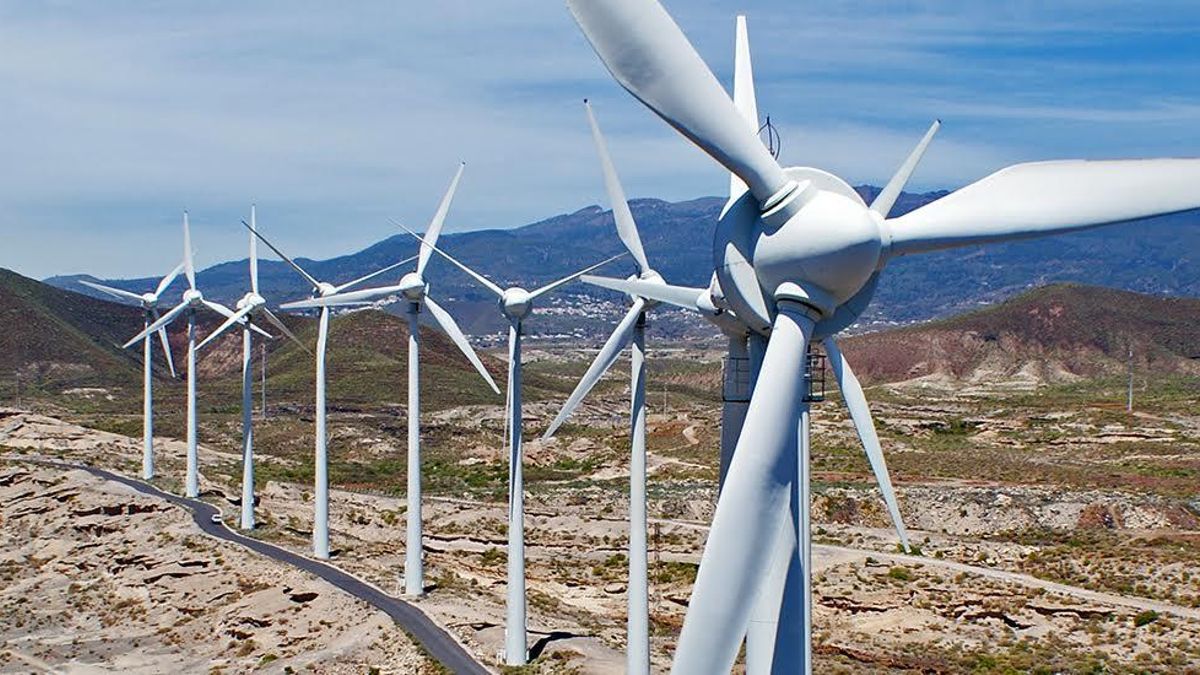
Only partly spared from this reliance, among the non-capital islands, are Fuerteventura and El Hierro. In the former case, this is thanks to installed capacity and greater penetration of wind power (though diesel still accounted for 67.4% of total generation there). In the latter, it is due to the contribution of the Gorona del Viento pumped hydro plant, which supplied 43.6% of final consumption in 2025. El Hierro even managed 178 consecutive hours last year during which the electricity used was exclusively from renewable or green sources.
The Canary Islands in the national picture
According to the same source identified above, installed electricity capacity in the Canary Islands in 2025 reached 3,438 megawatts (MW), of which 1,044 MW was renewable (30% in 2025, compared with 28.7% in 2024 and 27% in 2023). The remaining 2,395 MW came from non-renewable or conventional traditional systems. Installed capacity for electricity generation from green energy grew by 7.4% in 2025 compared with 2024, according to Red Eléctrica.
However, despite the increase in installed green energy capacity and for a variety of reasons, non-polluting generation only managed to cover 21% of total electricity consumption in the Canary Islands in 2025 (15% wind, 5% solar photovoltaic, 0.3% hydro and 0.8% from other renewable sources). This was slightly higher than in 2024, when the figure reached 20.8%, and was two percentage points above the 2023 threshold of 19%.
Total electricity generation in the islands last year stood at 8,998 gigawatt-hours (GWh), of which 1,889 GWh came from renewable sources. This overall generation figure represented 3.5% of Spain’s total, while the Canary Islands’ installed capacity accounted for 2.5% of the national register. In terms of installed capacity, the Canary Islands ranks 13th in Spain according to the 2025 classification by autonomous community, ahead of the Valencian Community, Cantabria, the Basque Country and the Balearic Islands, which bring up the rear. When it comes to electricity generation from green sources, however, the situation is far worse, with the islands placed third from bottom, better only than the Basque Country and, once again, the Balearic Islands at the foot of the table.
Tenerife recorded the highest electricity demand in the Canary Islands in 2025, accounting for 40.2% of the regional total, followed by Gran Canaria on 37.6%, Fuerteventura on 9%, Lanzarote on 8.8% and La Palma on 2.9%. Electricity consumption across the entire region grew by 1.1% last year compared with 2024.
What’s happening in the Canaries – straight to your phone
News, weather alerts and practical updates – direct from the islands, in English. We live here and know what’s going on – before the international media catch up. Everything lands on our WhatsApp channel – no middlemen, no algorithm. Curated for families, expats and travelers.

Canary Islands sea hits second-hottest year on record

Legal bid to halt tree felling in Santa Cruz’s La Salud

Fiesta del Charco: A journey through La Aldea’s past

Corralejo dunes power line set for removal

ULPGC launches 14 research projects at Las Canteras

TMT will never be built, says Canary Islands astrophysics chief

Pedro Duque: Canarias is the “ultimate dream” for rockets

Court blow to Tenerife motor circuit project
La Palma faces new volcanic risk planning deadline
