It is neither the first time it has happened in recent years nor does it seem likely to be the last. The Canary Islands have, would you believe it, become a market of interest for potato producers in Israel, all thanks to distributors of local produce who also import the same product having spotted a great opportunity to do business – perhaps very good business – at the expense of the fresher, local supply; in other words, produce from closer to home, but, of course, almost always at a slightly higher price. And that is precisely what is happening once again.
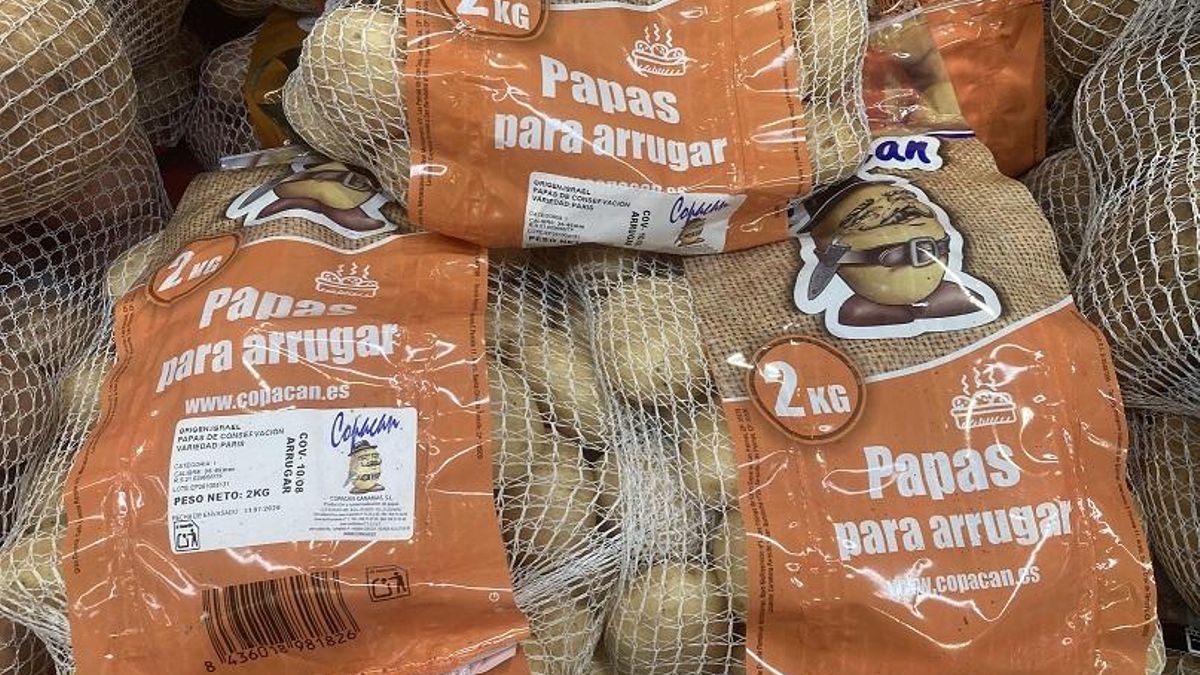
Israeli spuds labelled ‘para arrugar’ on sale in Hiperdino
These days, it has become common to find bags of potatoes of Israeli origin in certain supermarket chains, for example Hiperdino (it has also happened with Mercadona, Lidl and other platforms on previous occasions in the Canaries), with the prominent designation “para arrugar” – that is, the variety with a medium calibre or size: the ones you eat in one go, or in two portions. In the case in question, the local importer is one of the usual suspects when it comes to activating these wholesale sales to supermarkets across the islands. Its name is Copacan, but don’t be fooled – it is not the only one doing it. Previously, for the record, the company Cadimisa has also played that role, marketing both local potatoes and those from abroad, including those of Israeli origin. What is most disconcerting about Cadimisa, which is linked to the Casmi group, is that it is led by Ángela Delgado, who is in turn the president of the professional agricultural organisation (OPA) Asaga-Asaga.
If these days you, the consumer, happen to pop into one of the outlets of the Hiperdino network, for example the Superdino on Las Ramblas in Santa Cruz de Tenerife (the photo accompanying this report was taken there this Monday), you will be able to choose to buy the key raw ingredient for what is perhaps one of your favourite dishes of Canarian cuisine: papas arrugadas with mojo sauce. So far, so good. But if you are swayed by the label on the bags suggesting the potatoes are theoretically best suited to tackling that delicacy, don’t be guided by that message or the final price – instead, read and examine the label carefully before you buy: what you will be taking home will be potatoes for wrinkling that are of Israeli origin, meaning you will end up with a plate of Israeli wrinkled potatoes with mojo. That does not add up well at all.
Local potato ‘the laughing stock’ of supermarket aisles
This is what it has come to in these islands, where the local potato has become the laughing stock of the tuber offering in supermarkets. Perhaps the most dramatic thing of all is that these commercial operations, in this case by the company Copacan, are justified on the grounds that the local potato supply is failing – which is not currently the case in general terms – or, more sophisticatedly, that there is local produce available, but it is difficult to get hold of the right calibre for wrinkling. In Israel, apparently, this is very easy. The ideal calibre is the usual size requested for cooking and wrinkling potatoes: boiling them with plenty of coarse salt, checking they are cooked, draining off the boiling water and drying them over the heat for a little longer, until the skins wrinkle with a good crust of salt.
Snobbery or surrealism?
Currently, many retail food outlets can offer Canarians, mainland Spaniards and foreigners bagged potatoes for wrinkling – a culinary hallmark exclusive to the islands – but this time made with produce brought in from Israel, in case anyone fancies such an exquisite proposal. You will find them on sale in outlets across all the islands, and the price per kilo is not bad at all when compared with others on offer right next to them, these ones properly dug from Canarian soil on the island of La Palma. The former, bagged in two-kilo packs, cost €3.65 a bag; that is, €1.80 per kilo. Meanwhile, the local ones, which do not carry the designation “para arrugar” (wherever have you seen that?), cost €2.72 per kilo. The difference is almost a euro per kilo. Which one do you think most buyers – those who barely stop to check the label or simply have to pay less – would choose?
The figures speak for themselves: local cultivation in decline
Israeli potatoes continue to be sold in the Canary Islands hand over fist, whether or not there are local potatoes available, and these imports are carried out by the very same operators who sell seed to local farmers, the same ones who market their potatoes almost always with healthy commercial margins, sometimes more than others – and some of whom even have the job of defending the agricultural interests of the islands. “What does it matter,” they will think, “since nothing ever happens!” And they are right. Although, on reflection, perhaps something is happening: the fact is that potato farming in the Canary Islands, as with so many other agricultural and fishing activities in the islands, is going backwards, which is what the official records of the regional Ministry of Agriculture itself say. Its minister, Narvay Quintero (AHI), pointed out, not all that long ago, that he has his doubts about the quality of the potatoes arriving from Israel because of the use of phytosanitary products there.
There you have it: the local potato in free fall
Yes, the local potato continues its free fall, as the most recent official statistics available show. In the period 2013–2023, over ten years, Gran Canaria has lost a staggering more than 1,000 hectares of this crop, falling from 1,727 hectares in 2013 to 668 in 2023, according to figures published by Istac. That is the sharpest decline in the Canary Islands, something also evident on islands such as La Palma, Lanzarote and La Gomera. On El Hierro and Fuerteventura, areas with a low impact on the regional total – as are also the islands of Lanzarote and La Gomera – the area devoted to the crop has held up over the same period. The regional trend is not even worse thanks to the fact that Tenerife, which is also melting away, has not suffered the same pounding as Gran Canaria.
Tenerife, the islands’ largest producer, has seen its area under potato cultivation fall from 2,711 hectares in 2013 to 2,257 in 2023, a loss of more than 500 hectares of agricultural land for that product. Despite the shrinking of the blanket that keeps this crop warm, with 37% of the cultivated area in the islands abandoned over ten years (which has a major impact on the landscape of the northern mid-altitude zones, where the crop, rain-fed, is not easily replaceable and has always been most established), production harvested between the 2013 and 2023 extremes – something highly dependent on weather conditions and other factors, such as the impact of pests and other plant health problems – has fallen by 25%, from 105 million kilos of local potatoes in 2013 to 78 million in 2023, again according to Istac figures.
What’s happening in the Canaries – straight to your phone
News, weather alerts and practical updates – direct from the islands, in English. We live here and know what’s going on – before the international media catch up. Everything lands on our WhatsApp channel – no middlemen, no algorithm. Curated for families, expats and travelers.

Canary Islands approves new €1.6bn development fund

Mogán mayor says her €65,000 salary is too low

Abandoned cars in Canary Islands: hundreds left to rot

Work resumes on 27 affordable rental homes in Las Palmas

Los Realejos residents fight on against propane gas plant

Canarias among Spain’s poorest regions as 36.2% live on low incomes

Canary Islands bananas lose ground to imported bananas

Canary Islands bottom of Spain’s social housing table

Three migrant boats reach Canary Islands in 24 hours