Compiled with the help of artificial intelligence, based on Spanish-language information. Source below the article.
The Cabildo de Gran Canaria’s Department of Public Works and Infrastructure, Architecture and Housing, headed by Vice-President Augusto Hidalgo, completed the main waterproofing works on the Guiniguada viaduct on the Las Palmas de Gran Canaria ring road (GC-3) on Monday afternoon. This has allowed the southbound carriageway of this key artery in the island’s road network to open to traffic in full.
Thirteen days ahead of schedule
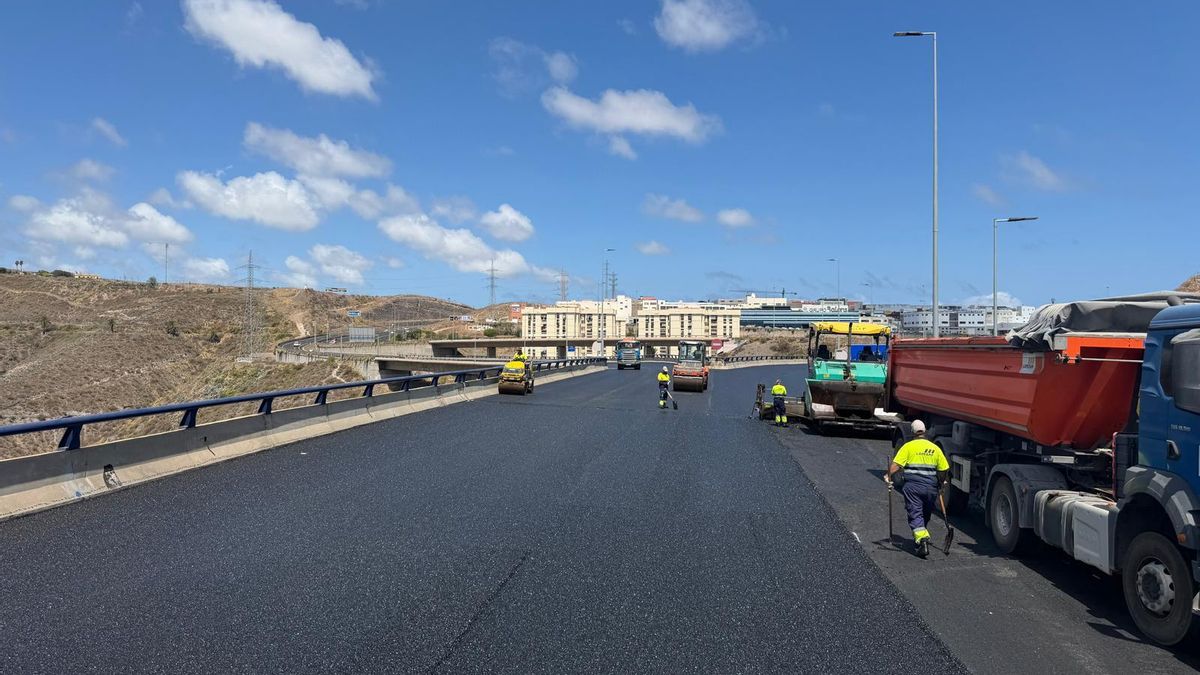
The structural waterproofing works were carried out in just 16 days, against an initial forecast of 29 days—13 days ahead of the original completion date of 30 August. In the final session of work, which took place on Monday morning, the last layer of asphalt—the wearing course—was laid using three paving machines simultaneously, with white road markings painted on before the closure was lifted and vehicles from the north heading south were allowed through.
This final layer of pavement is made from a special micro-aggregate that drains rainwater far more quickly than standard asphalt. The department led by Augusto Hidalgo highlighted that the effort and dedication shown by the technical teams from both the Public Works department and contractor Lopesan, along with all the workers involved in the waterproofing project, meant the northbound carriageway of the Guiniguada viaduct—the first to be tackled—was open to traffic in just seven days, with the southbound direction completed in nine days instead of the 15 originally planned for each carriageway.
Over 20,000 square metres of waterproofing membrane
The waterproofing works on the two decks of the Guiniguada viaduct involved laying more than 20,000 square metres of bituminous membrane across both carriageways, using around 300 bottles of propane gas to weld the membranes together. The department says this technology will guarantee the infrastructure remains watertight and prevent water seeping into the interior of the box girder and its steel tendons, as happened a few years ago when these tendons snapped.
Before the waterproofing could begin, Lopesan workers first milled (scraped) away 10 centimetres of the old asphalt, down to almost the concrete structure of the bridges. Over the 16 days of work, 1,650 cubic metres of old asphalt were removed from the two decks, requiring 138 lorries to transport the waste to a treatment plant. Once the waterproofing membranes had been laid, the final asphalt surfacing of the two bridge decks was carried out in two layers: an intermediate layer and a wearing course of micro-aggregate.
Northbound carriageway to receive final surfacing at night
For the northbound carriageway, it was decided to asphalt it and reopen it with just the intermediate layer so as not to delay the return to traffic in that direction, which is why the road markings on this carriageway are painted in yellow. In the coming weeks, night-time works will apply the micro-aggregate wearing course to this carriageway. In total, more than 18,000 square metres have been waterproofed across the two decks that make up the Guiniguada viaduct—work completed in record time, as these operations usually take considerably longer.
Remarkably, this is the first time the viaduct has been waterproofed, despite being in service for over 20 years. The work forms part of a wider project to resurface 11 kilometres of the GC-3 ring road, awarded by the Public Works department last year for €18,722,343 and carried out at night over several months. The waterproofing corresponds to Lot 2 of this project, undertaken by Lopesan Asfaltos y Construcciones, with €2.2 million of the total budget allocated to these works alone.
The resurfacing works along nearly the entire Las Palmas de Gran Canaria ring road will continue in the coming weeks, but will be carried out at night to avoid disrupting traffic, with completion expected next November.
TIME CONTEXT: Original article publication date: 2026-08-17T21:50:05.072Z Current date: 17 August 2026, MondayWhat’s happening in the Canaries – straight to your phone
News, weather alerts and practical updates – direct from the islands, in English. We live here and know what’s going on – before the international media catch up. Everything lands on our WhatsApp channel – no middlemen, no algorithm. Curated for families, expats and travelers.
Canary Islands international air arrivals fall 1.3% in September
Helicopter evacuates US cruise passenger near Tenerife
El Hierro airport sees 3.6% rise in September passengers
Gran Canaria approves €509k works to shore up GC-200 slope
Canary Islands gets €47.5m for free public transport in 2026
Canary Islands airports see 0.9% fall in September passengers
El Rejo road in La Gomera to close for six hours on Tuesday
Man, 65, seriously injured in GC-1 crash in Agüimes
Las Palmas traffic changes for emergency sewer works