A new direction for Canary Islands tourism
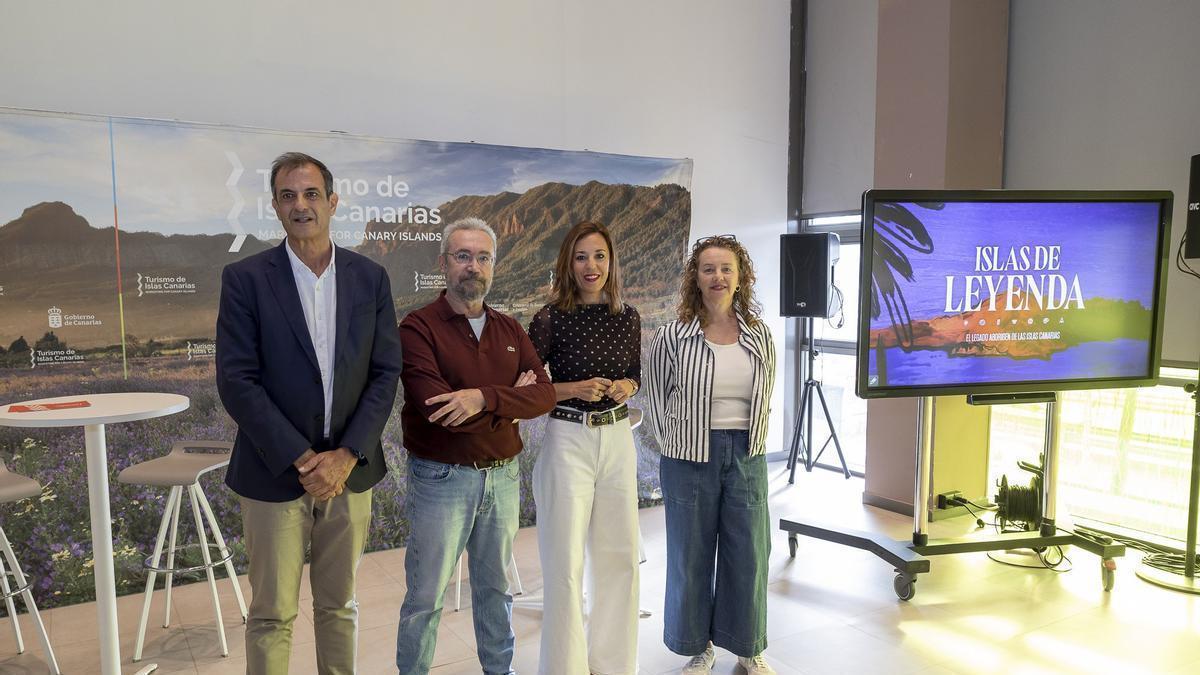
Canary Islands Tourism has launched an international campaign that champions the archipelago’s heritage and identity through its aboriginal legacy as a unique selling point for the destination. Under the banner ‘Islands of Legend’, seven animated short films inspired by aboriginal folklore bring together stories deeply rooted in the islands’ cultural imagination and collective memory, all reinterpreted through a contemporary lens.
According to the regional Ministry for Tourism and Employment, its head, Jéssica de León, presented the initiative alongside the managing director of Canary Islands Tourism, José Juan Lorenzo; the director of Product Promotion, Corporate Communication and Crisis Management for the public body, Mónica Palacios; and sociologist and journalist Yuri Millares, one of three experts who ensured the content’s accuracy.
“There is often a perception that our efforts are limited to promoting the sun-and-beach segment, but we have been demonstrating for some time now that this is not the case,” said De León. “We are continuing to work on what makes us unique, reinforcing our traditional attributes while positioning our culture and heritage as distinguishing features of the Canary Islands for the world.”
Cultural tourism on the rise in Europe
In Europe, cultural tourism now accounts for 40% of demand and is on an upward trajectory. The typical cultural traveller is an adult, predominantly aged between 30 and 65, with a medium-to-high educational level and a strong interest in the history, craftsmanship, gastronomy and culture of the places they visit.
Meanwhile, managing director José Juan Lorenzo stressed that this campaign “is not an isolated action, but the result of an evolution that has culminated in a milestone: the inclusion within the ‘Canary Islands Destination 2025-2027 Strategic Plan’ of the Protection and Conservation of Heritage, which is closely linked to another major and structural innovation – the importance we are giving to Canary Islands citizens in defining our model.”
He added: “Both tourists and residents are showing a growing interest in valuing the historical and cultural heritage of the Canary Islands, so carrying out actions for the preservation and regeneration of our tangible and intangible legacy is essential to maintaining and enhancing the essence of our destination.”
Seven legends, seven islands
‘Islands of Legend’ is structured around seven one-minute audiovisual pieces that reinterpret iconic myths from the archipelago using contemporary animation techniques and high-impact visual language. Each episode focuses on a different legend: the Garoé Tree (El Hierro), the Demon of Echeyde (Tenerife), the Giant of Mahán (Fuerteventura), the Cuesta de Silva (Gran Canaria), Gara and Jonay (La Gomera), Princess Ico (Lanzarote) and the Wall of Roberto (La Palma).
Mónica Palacios, director of Product Promotion, Corporate Communication and Crisis Management at Canary Islands Tourism, said they were always clear they did not want to produce a conventional campaign, “but rather to develop content with value in its own right. Content capable of generating genuine interest and connecting with audiences who today consume culture, entertainment and visual storytelling on digital platforms.”
Canary Islands Tourism defined which stories they wanted to tell and how to tell them, “for which we sought a balance between local authenticity and international projection, incorporating artists linked both to the archipelago and to some of our main source markets,” said the director.
A feast for the eyes and ears
A total of illustrators and creators are involved in the project, including Carla Garrido, Sara Herranz, Paulina Mocna, Ann Bahrs, Ciara Quilty-Harper, Nicolás Marsá and the studio Dedo Ciego. Each short film employs a different technique and aesthetic, while the entire collection maintains a common narrative identity.
The project also places particular emphasis on its sound dimension, with an original score incorporating traditional instruments such as the pito herreño (a type of flute from El Hierro) and voiceover in a Canarian accent for the Spanish market. Following the same logic of care and rigour, the project also involved extensive documentary and cultural advisory work to accompany the entire creative process and ensure a respectful connection with the imagination and identity of the islands.
To this end, Canary Islands Tourism enlisted journalist and sociologist Yuri Millares, archaeologist and historian Verónica Alberto, and Doctor of History Javier Velasco.
What’s happening in the Canaries – straight to your phone
News, weather alerts and practical updates – direct from the islands, in English. We live here and know what’s going on – before the international media catch up. Everything lands on our WhatsApp channel – no middlemen, no algorithm. Curated for families, expats and travelers.

Tenerife faces huge tourism expansion despite moratorium calls

El Bejeque in Las Canteras adds sea to its fire

Siam Park Gran Canaria must build its own desalination plant

Fuerteventura’s biggest resort to open on 1 November
Gran Canaria to teach tourism history in schools

Canary Islands see 0.3% rise in foreign tourists in August

Row over 368-bed hotel project in La Gomera

Spanish astronaut trains in Lanzarote for Moon mission

Tivoli La Caleta hosts first red tuna Kaitai in Canarias