
Compiled with the help of artificial intelligence, based on Spanish-language information. Source below the article.
A chronicle that has stood the test of time
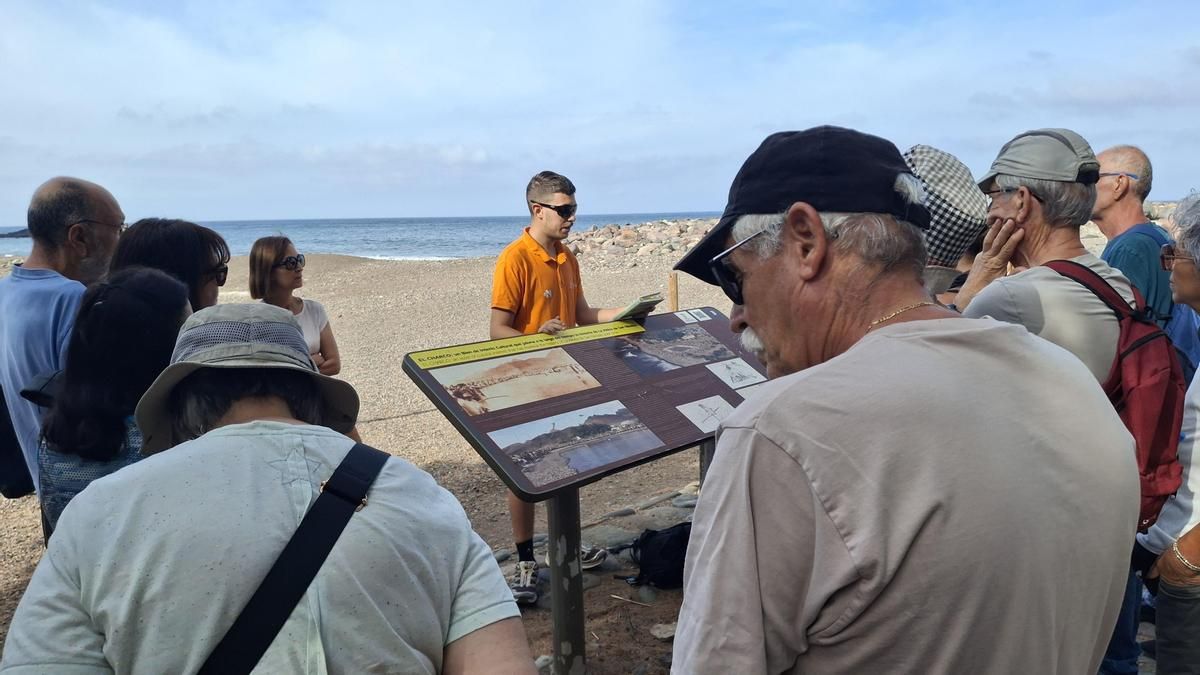
“Yo salí loco” — “I came away mad”. With that short phrase, Víctor Grau Bassas documented the Fiesta del Charco in La Aldea de San Nicolás in 1887, leaving behind a celebrated chronicle in which he summed up his experience of the event. Now, 139 years later, on 15 October, the historian David González, a guide on the routes organised by the island council’s Historical Heritage service, read out fragments of that article, in which the first curator of El Museo Canario captured the hubbub, the freshness and the sheer singularity of the celebration. At the cry of “¡al Charco!” — “to the Charco!” — the mayor of this town in western Gran Canaria would invite his fellow citizens to fish for mullet, echoing in some measure the embarbascada, the technique practised by the ancient Canarians to stun fish.
La Marciega, one of the best-preserved wetlands in the islands
David González enlightened those who joined this route about the cultural landscape of La Aldea from a gentle promontory affording a full view of the famous charco, the setting for one of the most popular festivities in the archipelago’s calendar of cultural and leisure events. It lies in La Marciega, one of the best-preserved wetlands in the islands, with an interesting diversity of waterfowl, endemic reptiles and an extensive forest of tarahales. From that same spot, much of the mountain terrain surrounding a municipality that holds a geological biodiversity unique in the Canarian context can be taken in, with rocks 14 million years old.
Standing on the bed of a charco that vanished thousands of years ago
Less than a hundred metres from the famous Charco, in the very delta of the La Aldea ravine but not in its current course, we stopped because González, our well-documented guide, explained that we were standing beside a palaeontological site around one and a half million years old. Some of the walkers knew of its existence, but the historian surprised us when he revealed that we were treading the bed of an ancient charco that disappeared for natural reasons thousands of years ago. La Marciega is a coastal wetland that allows us to understand the close relationship between water, the ravine, the coast and the communities that have inhabited this territory — a space closely bound, as Grau Bassas described, to La Aldea’s most representative celebration, which takes place in its waters every 11 September.
Los Caserones, one of Gran Canaria’s great indigenous settlements
The route then led us to the Los Caserones site, one of the great indigenous settlements known on Gran Canaria. The village came to spread across both banks of the mouth of the ravine. Historical and archaeological sources speak of hundreds of structures, including dwellings, communal spaces and funerary structures, which allow us to imagine the scale this place once reached. At the end of the 19th century, Víctor Grau Bassas counted close to 800 structures in this area. It is precisely at this archaeological complex that a new excavation campaign is being carried out, directed by Efraín Marrero, co-director of the company Prored. The archaeologists will remain at the site until the end of November.
Ceramics, stone tools and evidence of contact with Europeans
It was a privilege to hear first-hand about the richness of this site and the work currently under way. One of the tasks is to survey a large plot of land recently acquired by the island council. The archaeologists showed those taking part in the route fragments of pottery and stone tools found in this latest campaign; they also explained the typologies of the ancient aboriginal dwellings, with cruciform structures — the most abundant at coastal sites on Gran Canaria — and circular ones. In one of those rounded units, evidence has been found of contact between Europeans and the local populations in the final stage of the ancient Canarians’ culture.
Dating the settlement
Caserones was inhabited during the last centuries of the indigenous period. Recent radiocarbon dating confirms that it was populated in the 14th century. There are other, older dates, though less reliable as they were obtained from charcoal — the dating of bones and seeds is far more precise — which place the complex from the 8th century onwards. The results of this new excavation will continue to shed light on the first inhabitants of this part of the island.
What’s happening in the Canaries – straight to your phone
News, weather alerts and practical updates – direct from the islands, in English. We live here and know what’s going on – before the international media catch up. Everything lands on our WhatsApp channel – no middlemen, no algorithm. Curated for families, expats and travelers.
Canary Islands sea hits second-hottest year on record
Legal bid to halt tree felling in Santa Cruz’s La Salud

Corralejo dunes power line set for removal

ULPGC launches 14 research projects at Las Canteras

TMT will never be built, says Canary Islands astrophysics chief

Pedro Duque: Canarias is the “ultimate dream” for rockets

Court blow to Tenerife motor circuit project
La Palma faces new volcanic risk planning deadline

Fuerteventura launches campaign to rescue young shearwaters
