Compiled with the help of artificial intelligence, based on Spanish-language information. Source below the article.
Five years buried under ash and red tape
On 19 September 2021, Eva had to leave her home because a volcano had erupted just a few kilometres uphill. Five years later, although her house was ultimately spared by the lava, she is still living in a container. What has gone wrong in La Palma that 110 families have been unable to rebuild their lives?
A home buried by pyroclastic rain
Rayco, who lived in the centre of Todoque, has bought a plot with a barn to renovate in Mazo, 50 minutes from his old home. “Every time I want to socialise I have to cross half the island. If I lived in the west I would feel more at home, that’s where I grew up, but everything there is outrageously expensive.”
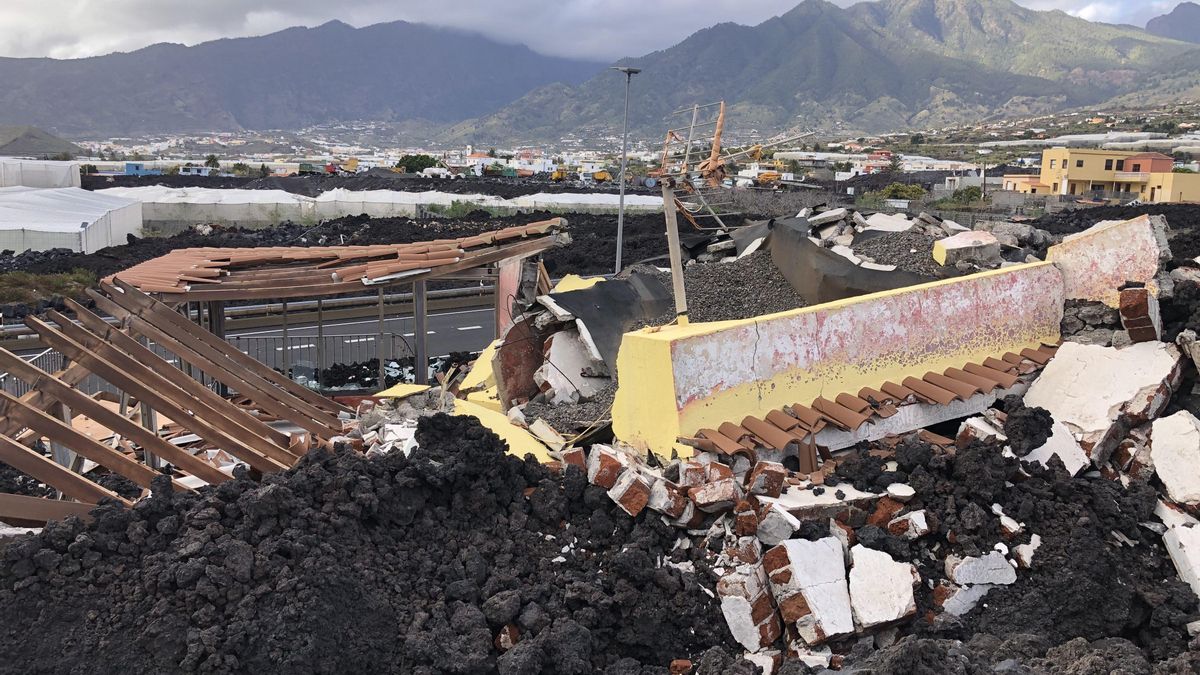
Vicente used to go into his house every week to sweep away ash. He wasn’t sweeping the floor, he was sweeping the roof: his home had been completely buried by the fall of pyroclastic material. He would clear the ash, knowing that after he left, his house would be covered again. “One day I arrived and realised there was no longer a house. I had to uncover it myself. I had to dig it out.” Vicente would leave sticks poking out of the chimney so that, on his return, he knew where to start digging again and could keep sight of the house beneath its blanket of ash.
1,600 homes lost beneath black rock
The Tajogaite volcano marked its fifth anniversary on 19 September, but not all of the island’s families have been able to recover their homes. In total, the lava took 1,600 houses and two entire neighbourhoods – El Paraíso and Todoque – which remain buried beneath a layer of black rock. For each affected home, Spain’s central government has granted aid of 60,000 euros, the Canary Islands government a further 30,000, and the island council (Cabildo) another 10,000. Those who had their homes insured have been able to receive the value of their property from the insurance consortium. But to receive all of this, the essential requirement is having a house.
The problem of homes that never existed on paper
And on paper, many of those affected did not have one. How is that possible? In La Palma, where the minimum wage is the norm and most of the land is not zoned for development – meaning what is available is expensive – many residents build their homes little by little over the years, starting from small farm outbuildings on a plot or on rustic land. And they never get around to legalising the dwelling. Some might call it cunning. For many, it is necessity. In this context, many people have been unable even to prove they were affected by a volcano, because they did not officially live in the area.
In La Palma, the volcano did not just take four walls. It took years of effort spent building a house, stone by stone, and it took away the neighbours who had helped to build it. Because when labour is expensive, on La Palma communal work gains ground and it is the community that helps with the construction.
When the lava divided neighbours as well as land
Five years ago, the volcano took the walls, but it also separated neighbours. These are not isolated cases; they represent one of the main problems of this eruption and explain why, five years on, 110 families are still living in the “barracks” that were built as supposedly temporary measures.
Life in these containers is not easy: those who live there now used to live, before the volcano, in a single-storey house with its vegetable garden and animals. The containers measure around 50 square metres and are located in a car park. In the town of Los Llanos, residents complain about the lack of soundproofing and insulation, both against the cold and the heat. Eva says she cannot feel the container is a home because “I’m not in my own environment, because I can’t move around. From here to the sofa, from the sofa to the bed, from the bed to the sofa. I don’t go out, because everyone out there has their ear pressed to the wall.”
Another difficulty those affected are facing is adapting to a way of life that does not match their customs. “We lived among families and got on very well with all the neighbours,” say two sisters from La Laguna, a neighbourhood that was partially lost. In the affected areas, it was most common to live in places with a vegetable plot or garden, which contrasts with the cramped space of a container. “Fruit trees, orange trees, orchids. We had everything. We were used to living in single-storey houses. And that is beneath the volcano.”
Eva concludes: “A container is not meant for people to live in. It’s made of sheet metal. Sheet metal is meant for putting furniture and animals in, and we are not that.”
Who counts as a volcano victim?
Affected residents have been able to build legally on rustic land. But who is considered a victim of the volcano? Therein lies another of the great problems. Rayco does not consider himself a victim for legal purposes, since his house was in his parents’ name. As a result, he has not been able to access the aid and the building permits offered by the authorities. The same applies to those who, after the death of the original owner, did not update the land registry. If the owner of the home is deceased, their heirs – children, above all – have been unable to receive aid for the loss of the house, even though they were registered as living there.
Vicente took three years to be recognised as affected. His house is still standing, although it was buried beneath the ash. “The value of what was lost under the lava has been paid. But what about these homes that are damaged, with cracks, no walls, no services…? For this there has been no provision at all.” Vicente cannot live in his house, because no road, water or electricity has yet reached his neighbourhood in Las Manchas. It is a neighbourhood still buried in ash. Only a few homes, like his, rise above the black desert.
Bureaucratic violence: paying to rebuild on your own land
Many residents denounce bureaucratic violence. “You go to the town hall and it’s nothing but problems. As if you weren’t affected, you know?” says Esther, who lost her house on the last day of the eruption and wanted to rebuild on the lava, on her own property. “To build, I had to ask to be removed from the exclusion zone. They removed me, then put me back in, without giving any explanation. We asked permission to level the ground, to remove the lava. They even charge you for the permits to level the land. On top of paying the digger operator, the town hall charges you too. It’s nothing but problems.”
A suitcase that never gets unpacked
It is hard to feel at home where it is hard to build a life project. Uncertainty has flooded the lives of residents, and questions such as “how long can I stay in the container?”, or “when can I start rebuilding my house?” swirl in their minds. “Neighbours who were born there, grew up there, and suddenly your whole root… what happens to all that part that disappears and leaves no trace?” recounts Belqui, whose house in the Tajuya neighbourhood was saved by a hair’s breadth.
The volcano took, in just 85 days, what for many residents represented 30 years of work. And it took away, in addition to that effort, and in contrast to it, their rest. Because a home is also being able to come back and lie down on the sofa, knowing that no one and nothing will interrupt that moment. For five years, the affected residents have passed through many locations, but none of them long-term, and none where they could rest fully. Rooms in shelters, containers, relatives’ houses and temporary rentals have made up some of the solutions offered to residents. But always carrying a suitcase on your back, it is difficult to build a home.
All of these testimonies and feelings feature in the podcast Hogar de Cenizas (Home of Ashes), by Canarias Ahora and elDiario.es.
What’s happening in the Canaries – straight to your phone
News, weather alerts and practical updates – direct from the islands, in English. We live here and know what’s going on – before the international media catch up. Everything lands on our WhatsApp channel – no middlemen, no algorithm. Curated for families, expats and travelers.

Canary Islands approves new €1.6bn development fund

Mogán mayor says her €65,000 salary is too low
Abandoned cars in Canary Islands: hundreds left to rot
Work resumes on 27 affordable rental homes in Las Palmas
Los Realejos residents fight on against propane gas plant
Canarias among Spain’s poorest regions as 36.2% live on low incomes

Canary Islands bananas lose ground to imported bananas
Canary Islands bottom of Spain’s social housing table

Three migrant boats reach Canary Islands in 24 hours