
Compiled with the help of artificial intelligence, based on Spanish-language information. Source below the article.
Tourists unaware they are in a protected reserve
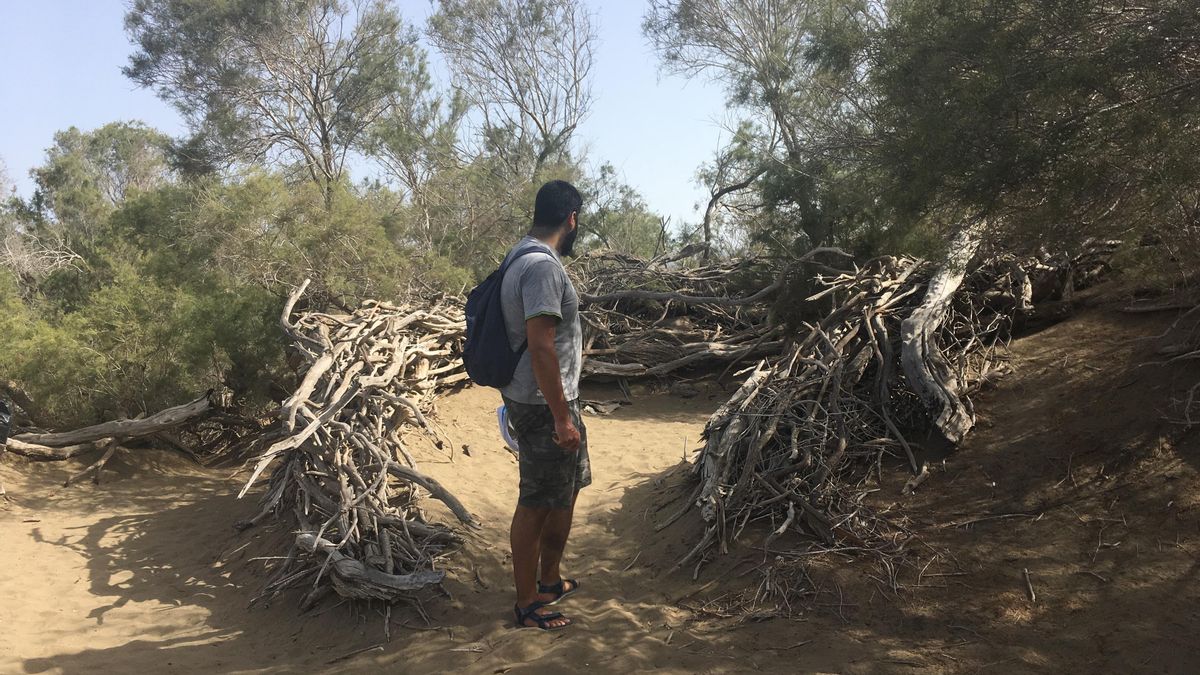
In April and May 2018, researchers from the University of Las Palmas de Gran Canaria (ULPGC) went to the protected Maspalomas dunes in the south of the island to ask tourists who were stepping beyond the reserve’s boundaries why they were doing so. Their aim was to understand the psychology, motivations and justifications of those who were causing damage to the area, and to measure their ecological awareness. The results were, to say the least, revealing: 78.2% of those surveyed (101 in total) did not know they were inside a protected Special Nature Reserve. Only 40.6% were aware that rules existed, and 62.4% did not know about the Interpretation Centre.
What is more, many visitors were adamantly opposed to paying a fee for the conservation of the dunes. Of the 28 who justified their refusal in writing, 60.7% said that nature is free and public and that access should therefore be free of charge; 21.4% argued that a fee would be detrimental to local tourism; and 7.14% warned they would not return to the dunes if they had to pay.
Restoration efforts undermined by lack of round-the-clock surveillance
That same year, also in 2018, ULPGC researchers mapped 298 points within the reserve where waste had accumulated or endemic vegetation had been destroyed. The Masdunas project, run by the Cabildo of Gran Canaria, managed to restore 295 of those sites and removed just over 2,000 cubic metres of plant debris between 2019 and 2023. But although the areas flagged in 2018 were almost fully recovered, the impossibility of maintaining round-the-clock surveillance has led to new pockets of degradation appearing in previously untouched areas and in the busiest zones.
All of this means that the Special Nature Reserve of the Maspalomas dunes is a reserve on paper only, according to a study published in the Journal of Outdoor Recreation and Tourism. The research shows that prohibited activities which destroy habitats continue to take place inside the space on a regular basis and that, despite the measures deployed to curb its deterioration, solid decisions involving all stakeholders are needed.
Visitors organise on social media to dodge surveillance
“Despite having removed some shelters, we have seen that people are still organising (through social networks and websites) to get into the reserve when there is no surveillance. This means that, even if there is a commitment to conserving the space, you cannot change people’s mentality from one year to the next or even in five years. That can only be achieved with a daily bombardment,” explains Carolina Peña-Alonso, researcher with the Institute of Oceanography and Global Change at ULPGC and lead author of the publication.
The research highlights several factors that complicate the protection of the dunes. One is the difficulty of educating a tourist population that stays in the islands for an average of a week. A visitor may become more aware during their stay, but that awareness does not necessarily last. The educational effort loses its effect when they get on the plane back home. And so it goes with the more than two million tourists who visit Maspalomas every year.
“Some foreign tourists also display a kind of sense of ownership when they build shelters in the reserve,” says Peña-Alonso. On numerous occasions, offenders were regular visitors who seemed to feel empowered by the knowledge that their actions would have no legal consequences, given the limited presence of security staff in Maspalomas. Many were aware, the article continues, that fines would never be collected once they returned to their home countries.
Business model accused of treating dunes as a ‘mere advertising showcase’
The study points the finger directly at the area’s business model for using the dunes as a mere advertising showcase to attract millions of visits without assuming barely any responsibility for their conservation. It also laments the clash of responsibilities between the different administrations in charge of managing the space, a situation that is compromising the survival of the dune system.
Peña-Alonso explains that for the dune system to function, the wind must push sand from the beach inland. “But if the machinery continues to be used to smooth the beach every day, and rows of sunbeds, umbrellas and the like continue to be installed, the entry zone is not in good shape, and that stops the sand from circulating.” Added to this is the mass construction of hotel complexes and roads that completely encircle the northern edge of the ecosystem. These structures have blocked the natural wind dynamics and have continued to hinder the movement of sand inland.
Coastline has retreated more than 100 metres
Peña-Alonso stresses that there is ever less sand reaching the dunes, while the range of intensive activities around them (and even inside them) has not ceased. She points out that in the Maspalomas area, the coastline has in fact already retreated more than 100 metres in recent decades. “We have unfortunately already passed that point of no return. So what we are left with is maintaining what we have. Above all, the dunes we see in the RIU Palace area, which is a picture postcard, the dunes moving freely without vegetation. That system depends on the entry zone at Playa del Inglés, which is being protected through the Masdunas projects. The southern part of the beach, which was one of the most sensitive areas, is also being restored,” she details.
Colillas, wet wipes and organic waste found in the dunes
The results of the research show that in more than 50% of the degraded points detected in 2018 (298 in total, 56 of which were inside the exclusion zone) there was damaged or felled vegetation. The waste found consisted mainly of cigarette butts, toilet paper, wet wipes, condoms and bags of organic rubbish. This refuse encourages the presence of exotic predators that have been introduced into the dune system, such as sewer rats, hedgehogs and feral cats from the surrounding developments, which pose a threat to protected lizards and birds.
The study indicates that 84.3% of those surveyed were foreigners (39.1% German and 15.2% British). 96.1% were men and 58.7% were over the age of 44. More than half (57.6%) had a university education (degree, master’s or doctorate). Paradoxically, 48.35% criticised the lack of facilities and called for bins and public toilets inside the reserve, services that are prohibited precisely to protect the environment. A further 13.1% complained about characteristics typical of a desert, noting that the dunes were too hot or lacked trees. And only 7.6% identified environmental degradation as a real problem.
All of this data formed part of the initial diagnostic for the Masdunas project just over seven years ago. The experts chose this period deliberately to move away from studies focused solely on the ecological conditions of protected areas and instead analyse how initial assessments can help improve management measures. What is happening in the dunes is, in the researchers’ view, a structural rather than circumstantial problem, the academic paper concludes.
Dunes protect the island from storms
“The Maspalomas dunes are unique because they represent the aeolian sedimentary spaces of Europe. They play a role in attracting tourism, which is ultimately the engine of our economy. But beyond that, on a functional level, it is a space that protects us from the storms from the west, which are increasingly powerful and longer-lasting. And if the dunes were not there, the water would come straight through to the hotels. In other words, on a climate level, we would have quite significant flooding problems,” Peña-Alonso concludes.
Smart cameras, sensors and megaphones deployed
The Cabildo of Gran Canaria, through the ImpulsaMaspalomas tourism sustainability plan, has installed intelligent video analytics cameras, real-time people flow sensors to measure visitor numbers, solar-powered posts and digital signage. It has also introduced smart megaphone systems at key access points to broadcast deterrent warnings in several languages to tourists attempting to leave the paths. And it has distributed 43 smart bins with fill-level sensors along the promenades and beach access points to prevent rubbish from spreading into the dunes.
Sources at the island corporation indicate that these are the latest measures announced by the Cabildo to protect the reserve, alongside the addition of afternoon patrol officers to reinforce surveillance. The study by Peña-Alonso and other experts calls for the implementation of an approach that brings together the various stakeholders and takes into account the motivations of those who visit the dunes. It highlights the importance of managing visitor expectations, launching effective environmental education campaigns, establishing clear guidelines and key information about the reserve and, finally, supporting security staff in their efforts to control conflicting uses.
What’s happening in the Canaries – straight to your phone
News, weather alerts and practical updates – direct from the islands, in English. We live here and know what’s going on – before the international media catch up. Everything lands on our WhatsApp channel – no middlemen, no algorithm. Curated for families, expats and travelers.

Canary Islands sea hits second-hottest year on record

Legal bid to halt tree felling in Santa Cruz’s La Salud

Fiesta del Charco: A journey through La Aldea’s past

Corralejo dunes power line set for removal

ULPGC launches 14 research projects at Las Canteras

TMT will never be built, says Canary Islands astrophysics chief

Pedro Duque: Canarias is the “ultimate dream” for rockets

Court blow to Tenerife motor circuit project
La Palma faces new volcanic risk planning deadline
