
Compiled with the help of artificial intelligence, based on Spanish-language information. Source below the article.
Record-breaking cosmic detection from La Palma
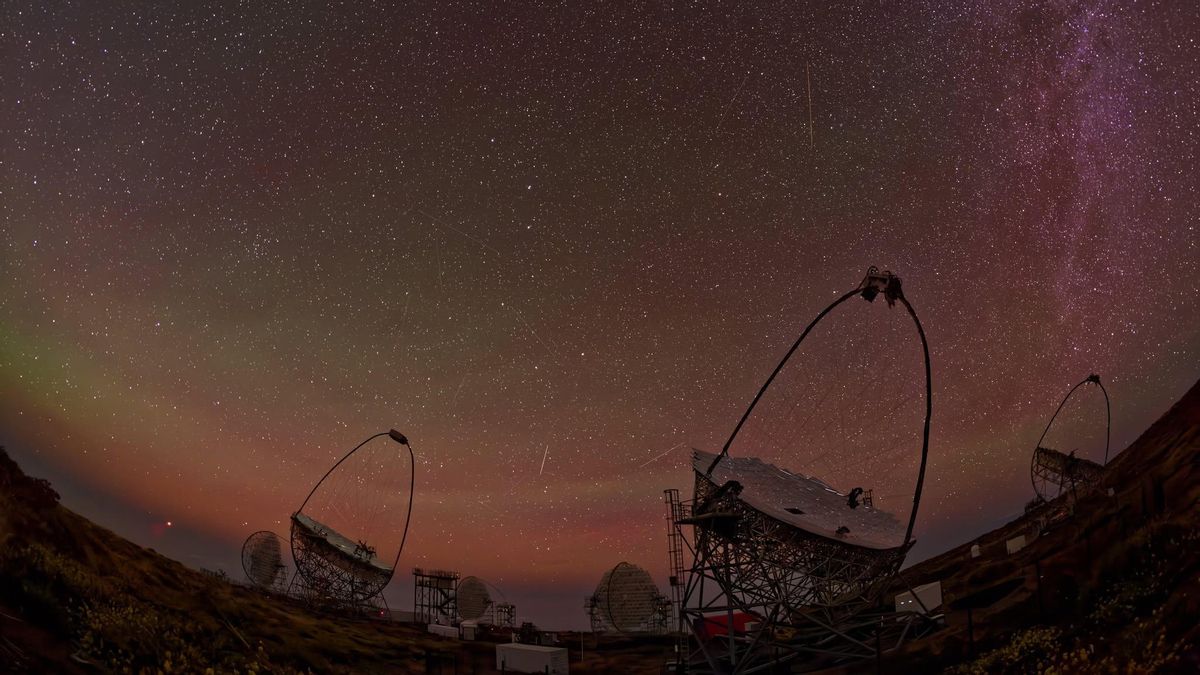
The prototype Large-Sized Telescope (LST-1) of the Cherenkov Telescope Array Observatory (CTAO), together with the two MAGIC telescopes at the Roque de los Muchachos Observatory in the highlands of Villa de Garafía, has broken the distance record for detecting the origin of cosmic flashes by capturing the most distant very-high-energy gamma ray sources ever observed, CTAO has announced.
On 15 August, CTAO reported on its website the extraordinary results of observations of OP 313, the most distant very-high-energy blazar ever recorded. The findings, published in the journal Astronomy & Astrophysics, present comprehensive observations carried out with the LST-1 prototype and the MAGIC telescopes at the Roque de los Muchachos Observatory.
A glimpse into the distant Universe
This comprehensive study follows the discovery of the very-high-energy source by LST-1 in December 2023, which was announced at the time via an Astronomer’s Telegram (ATel). The joint observations captured a flux of very-high-energy photons originating from a distance of approximately eight billion light-years.
By analysing these gamma rays, scientists were able to reveal crucial information about the diffuse extragalactic background light (EBL) and decipher the complex particle acceleration processes operating within the distant galaxy.
What are blazars?
Blazars are exceptionally bright active galactic nuclei – galaxies powered by a central supermassive black hole. OP 313, in particular, is classified as a flat-spectrum radio quasar, a specific type of blazar that ranks among the brightest and most powerful emitters in the Universe.
Around 11 billion years ago, the Universe experienced a period of peak activity known as “cosmic noon”, characterised by intense star and galaxy formation. As this burst subsided and galaxies began to mature, the Universe entered a quieter phase that continues to this day. It was during the beginning of this era that OP 313 emitted the powerful very-high-energy gamma ray flash detected by the LST-1 and MAGIC telescopes.
How the signal was detected
As these high-energy gamma rays travelled across the cosmos for eight billion years – reaching us from a redshift of z = 0.997 – they interacted with the EBL, a persistent field of radiation at all energies emitted by cosmic objects throughout the history of the Universe. This interaction weakens the gamma ray signal through a process known as pair production. When gamma rays collide with the EBL, their energy is transformed into pairs of particles, specifically an electron and a positron. As a result, the original gamma ray flux from the cosmic source is reduced across the vast distance it travels, making detection challenging and requiring exceptionally sensitive instruments.
By analysing the combined dataset from the LST-1 and MAGIC telescopes, alongside lower-energy data from other facilities, the authors of the publication obtained rigorous constraints on the density of the extragalactic background radiation and characterised the variability of the flux. They determined that the intense gamma ray emission was driven by a dense population of relativistic electrons.
In this so-called “leptonic scenario”, electrons were accelerated to near-light speeds within a massive plasma jet launched by OP 313’s central supermassive black hole. Colliding with the lower-energy light surrounding the black hole, the electrons transferred part of their immense energy to photons, boosting them into very-high-energy gamma rays. These findings represent a significant advance in understanding the internal mechanisms of flat-spectrum radio quasars.
Future prospects for the LST array
The LST-1 is the prototype for the Large-Sized Telescopes (LST), which are currently in the commissioning phase at the CTAO-North site on La Palma. The discovery of the most distant very-high-energy blazar during this testing phase is a clear demonstration of the telescope’s excellent performance and promising future.
On 15 October this year, the LST Collaboration will inaugurate the full LST sub-array on La Palma, which includes three additional telescopes. With the mission of lowering CTAO’s low-energy sensitivity to 20 GeV, future LST observations will successfully expand the gamma ray horizon, enabling researchers to observe extreme radiation at distances never before reached.
The CTAO LST Collaboration is an In-Kind Contributor (IKC) to CTAO, responsible for the construction of the Large-Sized Telescopes. The collaboration comprises more than 500 scientists and engineers from 25 institutions across 11 countries: Brazil, Bulgaria, Croatia, the Czech Republic, France, Germany, Italy, Japan, Poland, Spain and Switzerland.
What’s happening in the Canaries – straight to your phone
News, weather alerts and practical updates – direct from the islands, in English. We live here and know what’s going on – before the international media catch up. Everything lands on our WhatsApp channel – no middlemen, no algorithm. Curated for families, expats and travelers.

Canary Islands sea hits second-hottest year on record

Legal bid to halt tree felling in Santa Cruz’s La Salud

Fiesta del Charco: A journey through La Aldea’s past

Corralejo dunes power line set for removal

ULPGC launches 14 research projects at Las Canteras

TMT will never be built, says Canary Islands astrophysics chief

Pedro Duque: Canarias is the “ultimate dream” for rockets

Court blow to Tenerife motor circuit project
La Palma faces new volcanic risk planning deadline
