Compiled with the help of artificial intelligence, based on Spanish-language information. Source below the article.
A climate advantage
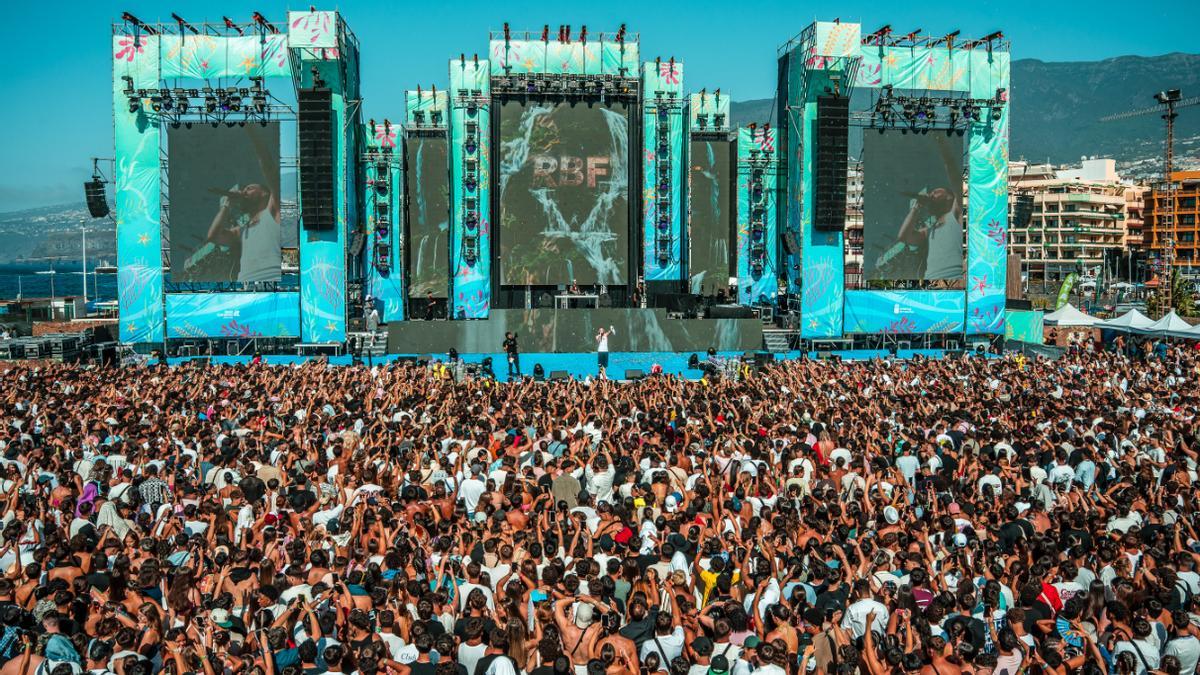
The rise in extreme heat episodes across Europe has ignited a debate over the viability of large-scale open-air festivals during the summer months. Cancellations, schedule changes, and reinforced protocols have become the new normal in cities across the continent. In the Canary Islands, however, the picture is different. The archipelago has not yet experienced heatwaves of the magnitude recorded on the Spanish mainland or in northern European countries, nor have such conditions coincided with major musical events.
Even so, promoters and organisers are beginning to incorporate the climate factor into their planning, not as an immediate urgency but as a strategic variable for the medium term. “The climate here has always worked in our favour,” sums up Leo Mansito, director of New Event and responsible for events such as Granca Live Fest and Tenerife Music Fest. “The truth is that in the Canaries we’ve never suffered that threat like they have elsewhere. Even in the middle of July at Granca Live, it has rained on me some years,” he explains.
The experience of many promoters confirms this: in contrast to the thermal peaks of the continent, the archipelago maintains a stability that positions it as a privileged enclave for live music. That comparative advantage does not, however, eliminate the need for adaptation. Juan Francisco Senabre, organiser of the Gran Canaria Sum Festival, frames it in terms of planning: “We work in October, so for now everything remains the same. But we have to take more and more things into account: the weather, temperatures, the forecast…”. Seasonality, in this case, functions as a mitigation tool, shifting events away from the hottest months.
Adapting to a warming world
Other promoters opt to avoid summer altogether. Juan Salan, of Salan Producciones, is clear about his approach: “If I held festivals during the hottest period, I would take it into account. Audience wellbeing comes first, so we would have to consider later start times, free water, shaded areas, and more medical assistance.” In his case, the strategy is to schedule events in June and October, “and if it coincided with heat, we would apply all those measures,” he adds, underlining the preventive approach.
From a more operational perspective, José María de la Cova, promoter of the Tenerife Cook Music Fest, plays down the impact of heat on logistics. “In 2024 we were caught out by a heatwave and we held the concerts without any major inconvenience. It’s like the fairs: whether there’s a heatwave or not, they go ahead,” he notes. The key, he points out, lies in technical adaptation: “If the stages can’t be set up during the day, you work at night. That’s something that has been done for years.” His view connects with a tradition of events in demanding climates, where organisation adjusts without altering the calendar.
Beyond the operational side, the debate broadens to the audience experience. Carlos Ulises Salazar is co-director of Phe Festival in Puerto de la Cruz, and introduces the concept of holistic sustainability: “A festival can’t just be about waste or energy. It also has to do with people being comfortable, able to hydrate and rest.” In the case of this festival, which for years took place in August and has now moved to early September, measures such as free access to water and the creation of shaded areas are part of its design. “We don’t want anyone to have to choose between hydrating or spending money,” Salazar says. He acknowledges, however, that although he does not perceive a clear increase in heat locally, he does recognise a worrying global context: “The data on ocean temperatures is alarming, and that will have consequences.”
Wind, uncertainty and forward planning
Along similar lines, Javier Jiménez, promoter of the Boreal Festival in Los Silos, interprets the phenomenon as an opportunity for improvement. “Anything that makes us rethink a festival is going to have a positive impact on the audience,” he maintains. Boreal takes place every September, and in 2025 it unfolded during an intense heatwave that forced organisers to readjust schedules and bolster services. “We rescheduled activities, increased the free water supply, and adapted the programme to make it more manageable,” he details. His approach prioritises environmental coherence: “It’s not about fighting the heat with more energy consumption, but about finding sustainable solutions.”
However, the impact of climate change in the Canary Islands is not limited to heat alone. Neftalí Acosta, director of Sonidos Líquidos in Lanzarote, points to other emerging factors: “Here we don’t suffer those extreme heatwaves, but we are seeing changes, especially in the wind.” His festival, held in La Geria, had to be cancelled this very year due to gusts of up to 80 kilometres per hour in early June. “We’ve always had insurance for adverse weather, and this year we’ve had to use it,” he explains. For Acosta, the challenge is not so much the heat as the unpredictability: “Nothing is mathematical anymore. You have to plan for any eventuality.”
A fragile advantage
Overall, the sector agrees that the Canary Islands maintains optimal conditions for open-air events for much of the year. The possibility of scheduling concerts beyond summer, in other seasons such as spring or autumn, and even in winter, strengthens its appeal compared to other destinations. However, the evolution of the global climate introduces a new layer of complexity.
For now, there is no alarmism. But there is a growing awareness that the climate is no longer a backdrop, but an actor that conditions cultural production. In the words of Carlos Ulises Salazar: “Weather conditions are part of event planning and you have to anticipate them.” The Canary Islands, with their climatic balance, start with an advantage. The question is how long that advantage will last, and how it will be managed in an increasingly uncertain scenario.
What’s happening in the Canaries – straight to your phone
News, weather alerts and practical updates – direct from the islands, in English. We live here and know what’s going on – before the international media catch up. Everything lands on our WhatsApp channel – no middlemen, no algorithm. Curated for families, expats and travelers.

Two men injured in fall from wall in Playa de Troya
Tenerife-forged bell rings again in tiny Rioja village

Canarian journalists to discuss a world in conflict at Las Palmas theatre

Festival del Sur returns to Agüimes with theatre from three continents
Man, 24, seriously hurt in buggy crash on Gran Canaria track

Woman, 81, rescued from sea at Las Vistas beach in Adeje

Tenerife to receive ES-Alert volcano drill messages

Canary film Benito Pérez Buñuel to premiere in Venezuela

Teen rescued after ravine fall in Güímar, Tenerife