
Compiled with the help of artificial intelligence, based on Spanish-language information. Source below the article.
A tiny organism with a huge role
The minuscule algae that sustain a significant proportion of life on Earth are set to take centre stage in a museum collection that will put the Canary Islands on the world map. A comprehensive collection of diatoms from across the Archipelago will feature in a scientific display at the Museum of Nature and Archaeology (MUNA), enabling researchers from anywhere in the world to study the characteristics, patterns and functions of these tiny incubators of life, about which far more mysteries than certainties remain.
“These species are hugely important because they form the base of the food chain, yet very little research has been carried out on them here in the Canary Islands,” explains Irene Cáceres, curator at the Museum of Nature and Archaeology (MUNA) in Tenerife and the driving force behind this exhibition, which will debut at the museum in due course. Diatoms are plant organisms that photosynthesise and produce oxygen, making them the foundation of the food chain for countless organisms that feed on them.
Filling a global gap
The initiative aims to develop a collection that brings together live cultures, permanent microscopic preparations, images obtained through optical and electron microscopy, DNA samples and associated genetic information. “There are very few diatom collections in the world, perhaps because this is a group that goes largely unnoticed,” the researcher explains. Indeed, there are barely any taxonomic records of the diatom species found in the Canary Islands.
“Species lists have been drawn up and there is the odd thesis that covers them, but in general we are lacking a great deal of information,” she stresses. The aim of this project, therefore, is ultimately to expand knowledge of the diatom species found in the Canary Islands, whilst also preserving specimens of the different species encountered and making them available at the museum. But their appeal is not purely scientific – it is also commercial. “They have industrial uses too, for filtering and drying, as well as in forensic investigations,” reveals Cáceres.
A forensic clue in the water
In this latter context, diatoms serve as a marker to determine whether a person found in the sea died by drowning or from another cause. “If someone drowns, they tend to swallow water before dying, which means diatoms enter through the lungs, cross the alveoli and pass into the bloodstream,” she explains. Should a forensic examiner find no trace of diatoms whatsoever, it may offer a clue that the individual died before entering the water.
An ambitious undertaking for MUNA
This is one of the most ambitious scientific projects MUNA has ever taken on. It is not simply a matter of creating a suitable space to house these tiny single-celled creatures, but also of keeping them alive long enough for them to be catalogued and studied in depth. This is the considerable challenge that the museum’s young curator, Irene Cáceres, has taken on, admitting that the project is still in its early stages.
“We still lack the infrastructure to keep these tiny algae at the museum, so while we prepare it, we are working in collaboration with the University of La Laguna (ULL),” she states. But the problem is not merely one of space. Handling these elusive algae is also a major headache for the scientist. The process is divided into several stages, from their extraction from the sea to their treatment in the laboratory, and it has one fundamental drawback: the fragility of these tiny organisms and their propensity to die.
Delicate work in the lab
The first step is to collect the environmental sample. In this case, the team of scientists responsible for the sampling is collecting benthic diatoms (which grow attached to rocks or on the seabed) and planktonic diatoms (which float freely in the water column). “We collect the benthic ones by scraping rocks with a small brush and storing what falls off in a jar, or, if they are attached to macroalgae, we place them in a zip-lock bag and rub them to loosen them,” she explains. For planktonic diatoms, scientists must take to a boat and collect them using plankton nets. “We collect all sorts of things there, but we focus on the diatoms,” she insists.
Once samples reach the laboratory, a complex process requiring almost surgical precision begins: each cell must be separated without dying in the process. “It arrives as a mixture of different species and we have to separate them, adding a culture medium with all the necessary nutrients for them to survive,” explains the researcher, who notes that once that ecosystem has been created, “they remain sustained.”
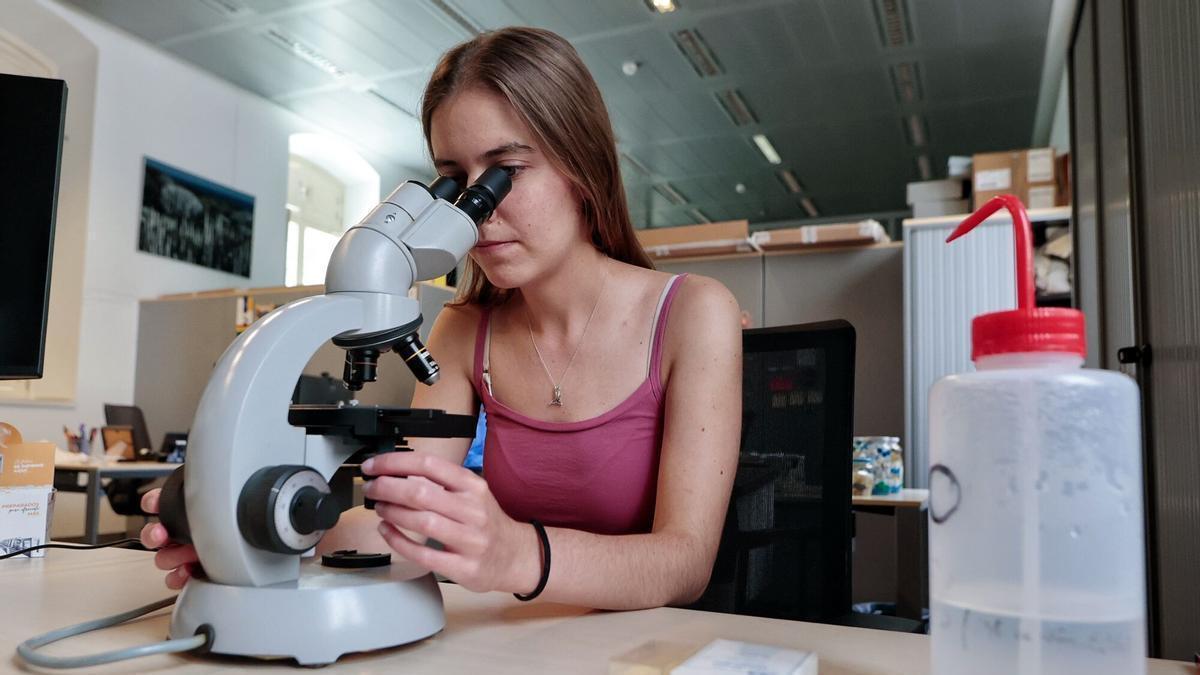
To observe and study them, the researchers must use an inverted microscope, the only instrument that allows them to be handled with extreme delicacy. To extract any sample, a modified pipette with no sharp edges is used, brought close to the cell. The pipette is connected to a tube through which the researcher gently sucks to separate the cells. “The idea is to try to capture that single cell to store it,” she states.
Once the sample has been extracted, it is placed on a plate containing a single diatom, which must live there in a culture chamber with a specific cycle of light and darkness, and a temperature limit. “I check them weekly to see if they grow and clone themselves,” she explains. Indeed, the most interesting aspect of the project is getting a single diatom to reproduce itself. “That interests us because it allows us to study its morphological characteristics (and thus observe them from different angles) and its genetics together, and to have reference material available,” the researcher concludes.
What’s happening in the Canaries – straight to your phone
News, weather alerts and practical updates – direct from the islands, in English. We live here and know what’s going on – before the international media catch up. Everything lands on our WhatsApp channel – no middlemen, no algorithm. Curated for families, expats and travelers.

Canary Islands sea hits second-hottest year on record

Legal bid to halt tree felling in Santa Cruz’s La Salud

Fiesta del Charco: A journey through La Aldea’s past

Corralejo dunes power line set for removal

ULPGC launches 14 research projects at Las Canteras

TMT will never be built, says Canary Islands astrophysics chief

Pedro Duque: Canarias is the “ultimate dream” for rockets

Court blow to Tenerife motor circuit project
La Palma faces new volcanic risk planning deadline
