
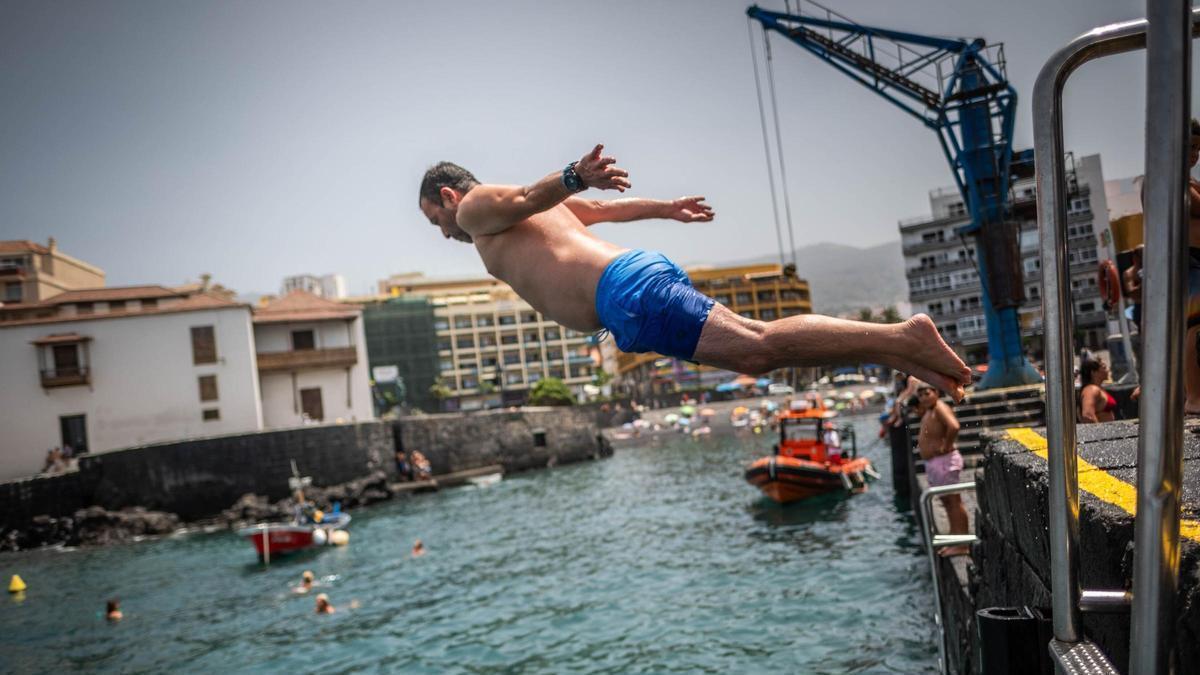
Some launch themselves into the water from the jetty amid laughter and racing steps. Others plant their parasols on the tiny pebble beach that gives access to the dock, unpacking cool boxes and folding chairs. A few take advantage of the tide to try to catch their lunch with a rod propped on the rocks, while the youngest children scurry about slathered in sunscreen, still wearing their goggles and clutching an ice cream. The thermometer frequently exceeds 30°C and, just a few hundred metres away, with their backs to the much-publicised Playa Jardín, the locals of Puerto de la Cruz dive straight into the water at the jetty, the emblematic swimming spot of their town.
Juan Rodríguez, a 74-year-old portuense who is “very well preserved”, as he jokes while raising his hands in a gesture of mock innocence, is part of this summer ritual. Every summer morning, he makes his way down to this small bathing area “with the same leisurely pace as when I was a kid”. Even before finding a spot on the little cove – where, at other times of year, you might spot goats cooling off or the Virgen del Carmen being carried into the sea amid hundreds of devotees – the septuagenarian has already greeted dozens of familiar faces.
“My father used to bring me here holding my hand, and now I’m the one coming down with my grandchildren. This isn’t just a place for a swim; you come, take a dip and, while you’re at it, catch up with everyone,” he says with a chuckle.
A way of life
Not far away, María del Carmen González, another local in her mid-50s, unrolls her towel and pulls several Tupperware boxes of food from her backpack. “We come here to spend the day,” she says, looking for a shady spot. She recalls that when she was little, her mother hardly ever had to ask where she was. “If I wasn’t at a friend’s house, I was here. We’d spend the whole day in the water and only go back up when hunger got the better of us,” she remembers.
More than four decades on, she admits the jetty has changed, though perhaps not as much as it seems. “Before,” she says, glancing towards the lighthouse, “there weren’t all these lilos, goggles or inflatable contraptions; with a pair of flip-flops, a towel and a willingness to jump in, your day was made.”
A proud maritime history
Long before it became a meeting point for bathers from the north of Tenerife, the jetty was the heart of the municipality. The earliest documents recording the intention to build a dock in what was then Puerto de La Orotava date back to the early 16th century. For centuries, it served as the main gateway to the Valle de La Orotava – the point from which wines, bananas and tomatoes were loaded for other markets, and where vessels from various corners of the Atlantic would dock. It also provided shelter for fishermen and small boat owners who found in this little inlet a place to work and haul their boats out of the water.
Its location, hidden behind the mouth of the San Felipe ravine, was no accident either. It offered one of the safest anchorages on the island, a condition that shaped the growth and life of Puerto de la Cruz as we know it today.
Still the town’s living room
Now, as the Loro Parque train trundles past tooting its horn, full of tourists, and children dash across Plaza del Charco with wet hair, the jetty blends seamlessly into the ebb and flow of restaurants, bars, terraces and beach bars. Those who haven’t brought their lunch from home stop to refuel before heading back into the water.
Martina Hernández has worked at one of the kiosks in the area for years and says she has rarely seen this corner without life. “The jetty has something that makes people always come back… the grandparents came, then the children, and now the grandchildren. There are whole families who have been coming down here every summer for their entire lives,” she explains. From her small counter, she watches a daily parade of children arriving barefoot for an ice cream, or parents in wet swimming trunks in search of potatoes or a soft drink. For her, the jetty is the “engine” and “the living room of Puerto de la Cruz”.
A practical escape
But you don’t have to have been born in the municipality to understand the appeal of jumping off the green lighthouse. Manuel Salazar comes down from Los Realejos whenever he can. “It’s much more practical here. You park, take a dip and head home. The beach is a different story altogether,” he sums up, beer in hand.
Right there, Rómulo Díaz, a resident of La Cruz Santa, has just emerged from the water after leaping off the jetty. He shares the same sentiment. “With this heat,” he admits, “you come down for a bit with the kids, leave the car right here and you’re back home in no time.”
The scene also captivates the younger generation. Killian Expósito, 14, from Santa Úrsula, comes down with a towel over his shoulder and a fishing rod. “We come here a lot with my mates. Sometimes we swim and other times I fish; if I’m lucky, I even take home a parrotfish,” he says with a laugh.
Close by, Suma Jallow, a Gambian national who has lived on the island for six years, waits his turn to get back in the water. “I come by bus, sometimes alone and sometimes with friends. Here you always end up meeting someone,” he says.
Because you only need to stay for a few minutes to see that, as some people leave, others are just arriving.
What’s happening in the Canaries – straight to your phone
News, weather alerts and practical updates – direct from the islands, in English. We live here and know what’s going on – before the international media catch up. Everything lands on our WhatsApp channel – no middlemen, no algorithm. Curated for families, expats and travelers.

Canary Islands sea hits second-hottest year on record

Legal bid to halt tree felling in Santa Cruz’s La Salud

Fiesta del Charco: A journey through La Aldea’s past

Corralejo dunes power line set for removal

ULPGC launches 14 research projects at Las Canteras

TMT will never be built, says Canary Islands astrophysics chief

Pedro Duque: Canarias is the “ultimate dream” for rockets

Court blow to Tenerife motor circuit project
La Palma faces new volcanic risk planning deadline
