
Teide: No Longer Sleeping
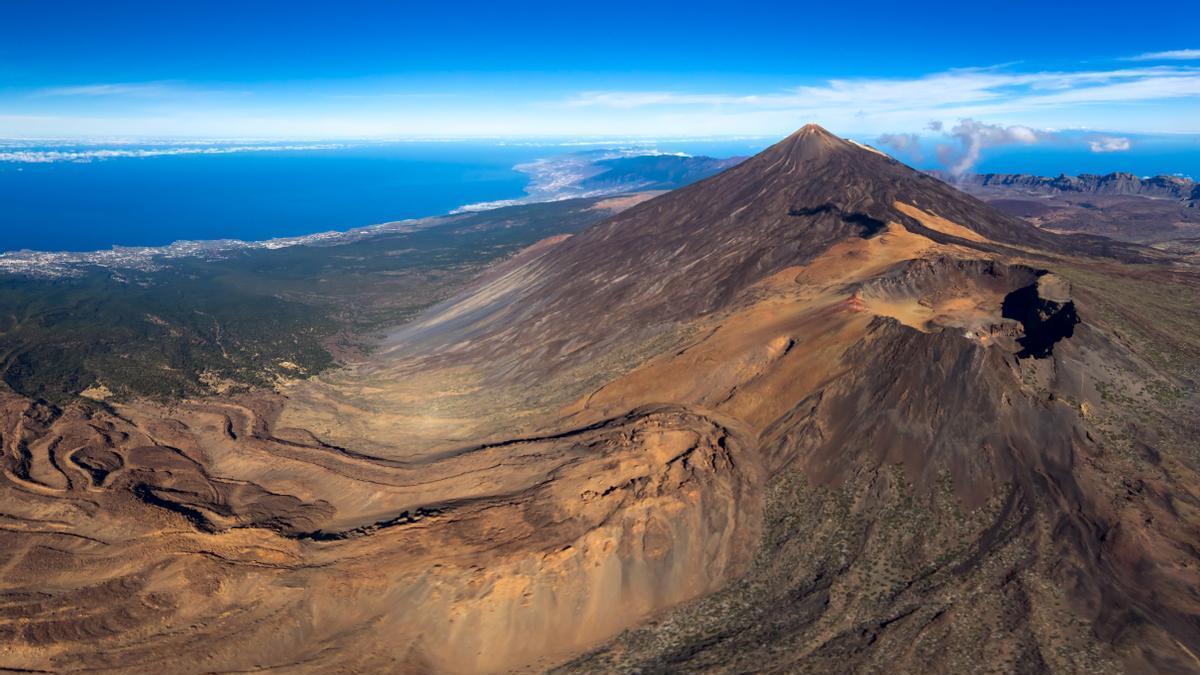
The Teide stopped sleeping a long time ago. For ten years, its depths have been stirring to the rhythm of hundreds of earthquakes, and just five months ago, that extraordinary activity stopped being unusual and became background noise accompanying the Canary Islanders almost daily. Pulses, earthquakes and, occasionally, even seismic swarms remind us that Tenerife is a volcanically active island where a long-term eruption cannot be ruled out. For now, however, any medium or short-term forecast remains closer to science fiction than tangible reality. With that in mind, here are some questions and answers to help understand what is brewing beneath Las Cañadas del Teide.
When Did Scientists First Notice Something Was Wrong?
The National Geographic Institute (IGN) and the Canary Islands Volcanological Institute (Involcan) first detected anomalous activity at the Teide in 2016. That seismic activity, in the form of a small swarm, repeated itself up to six more times over the following nine years: in 2016, 2019, twice in 2022, and again in 2024 and 2025. In February 2026, the tremors went a step further, acquiring a new characteristic that had not previously been described. For the first time, seismic pulses were detected beneath the Teide. These are a type of sustained vibration, far less powerful and almost imperceptible. Since then, a further ten swarms have been recorded: in February, and another three in the last two months – one in June and two in July.
Where Exactly Are the Tremors Being Felt?
The earthquakes recorded beneath the Teide since February are always very similar. Most are of low magnitude (barely reaching 1 mbLg) and occur in the same area. Specifically, they are detected at depths of between 10 and 15 kilometres, always to the west of the Las Cañadas del Teide National Park, between Guía de Isora, Vilaflor de Chasna and Santiago del Teide. In addition to the earthquakes, seismic pulses are also being recorded, which scientists have compared to the sound a cavity makes when it vibrates. In recent months, both activities have also been recorded intertwined.
Could This Lead to an Eruption?
Although many theories have been shared on social media and around the dinner table in recent months, the reality is that this activity is not linked to direct precursors of an eruption. These small earthquakes are, on the contrary, related to the island’s own volcanic system and its normal activity. In fact, many volcanoes around the world record this type of seismicity. This means that these swarms do not herald an eruption in the short or medium term on Tenerife, as scientists do not consider them a precursor to an imminent eruption. That is not to say that tomorrow a seismic crisis could not begin in which far more evident indicators are detected (such as seismicity, ground deformation or gas emissions). However, for now, that is not the case.
What Other Signs Have Been Detected?
Every day, dozens of parameters related to the possible occurrence of an eruption are monitored. In addition to the seismicity recorded over the past decade, since 2023 a tiny ground deformation (of just two centimetres) and a slight increase in gas emissions have also been detected. However, none of these indicators – either together or separately – demonstrate that an eruption is likely on the island in the short or medium term.
The seismic activity being recorded on Tenerife is normal in the context of a volcanically active island. The Teide has been monitored since 2003, but the quality and number of instruments available to science for monitoring it is far greater now. This also makes it easier to record small movements that previously went unnoticed. Many volcanoes and volcanic islands around the world show this activity on a sustained basis.
What Is the Scientific Explanation?
The volcanic system of Tenerife is highly complex to study and understand. The island consists of a large volcanic complex that rises more than 7,000 metres from the ocean floor. It is a structure in which ancient volcanic massifs (Teno, Anaga and Adeje), active volcanic ridges (Teno and La Esperanza), exterior explosive volcanoes (Montaña de Guaza, Caldera del Rey, Montaña Pelada), fields of recent volcanoes (Granadilla and Rasca) and, finally, at the island’s summit, the Teide-Pico Viejo stratovolcano, are all intertwined. However, the main hypothesis scientists are considering is that the earthquakes, the deformation and the carbon dioxide emissions recorded so far are related to an injection of gases or other fluids underground (such as water vapour, carbon dioxide, sulphur dioxide or hydrogen sulphide) caused by the movement of magma at the base of the island.
Scientists agree that, in addition to having a volcanic origin, the movements are not related to a magmatic intrusion towards the surface. For this reason, they do not consider that, in principle, these indicators are related to the occurrence of an eruption in the medium or short term, that is, within days or months.
How Closely Is the Teide Being Watched?
Tenerife is one of the most closely monitored volcanic islands in Europe. Around Las Cañadas and spread across the three main ridges of Tenerife, there are nearly 100 seismic stations, GPS (GNSS) antennas, visual and thermal cameras, geochemical measurement stations and tiltmeters monitoring the great volcano’s heartbeat every day. These networks, installed by the IGN and Involcan, not only allow scientists to listen to the island’s volcanic depths, they will also be what guarantees seeing the warning signs of a possible eruption in time.
What Would an Imminent Eruption Look Like?
Should that happen, the signs would be noticeable. There would be more tremors of magnitude greater than 2 and 3, which would be felt by the population; the deformation would accumulate far more and in less time – on Tenerife we have accumulated two centimetres in three years, compared to the 30 centimetres recorded on La Palma in the week before the Tajogaite eruption – and the emission of volcanic gases would, likewise, be far more evident.
Although the answer is based on probabilities that may or may not come true, there is one enclave where danger shoots up: western Tenerife. According to the Insular Action Plan for Volcanic Risk (PAIV), drawn up in 2018, the area of greatest volcanic hazard on the island is, specifically, the ridge that runs from the Teide towards the Teno massif, also known as the Abeque ridge. Over the last 2,000 years, it has been the most volcanically active area on the island. Abeque has witnessed at least five historical eruptions, similar to the one on La Palma in 2021 – that is, Strombolian in type with basaltic lava flows.
What’s happening in the Canaries – straight to your phone
News, weather alerts and practical updates – direct from the islands, in English. We live here and know what’s going on – before the international media catch up. Everything lands on our WhatsApp channel – no middlemen, no algorithm. Curated for families, expats and travelers.

Canary Islands sea hits second-hottest year on record

Legal bid to halt tree felling in Santa Cruz’s La Salud

Fiesta del Charco: A journey through La Aldea’s past

Corralejo dunes power line set for removal

ULPGC launches 14 research projects at Las Canteras

TMT will never be built, says Canary Islands astrophysics chief

Pedro Duque: Canarias is the “ultimate dream” for rockets

Court blow to Tenerife motor circuit project
La Palma faces new volcanic risk planning deadline
