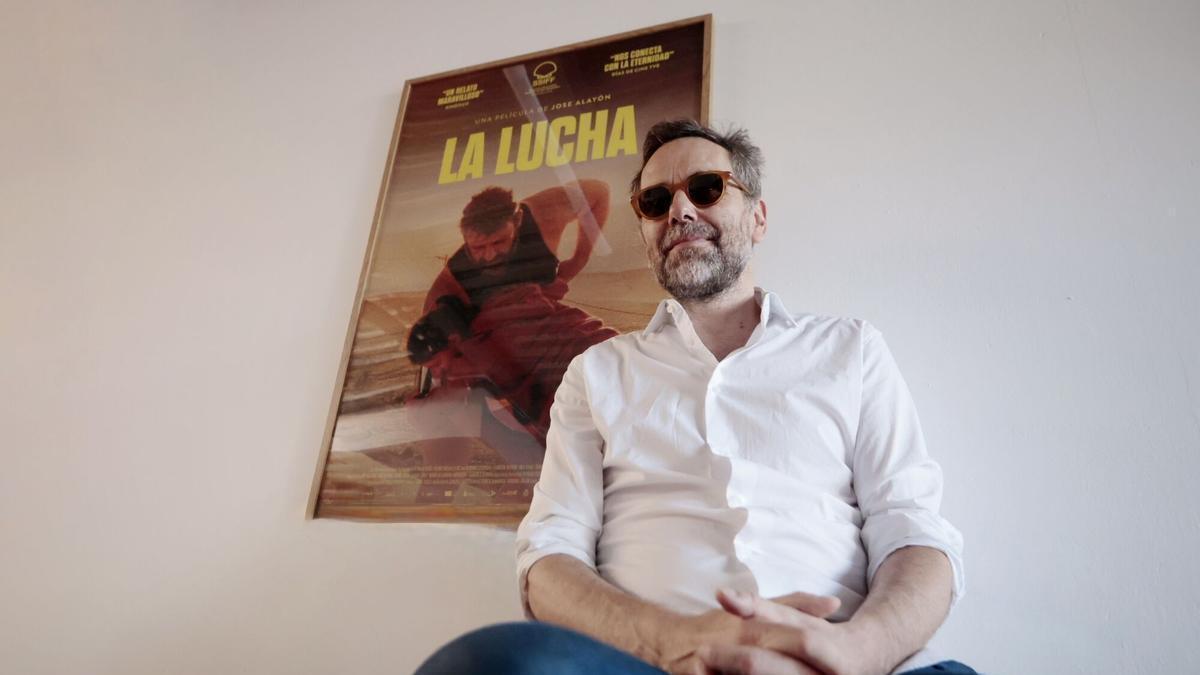
Masterclass in Santa Cruz
Mauro Herce, the cinematographer behind two Goya Award-winning films, Sirat and O que arde, is visiting Tenerife to lead a masterclass at the Fuera de Campo Film School in Santa Cruz, and to prepare a new feature he will shoot between the island and Chile. Herce champions the bond between technique, thought and sensitivity in shaping a film’s vision: “I am very attuned to the mystery of things, of life and of everything around us.”
That outlook, closer to contemplation than to the simple capture of images, defines the career of Herce, one of Spain’s most celebrated cinematographers working today. With a body of work linked to filmmakers such as Oliver Laxe, Lisandro Alonso, Théo Court, Lois Patiño and Manuel Muñoz Rivas, Herce sees cinematography as a form of thinking. For him, a film is built not only from the final image but from every decision that surrounds its creation.
A dialogue between disciplines
“I wanted to orient the masterclass above all towards people interested in cinematography and directing, and in that dialogue between the two disciplines. How a shared universe is built. We also talk about production strategies, because I believe the way a film is made ends up having a strong impact on its cinematic form. Students need to be aware of that relationship between design, production and cinematic form, drawing on different examples from film history.”
“Both parts are necessary. On one side there is the theory, the reflective work, the talking and reading; on the other, the move into practice. I do not think we could do this well without one of the two. Practice is very important. I always tell film school students that they need to practise a lot, shoot as much as they can and get involved in as many projects as possible. It is necessary for those more theoretical concepts to be fully understood, taken further, or even called into question again.”
Advice for emerging filmmakers
“At the beginning, because you do not know anyone, the hardest part is getting work, and sometimes it is not the most interesting. My advice for those starting out is not to be too fussy waiting for the best project in the world, because you need to learn and practise. It is important for students to team up, to develop relationships of trust and learn to work together. Early in a career, you have to take part in every project possible. Later on, of course, if things go well, you can be more selective.”
Choosing the right director
“I am sensitive to quite a few aspects, and that has also evolved over the course of my life. First of all, I have to feel there is something in common with the director, that we share a sensibility and can establish a relationship of mutual trust, even friendship. Sometimes it is not just the script. There are scripts that may not be perfectly written, but you feel a good film can be made because there are other variables defining the framework of work that you trust. Also, in my case, as I am an adventurous and well-travelled person, for many years I have been drawn to the idea of living an adventure. If it also happens in a place I do not know, I am even more interested.”
A long bond with the Canary Islands
“With José [Álvarez], I have a relationship going back many years. We studied together at the film school in Cuba almost 28 years ago. We made many short films together there, so José is part of my film family. We have a very collaborative, horizontal working group. Beyond our specific roles, we consider ourselves filmmakers and we like to talk about cinema, about how to improve a film, a script or an edit. The first film we made in the Canary Islands was a short that served as preparation for Slimane, José’s first feature, which we shot in the south of the island, around Arona. Since then, I have been very closely linked to the Canary Islands.”
A landscape of wonder
“Yes. When I spoke earlier about adventure, I was also talking about adventure in relation to a landscape, to a country that catches my attention. I love seeing landscapes, and I am very fond of nature. But I am not interested in filming it in a postcard-like, quick and easily digestible way. Everything fascinates and arouses my curiosity, whether it is a tree, a plant, an animal or a moment of light. I am sensitive to these things, and I think that shows in my work. Some directors have called me precisely for that reason, because they liked how I filmed nature or how I captured certain atmospheres.”
Tenerife’s unique light
“You would have to be blind not to see it. It is a truly unique place. I do not think there are many places in the world where there is such a simultaneity of such different landscapes, climates and changes of light. You go from sea level to more than 3,000 metres in a very short distance, and that implies an enormous transformation of the landscape. I have experienced incredible moments, like going up to Punta de Teno and watching the sea of clouds passing from one side to the other, the panza de burro moving along the coast, or the sun’s rays cutting through that atmosphere. There are volcanic landscapes of many kinds and enormous variety. On the mainland, you would have to travel thousands of kilometres to find such variation.”
New projects on the horizon
“I am fortunate that I am now being offered more work than ever, and I am constantly reading scripts. The most likely is a film called Tres noches negras, which would in principle shoot between January and March next year across Tenerife and Chile. I am also reading a script for an American film that I like very much, although there is a scheduling problem. And there is another Japanese film, which would be shot on an island in northern Japan. It is a small film, about five weeks, but I really liked the script. The problem is always the calendars. People would be surprised by the amount of time we spend sitting around trying to make dates fit. Almost half of our job consists of making those schedules compatible.”
What’s happening in the Canaries – straight to your phone
News, weather alerts and practical updates – direct from the islands, in English. We live here and know what’s going on – before the international media catch up. Everything lands on our WhatsApp channel – no middlemen, no algorithm. Curated for families, expats and travelers.
El Bejeque in Las Canteras adds sea to its fire
Siam Park Gran Canaria must build its own desalination plant
Fuerteventura’s biggest resort to open on 1 November
Gran Canaria to teach tourism history in schools
Canary Islands see 0.3% rise in foreign tourists in August
Row over 368-bed hotel project in La Gomera
Spanish astronaut trains in Lanzarote for Moon mission
Tivoli La Caleta hosts first red tuna Kaitai in Canarias
La Laja natural pools reopen in Las Palmas