
El Caletón natural pools, Garachico
The natural pools of El Caletón are one of the great classics of north Tenerife. They lie next to the historic centre of Garachico, just metres from San Miguel Castle and with views of the rocky outcrop that recalls the volcanic eruption of 1706, an event that changed the town’s history forever. The lava flows that reached the sea formed this collection of natural rock pools, which today is one of Garachico’s main attractions, especially during the summer months. From El Caletón you can also see the cliffs of La Culata and part of Tenerife’s north coast. It is a highly recommended option for those seeking a swim without straying far from the town centre and its restaurants.
El Arenisco pool, Punta del Hidalgo
The El Arenisco pool in Punta del Hidalgo is another standout spot on La Laguna’s coastline. The surroundings mix volcanic rock, black sand and lava arms that reach the sea, creating rock pools and small bathing areas. It is a popular spot for local families, especially at weekends. El Arenisco has also renewed its Blue Flag status.
Jóver natural pool, Tejina
The Jóver natural pool is located in Tejina and offers one of the calmest swims on the La Laguna coastline. It is a small, sheltered spot with open views towards Tenerife’s north coast. One of the most curious details of Jóver is the fresh water that flows down from the mountain through small channels worn into the rock over time. The surroundings are very peaceful, making this natural pool a good choice for those looking to slow down from the pace of daily life. Jóver is also among the La Laguna bathing spots that have renewed their Blue Flag status for 2026.
Charco del Cumplido, Los Silos
In the municipality of Los Silos, the Charco del Cumplido takes its name from its elongated shape. It is a bathing spot where volcanic rock and ancient natural salt pans form part of the landscape. The pool has a ramp for access, and its deepest part does not exceed two metres. Nearby are other pools such as Las Damas and El Romancito, also suitable for bathing at low tide provided the sea is calm.
Charco Los Chochos, Los Silos
Also in Los Silos is the Charco Los Chochos, located next to the Charco de La Araña. It is one of the best-known rock pools in the area and can be a good option for families with children when the sea is calm. From the spot you can see the cliffs of La Culata and, on clear days, even Mount Teide. Its name comes from an old agricultural custom: lupin seeds were soaked in saltwater here to remove their bitterness, a legume known in the Canary Islands as chochos. As with other rock pools in north Tenerife, it is important to take tides and waves into account before bathing.
Charco de La Laja, San Juan de la Rambla
The Charco de La Laja is the main bathing spot in San Juan de la Rambla and one of the most photographed natural rock pools in north Tenerife. It appears almost by surprise at the end of a street in the town centre and stands out for its shape, colour and how it blends into the volcanic rock. It is a very beautiful spot, especially when the sea is calm and allows for a safe swim. Its location, very close to the town centre, makes it easy to combine a visit with a stroll through San Juan de la Rambla.
Charco del Viento, La Guancha
The Charco del Viento is the busiest bathing spot in La Guancha and one of the best-known natural rock pools in north Tenerife. Its appeal lies in the combination of rocks, inlets, small sandy areas and the contrast between volcanic black and Atlantic blue. Access is relatively easy via a staircase, reached by a road that crosses banana plantations. Although it has several areas where swimming can be calm, the force of the sea sometimes comes in strongly.
Isla Cangrejo pool, Santiago del Teide
On the coast of Santiago del Teide, within the Isla Cangrejo development, this natural pool is protected by a concrete wall that reduces the force of the waves. The Isla Cangrejo pool is a good alternative for those looking for a family swim on the west coast of Tenerife. Its surroundings allow you to sunbathe and enjoy the sea in a more sheltered space than other rock pools that are directly open to the ocean.

Canary Islands sea hits second-hottest year on record

Legal bid to halt tree felling in Santa Cruz’s La Salud

Fiesta del Charco: A journey through La Aldea’s past

Corralejo dunes power line set for removal

ULPGC launches 14 research projects at Las Canteras

TMT will never be built, says Canary Islands astrophysics chief

Pedro Duque: Canarias is the “ultimate dream” for rockets

Court blow to Tenerife motor circuit project
La Palma faces new volcanic risk planning deadline

Fuerteventura launches campaign to rescue young shearwaters
The natural swimming pools of Bajamar are one of the most popular bathing spots in north-east Tenerife. They feature two large pools, a children’s pool and a small beach sheltered from the waves, making them an ideal choice for families and residents of the area. Their main advantage is that they allow you to enjoy the sea in a comfortable environment even when the Atlantic is rougher. They are also located in an area with nearby services, making them a good option for spending much of the day there. Bajamar is part of the coast of La Laguna, and in 2026 the pools have been awarded Blue Flag status again, along with Jóver and El Arenisco.
El Caletón natural pools, Garachico
The natural pools of El Caletón are one of the great classics of north Tenerife. They lie next to the historic centre of Garachico, just metres from San Miguel Castle and with views of the rocky outcrop that recalls the volcanic eruption of 1706, an event that changed the town’s history forever. The lava flows that reached the sea formed this collection of natural rock pools, which today is one of Garachico’s main attractions, especially during the summer months. From El Caletón you can also see the cliffs of La Culata and part of Tenerife’s north coast. It is a highly recommended option for those seeking a swim without straying far from the town centre and its restaurants.
El Arenisco pool, Punta del Hidalgo
The El Arenisco pool in Punta del Hidalgo is another standout spot on La Laguna’s coastline. The surroundings mix volcanic rock, black sand and lava arms that reach the sea, creating rock pools and small bathing areas. It is a popular spot for local families, especially at weekends. El Arenisco has also renewed its Blue Flag status.
Jóver natural pool, Tejina
The Jóver natural pool is located in Tejina and offers one of the calmest swims on the La Laguna coastline. It is a small, sheltered spot with open views towards Tenerife’s north coast. One of the most curious details of Jóver is the fresh water that flows down from the mountain through small channels worn into the rock over time. The surroundings are very peaceful, making this natural pool a good choice for those looking to slow down from the pace of daily life. Jóver is also among the La Laguna bathing spots that have renewed their Blue Flag status for 2026.
Charco del Cumplido, Los Silos
In the municipality of Los Silos, the Charco del Cumplido takes its name from its elongated shape. It is a bathing spot where volcanic rock and ancient natural salt pans form part of the landscape. The pool has a ramp for access, and its deepest part does not exceed two metres. Nearby are other pools such as Las Damas and El Romancito, also suitable for bathing at low tide provided the sea is calm.
Charco Los Chochos, Los Silos
Also in Los Silos is the Charco Los Chochos, located next to the Charco de La Araña. It is one of the best-known rock pools in the area and can be a good option for families with children when the sea is calm. From the spot you can see the cliffs of La Culata and, on clear days, even Mount Teide. Its name comes from an old agricultural custom: lupin seeds were soaked in saltwater here to remove their bitterness, a legume known in the Canary Islands as chochos. As with other rock pools in north Tenerife, it is important to take tides and waves into account before bathing.
Charco de La Laja, San Juan de la Rambla
The Charco de La Laja is the main bathing spot in San Juan de la Rambla and one of the most photographed natural rock pools in north Tenerife. It appears almost by surprise at the end of a street in the town centre and stands out for its shape, colour and how it blends into the volcanic rock. It is a very beautiful spot, especially when the sea is calm and allows for a safe swim. Its location, very close to the town centre, makes it easy to combine a visit with a stroll through San Juan de la Rambla.
Charco del Viento, La Guancha
The Charco del Viento is the busiest bathing spot in La Guancha and one of the best-known natural rock pools in north Tenerife. Its appeal lies in the combination of rocks, inlets, small sandy areas and the contrast between volcanic black and Atlantic blue. Access is relatively easy via a staircase, reached by a road that crosses banana plantations. Although it has several areas where swimming can be calm, the force of the sea sometimes comes in strongly.
Isla Cangrejo pool, Santiago del Teide
On the coast of Santiago del Teide, within the Isla Cangrejo development, this natural pool is protected by a concrete wall that reduces the force of the waves. The Isla Cangrejo pool is a good alternative for those looking for a family swim on the west coast of Tenerife. Its surroundings allow you to sunbathe and enjoy the sea in a more sheltered space than other rock pools that are directly open to the ocean.
The natural swimming pools of Bajamar are one of the most popular bathing spots in north-east Tenerife. They feature two large pools, a children’s pool and a small beach sheltered from the waves, making them an ideal choice for families and residents of the area. Their main advantage is that they allow you to enjoy the sea in a comfortable environment even when the Atlantic is rougher. They are also located in an area with nearby services, making them a good option for spending much of the day there. Bajamar is part of the coast of La Laguna, and in 2026 the pools have been awarded Blue Flag status again, along with Jóver and El Arenisco.
El Caletón natural pools, Garachico
The natural pools of El Caletón are one of the great classics of north Tenerife. They lie next to the historic centre of Garachico, just metres from San Miguel Castle and with views of the rocky outcrop that recalls the volcanic eruption of 1706, an event that changed the town’s history forever. The lava flows that reached the sea formed this collection of natural rock pools, which today is one of Garachico’s main attractions, especially during the summer months. From El Caletón you can also see the cliffs of La Culata and part of Tenerife’s north coast. It is a highly recommended option for those seeking a swim without straying far from the town centre and its restaurants.
El Arenisco pool, Punta del Hidalgo
The El Arenisco pool in Punta del Hidalgo is another standout spot on La Laguna’s coastline. The surroundings mix volcanic rock, black sand and lava arms that reach the sea, creating rock pools and small bathing areas. It is a popular spot for local families, especially at weekends. El Arenisco has also renewed its Blue Flag status.
Jóver natural pool, Tejina
The Jóver natural pool is located in Tejina and offers one of the calmest swims on the La Laguna coastline. It is a small, sheltered spot with open views towards Tenerife’s north coast. One of the most curious details of Jóver is the fresh water that flows down from the mountain through small channels worn into the rock over time. The surroundings are very peaceful, making this natural pool a good choice for those looking to slow down from the pace of daily life. Jóver is also among the La Laguna bathing spots that have renewed their Blue Flag status for 2026.
Charco del Cumplido, Los Silos
In the municipality of Los Silos, the Charco del Cumplido takes its name from its elongated shape. It is a bathing spot where volcanic rock and ancient natural salt pans form part of the landscape. The pool has a ramp for access, and its deepest part does not exceed two metres. Nearby are other pools such as Las Damas and El Romancito, also suitable for bathing at low tide provided the sea is calm.
Charco Los Chochos, Los Silos
Also in Los Silos is the Charco Los Chochos, located next to the Charco de La Araña. It is one of the best-known rock pools in the area and can be a good option for families with children when the sea is calm. From the spot you can see the cliffs of La Culata and, on clear days, even Mount Teide. Its name comes from an old agricultural custom: lupin seeds were soaked in saltwater here to remove their bitterness, a legume known in the Canary Islands as chochos. As with other rock pools in north Tenerife, it is important to take tides and waves into account before bathing.
Charco de La Laja, San Juan de la Rambla
The Charco de La Laja is the main bathing spot in San Juan de la Rambla and one of the most photographed natural rock pools in north Tenerife. It appears almost by surprise at the end of a street in the town centre and stands out for its shape, colour and how it blends into the volcanic rock. It is a very beautiful spot, especially when the sea is calm and allows for a safe swim. Its location, very close to the town centre, makes it easy to combine a visit with a stroll through San Juan de la Rambla.
Charco del Viento, La Guancha
The Charco del Viento is the busiest bathing spot in La Guancha and one of the best-known natural rock pools in north Tenerife. Its appeal lies in the combination of rocks, inlets, small sandy areas and the contrast between volcanic black and Atlantic blue. Access is relatively easy via a staircase, reached by a road that crosses banana plantations. Although it has several areas where swimming can be calm, the force of the sea sometimes comes in strongly.
Isla Cangrejo pool, Santiago del Teide
On the coast of Santiago del Teide, within the Isla Cangrejo development, this natural pool is protected by a concrete wall that reduces the force of the waves. The Isla Cangrejo pool is a good alternative for those looking for a family swim on the west coast of Tenerife. Its surroundings allow you to sunbathe and enjoy the sea in a more sheltered space than other rock pools that are directly open to the ocean.
Rock pools and natural swimming pools in Tenerife
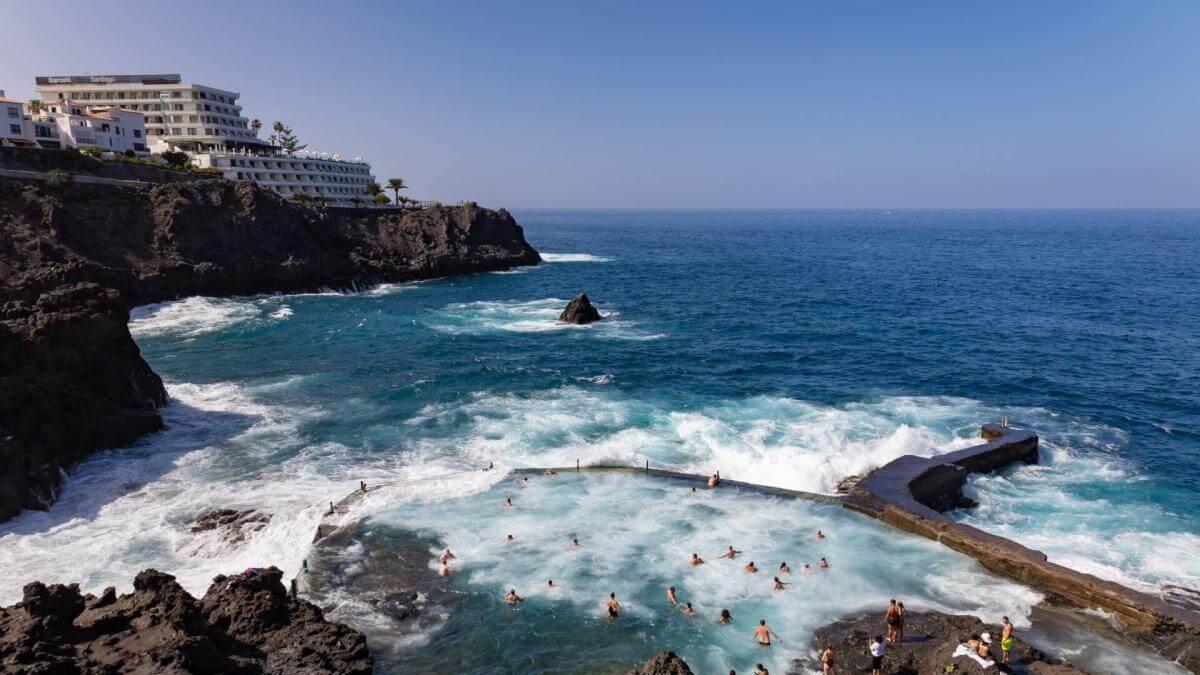
From Garachico to Santiago del Teide, Tenerife is not just enjoyed from the sand. Beyond its black sand beaches, tourist resorts and coastal promenades, the island holds some of its most special bathing spots among volcanic rocks, rock pools and natural swimming pools open to the Atlantic. These are corners well known to locals and increasingly sought out by visitors who want to discover another way to enjoy saltwater. Some are well equipped with easy access and nearby facilities. Others retain a wilder character and require a careful check of the ocean conditions before getting in. Most are concentrated on the north coast, where lava and tides have carved small natural pools into the rock. There, a swim has little in common with a day at the beach, and it is always advisable to consult the state of the sea before jumping in. Here is a list of the best rock pools and natural swimming pools in Tenerife.
Bajamar natural swimming pools
The natural swimming pools of Bajamar are one of the most popular bathing spots in north-east Tenerife. They feature two large pools, a children’s pool and a small beach sheltered from the waves, making them an ideal choice for families and residents of the area. Their main advantage is that they allow you to enjoy the sea in a comfortable environment even when the Atlantic is rougher. They are also located in an area with nearby services, making them a good option for spending much of the day there. Bajamar is part of the coast of La Laguna, and in 2026 the pools have been awarded Blue Flag status again, along with Jóver and El Arenisco.
El Caletón natural pools, Garachico
The natural pools of El Caletón are one of the great classics of north Tenerife. They lie next to the historic centre of Garachico, just metres from San Miguel Castle and with views of the rocky outcrop that recalls the volcanic eruption of 1706, an event that changed the town’s history forever. The lava flows that reached the sea formed this collection of natural rock pools, which today is one of Garachico’s main attractions, especially during the summer months. From El Caletón you can also see the cliffs of La Culata and part of Tenerife’s north coast. It is a highly recommended option for those seeking a swim without straying far from the town centre and its restaurants.
El Arenisco pool, Punta del Hidalgo
The El Arenisco pool in Punta del Hidalgo is another standout spot on La Laguna’s coastline. The surroundings mix volcanic rock, black sand and lava arms that reach the sea, creating rock pools and small bathing areas. It is a popular spot for local families, especially at weekends. El Arenisco has also renewed its Blue Flag status.
Jóver natural pool, Tejina
The Jóver natural pool is located in Tejina and offers one of the calmest swims on the La Laguna coastline. It is a small, sheltered spot with open views towards Tenerife’s north coast. One of the most curious details of Jóver is the fresh water that flows down from the mountain through small channels worn into the rock over time. The surroundings are very peaceful, making this natural pool a good choice for those looking to slow down from the pace of daily life. Jóver is also among the La Laguna bathing spots that have renewed their Blue Flag status for 2026.
Charco del Cumplido, Los Silos
In the municipality of Los Silos, the Charco del Cumplido takes its name from its elongated shape. It is a bathing spot where volcanic rock and ancient natural salt pans form part of the landscape. The pool has a ramp for access, and its deepest part does not exceed two metres. Nearby are other pools such as Las Damas and El Romancito, also suitable for bathing at low tide provided the sea is calm.
Charco Los Chochos, Los Silos
Also in Los Silos is the Charco Los Chochos, located next to the Charco de La Araña. It is one of the best-known rock pools in the area and can be a good option for families with children when the sea is calm. From the spot you can see the cliffs of La Culata and, on clear days, even Mount Teide. Its name comes from an old agricultural custom: lupin seeds were soaked in saltwater here to remove their bitterness, a legume known in the Canary Islands as chochos. As with other rock pools in north Tenerife, it is important to take tides and waves into account before bathing.
Charco de La Laja, San Juan de la Rambla
The Charco de La Laja is the main bathing spot in San Juan de la Rambla and one of the most photographed natural rock pools in north Tenerife. It appears almost by surprise at the end of a street in the town centre and stands out for its shape, colour and how it blends into the volcanic rock. It is a very beautiful spot, especially when the sea is calm and allows for a safe swim. Its location, very close to the town centre, makes it easy to combine a visit with a stroll through San Juan de la Rambla.
Charco del Viento, La Guancha
The Charco del Viento is the busiest bathing spot in La Guancha and one of the best-known natural rock pools in north Tenerife. Its appeal lies in the combination of rocks, inlets, small sandy areas and the contrast between volcanic black and Atlantic blue. Access is relatively easy via a staircase, reached by a road that crosses banana plantations. Although it has several areas where swimming can be calm, the force of the sea sometimes comes in strongly.
Isla Cangrejo pool, Santiago del Teide
On the coast of Santiago del Teide, within the Isla Cangrejo development, this natural pool is protected by a concrete wall that reduces the force of the waves. The Isla Cangrejo pool is a good alternative for those looking for a family swim on the west coast of Tenerife. Its surroundings allow you to sunbathe and enjoy the sea in a more sheltered space than other rock pools that are directly open to the ocean.