
A tale of two realities: the gap in Lanzarote’s energy debate
An abyss separates the authorities designing energy policies on Lanzarote from those living with their consequences. That is the stark finding of a comprehensive, pioneering study commissioned by the César Manrique Foundation (FCM) into the implementation of wind power on the island.
The report, produced by researchers from the University of Santiago de Compostela (USC), reveals that all sectors of the island agree on three points: the ecological transition is necessary and undeniable; Lanzarote is a fragile territory requiring planning adapted to its unique characteristics; and decisions about the island’s future model cannot be made behind its people’s backs.
How the study was conducted and what it found
After 18 months of work, the USC’s Bioeconomy, Natural Resources and Ecological Economics Group presented the study on the island. During this period, researchers met with fishermen, farmers, scientists, environmental groups, associations, the Chamber of Commerce, and people linked to public administrations. This painstaking process led them to conclude that the model applied on Lanzarote to date is a neo-extractivist one, as is also the case on the rest of the Canary Islands and mainland Spain. “In other words, we are applying the same approach in renewables that we applied in fossil fuels,” stressed Rosa María Regueiro Ferreira, the team’s coordinator, in an interview with this newspaper.
Lanzarote’s unique fragility
Lanzarote presents a series of singularities. It is a small island, covering just 845.9 square kilometres, with 41% of its territory protected. Its food dependency is measured in days of autonomy, its landscape is recognised globally as a World Heritage site, and its economy revolves around tourism and agriculture. For this reason, the research argues, decisions about where and how to install renewables are not minor technical matters, but strategic choices about the kind of island Lanzarote wants to be.
A call for active public participation
To achieve a fair and efficient energy transition, the study proposes a model of active public participation. “This does not just mean that citizens have the right to submit objections, but that they take part in the entire process,” Regueiro explained. The senior lecturer in the USC’s Department of Applied Economics pointed to Denmark as an example: a country that decided by law to base its model on a democratic foundation where all stakeholders are represented and no one is left out. “It should not be forgotten that social participation increases social acceptance, adds local value and fosters territorial cohesion,” the study notes.
The controversial rollout of renewable acceleration zones
The presentation of the report comes at a decisive moment for the island. The Government of the Canary Islands and the Cabildo of Lanzarote have approved the Renewable Acceleration Zones (ZAR) in a process that has not been without controversy. The maps published by the regional Ministry of Ecological Transition set aside 3.75% of the island for onshore wind and solar photovoltaic plants, although only 0.23% would be needed to meet energy targets. The social backlash against this decision, which was not agreed with the public, forced the island council to backpedal and ask the regional government to suspend the ZARs.
The FCM study stresses that the delimitation of the acceleration zones did not specifically incorporate variables such as landscape or public participation, despite the fact that transparency and early citizen involvement are two indispensable requirements in drawing up the ZARs, as stipulated in Royal Decree-Law 7/2026, of 20 March, approving the Comprehensive Response Plan to the Crisis in the Middle East.
Furthermore, 73.67% of the land set aside for the ZARs is agricultural land. “Ceding rural land to private energy facilities,” the report indicates, “is equivalent to mortgaging the island’s future as a minimally self-sufficient territory.” It adds that fallow land is not useless land, but “a strategic reserve for when necessity bites.”
Alternatives: repowering and public ownership
Damiano Volpi, an environmental technician and member of the research team, suggests an alternative: reinforcing existing wind farms, provided that the potential environmental impact of this option is thoroughly assessed. “None of the alternatives has zero impact,” he stresses. The study therefore proposes taking the Danish model as a reference and betting on public ownership of renewable energy, to ensure that the benefits return to the island and not just to multinational companies.
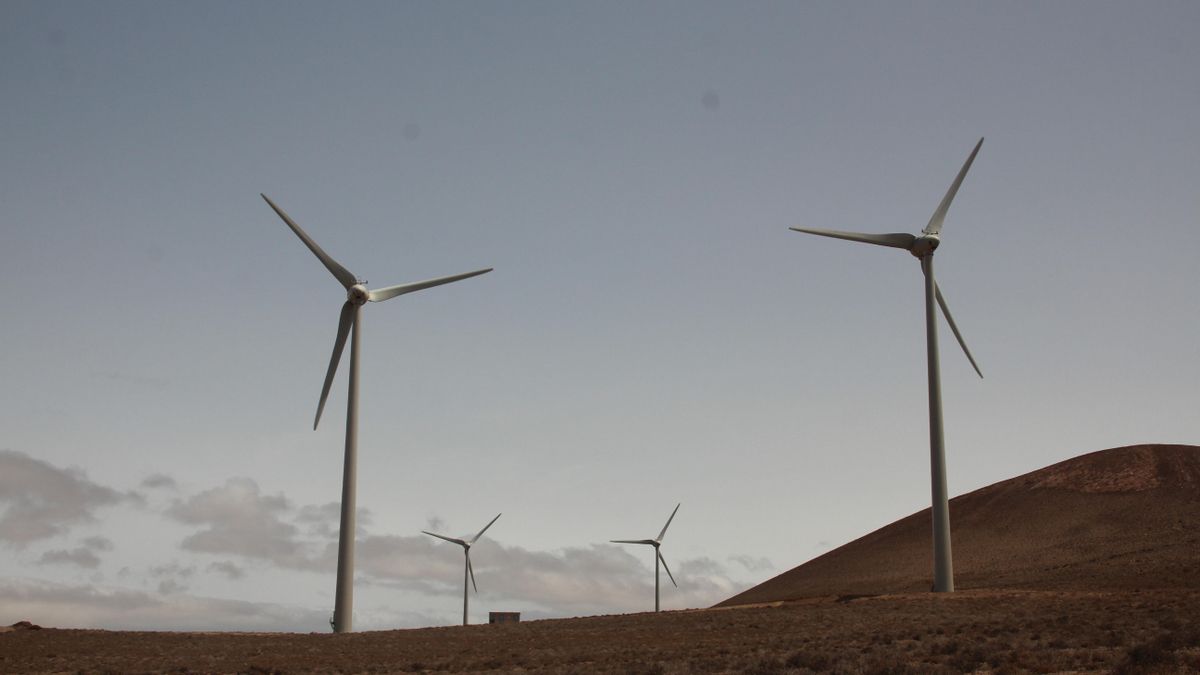
At present, Lanzarote has 40.7 MW installed, distributed across five wind farms with a total of 24 turbines: ten in Los Valles, two in Punta Grande, four in Teguise I, four in Arrecife, and another four in San Bartolomé. At peak times, wind power can cover up to 35% of the island’s total electricity consumption.
Offshore wind plans raise concerns
Two offshore wind energy projects are already being planned at sea, harnessing wind power to generate electricity. The first, known as Lanzarote Este, consists of four turbines and is promoted by the company Ocean Winds off the coast of the village of Las Caletas. The second, named Timanfaya, is driven by Capital Energy and includes another four turbines. The height of these turbines reaches 247 metres—just 70 metres less than the Eiffel Tower—in an island landscape where the maximum built height does not exceed 25 to 55 metres.
According to researcher Torcuato Teixeira Valoira, a lawyer specialising in fisheries law, both projects are located less than two kilometres from the coast, given the orography and depth of the Canary Islands’ seabed. “This is the shortest distance in the entire Spanish maritime spatial planning,” he noted.
Fishermen’s fears and the call for urgent studies
Fishermen on the island have conveyed their concern to the research team about the imposed model and their lack of visibility in decision-making. In the case of those in the north of the island, they fear that the planned energy parks will increase pressure on the La Graciosa Marine Reserve. “Planning has been done without data from the fishing sector, so the model is flawed from the outset,” Teixeira argued. To achieve a fair energy transition, the expert urges that urgent studies be conducted on the potential impact of offshore wind projects on the seabed.
Water: a decisive factor in energy planning
Water is another decisive factor to consider in Lanzarote’s energy planning, explained Rosa María Regueiro. “Many people warned us that there were water and electricity supply cuts in rural areas. The agricultural sector told us how could they be expected to lead an expansion initiative if they did not have this fundamental element guaranteed,” the researcher reported.
The report provides a snapshot of Lanzarote’s current water system. The main problem is the enormous losses from desalination plants. More than 50% of this resource is lost before reaching homes due to deficiencies in the network. Furthermore, the tourism model intensifies human pressure on this resource, accounting for 44.5% of total consumption, far above agriculture’s 4.1%.
Meanwhile, the service for capturing, treating and distributing water consumed 13.72% of the energy produced on Lanzarote in 2024, below household consumption (28.58%) and accommodation services (27.98%).
A logical order of priorities
Along these lines, the study argues that reducing the amount of water lost in transit would also reduce energy demand “without installing a single turbine.” Before sacrificing agricultural land and landscape, the study concludes, there is “a logical and legally sustainable order of priorities.”
On the one hand, this means repowering existing wind farms and promoting the sensible installation of photovoltaic panels on urban and industrial rooftops, making use of already degraded areas and boosting local energy communities. In this vein, they note that the RED III Directive establishes that ZARs must prioritise degraded land over productive land.
On the other hand, they urge a commitment to a model of renewable energy development on the island based on active participation and public ownership, prioritising respect for the territory and Lanzarote’s identity. “The operating profits should stay in the territory,” they propose.
“Obviously, no one questions the fight against climate change, neither on Lanzarote nor anywhere else. But what must be questioned is whether this fight should be waged with an extractivist model or with a model based on respect for biodiversity, landscape, ecosystems and the primary sectors that live off the land and the sea,” concluded Torcuato Teixeira.
What’s happening in the Canaries – straight to your phone
News, weather alerts and practical updates – direct from the islands, in English. We live here and know what’s going on – before the international media catch up. Everything lands on our WhatsApp channel – no middlemen, no algorithm. Curated for families, expats and travelers.

Canary Islands sea hits second-hottest year on record

Legal bid to halt tree felling in Santa Cruz’s La Salud

Fiesta del Charco: A journey through La Aldea’s past

Corralejo dunes power line set for removal

ULPGC launches 14 research projects at Las Canteras

TMT will never be built, says Canary Islands astrophysics chief

Pedro Duque: Canarias is the “ultimate dream” for rockets

Court blow to Tenerife motor circuit project
La Palma faces new volcanic risk planning deadline
