Crackdown on illegal shanty towns in Adeje
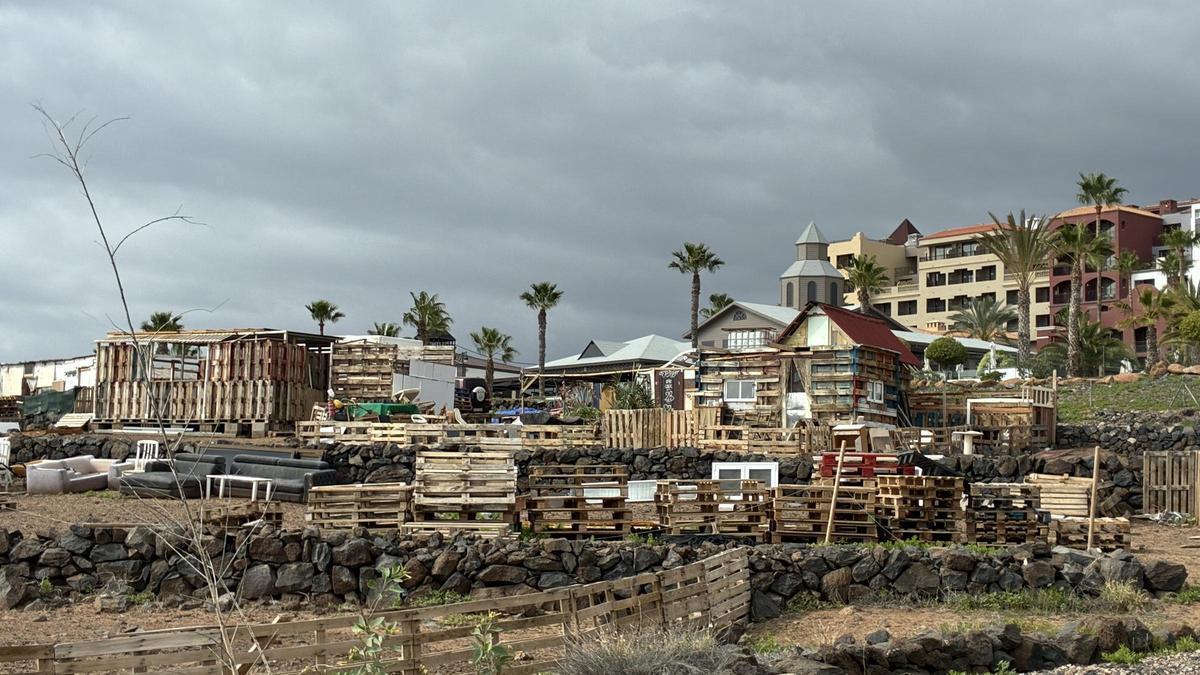
Adeje council has convened a meeting with various authorities to tackle the proliferation of shanty towns in the municipality, stating that the vast majority of the dwellings are second homes, and that some are even being used for illegal holiday lets or longer-term rentals.
Multi-agency talks on illegal settlements
The council’s security councillor, Mercedes Vargas, met with representatives from the Local Police, National Police, Civil Guard, legal experts and the director of the Canary Islands Agency for the Protection of the Natural Environment, Montserrat Ortega, to discuss the situation of illegal settlements in the area.
In a council statement, Ms Vargas explained that the phenomenon is concentrated mainly in the areas of El Valito, Llano Negro, Las Moreras, El Puertito and La Caleta. She noted that it has evolved from occasional residential use into a situation involving illegal holiday lets and longer-term rentals.
Health and environmental risks
The councillor pointed out that the situation has worsened in recent months, with an accumulation of waste posing a real risk to public health and the natural environment due to the proliferation of pests, the discharge of sewage into the sea and the risk of fires. As a result, the council has set itself the objective of “establishing a joint action roadmap and starting to work with all the necessary legal safeguards”.
Agency powers and legal process
The director of the Canary Islands Agency for the Protection of the Natural Environment explained that the body processes individual restoration and penalty procedures for each planning infringement, but stressed that the comprehensive management of a settlement cluster like the one detected in Adeje falls under municipal jurisdiction. The Agency also informed the council that it has all the necessary legal arguments to open proceedings of its own motion against the landowner for the accumulation of waste, and can also request the owner’s authorisation to proceed with an eviction. The director offered the Agency’s cooperation in relation to the public maritime-terrestrial easement areas that fall within its remit.
Individual case files to be opened
The council’s legal services confirmed that individual case files will be opened for each dwelling identified, in application of the Land Law, in order to guarantee the legal security of the process. However, the physical execution of the actions may be carried out simultaneously and jointly with the Environment and Coasts Agency.
Not a housing crisis, say officials
Along the same lines, the councillor for the Presidency and Urban Planning, Manuel Luis Méndez, pointed out that most of the cases detected correspond to second homes or alternative lifestyles, and not to situations of housing need. He highlighted that the council already has a precedent for good practice in the operation carried out in Diego Hernández, where advance notice to the occupants meant that only one person remained in the area at the time of the eviction.
“It is an absolute necessity to start intervening, and the Diego Hernández experience shows that if the proper preparatory work is done, action can be taken with legal guarantees and with the least possible impact on people,” Mr Méndez stated.
Social services on standby
The councillor for Community Welfare and Social Cohesion, Raquel Rodríguez, indicated that the council has identified the people occupying these settlements and specified that the vast majority are not in a situation of vulnerability or social exclusion. Only a small number of cases require monitoring by the municipal social services.
“We have identified the people who are in a more delicate situation, and they will be given whatever response we can provide within the council’s means in the event that evictions take place,” she said.
Coordinated action agreed
In conclusion, the authorities agreed to coordinate the notification and identification processes simultaneously, and to share direct communication channels to speed up the administrative procedures.
What’s happening in the Canaries – straight to your phone
News, weather alerts and practical updates – direct from the islands, in English. We live here and know what’s going on – before the international media catch up. Everything lands on our WhatsApp channel – no middlemen, no algorithm. Curated for families, expats and travelers.

Tenerife faces huge tourism expansion despite moratorium calls

El Bejeque in Las Canteras adds sea to its fire

Siam Park Gran Canaria must build its own desalination plant

Fuerteventura’s biggest resort to open on 1 November
Gran Canaria to teach tourism history in schools
Canary Islands see 0.3% rise in foreign tourists in August

Row over 368-bed hotel project in La Gomera
Spanish astronaut trains in Lanzarote for Moon mission

Tivoli La Caleta hosts first red tuna Kaitai in Canarias