Smoking banned in all open areas of Teide National Park
Thousands of visitors explore Teide National Park every day. Some take photos, others rest at the viewpoints, and many set off on hiking routes. Since 19 June, however, all of them must comply with a new rule: smoking is prohibited across all open areas of the park as a preventive measure against the risk of forest fires. The ruling affects anyone who lights up on trails, tracks, viewpoints, recreational areas, car parks, rest zones and public-use facilities, except within covered buildings where smoking is expressly permitted. The decision follows three fires in protected areas of Tenerife in recent weeks, which are believed to have been started by discarded cigarette butts.
Limited signage and visible butts
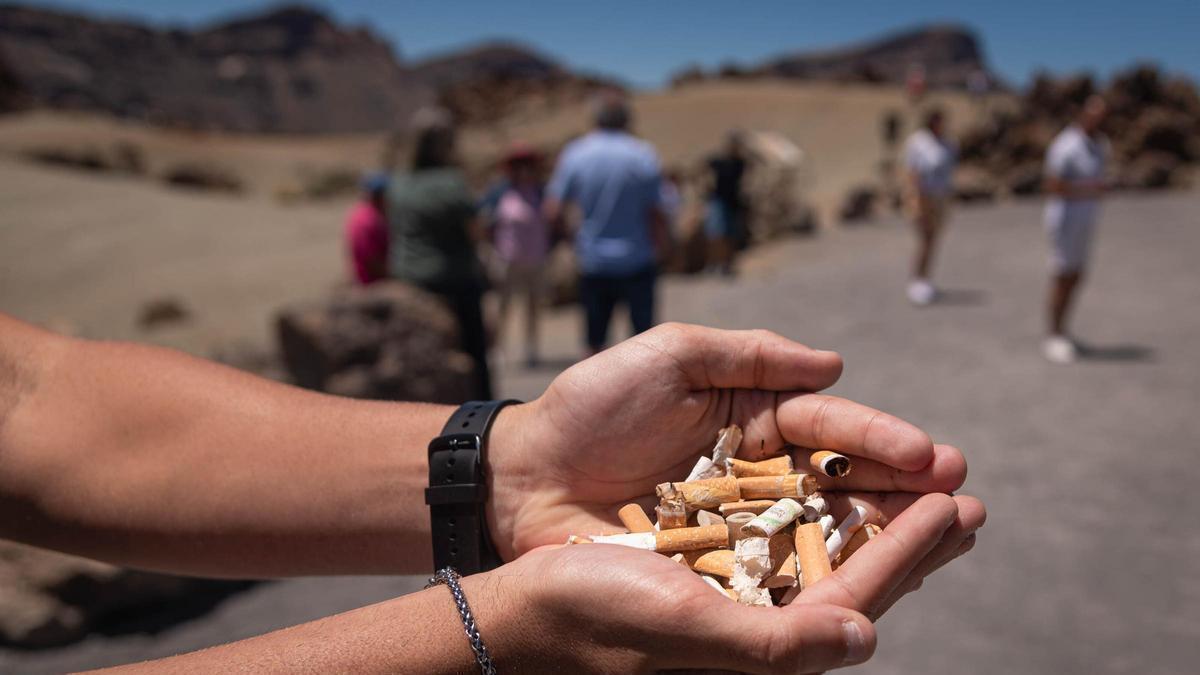
Several days after the ban came into effect, however, there are barely any visible reminders of the new rules across the protected area. This is particularly striking at some of the stops along the TF-21 road. At one such spot, next to the entrance to a walking trail, more than 30 cigarette butts were found within just a few minutes – and all this at the start of summer, with high temperatures and the sun beating down ever more intensely on Las Cañadas. It was this very scene that surprised Rebeca, Javier and Pablo, a family from Burgos, who were spending the morning exploring the lower slopes of the volcano. Although unaware of the new regulation, they were astonished to find numerous signs of smokers on one of the paths. “We haven’t stopped seeing cigarette butts,” said Javier, the father, even before being asked for his opinion. His partner, however, welcomed news of the ban. “We think it’s a very good decision that you can’t smoke. Well done, hats off!” applauded Rebeca. Neither of them smokes, but they say they understand those who do, and still believe the measure is necessary.
‘A very important natural area needs protecting’
“The rule is good because we are protecting a very important natural area, and it has to be treated with great care,” Javier pointed out. The family recalled fires that have occurred in other parts of Spain and stressed the importance of avoiding any carelessness. “We are from the north, but we go to Galicia a lot, and it is constantly burning there, just like in Zamora and other provinces with lots of natural environment. That it burns deliberately or because of a cigarette butt is such a shame,” added the mother. Adaptation to the new regulation still seems to be a work in progress. During our visit, several people were observed smoking at various points in the protected area, many of them apparently unaware of the ban.
Park staff: informing smokers rather than fining them
This situation does not come as a complete surprise to those who work on the ground. Both rangers and park management staff acknowledge that the measure has only been in force for a few days and that, for now, there is no specific signage reminding visitors that smoking is prohibited. A Gesplan technician, when asked how they respond to violations, explained that there are already plans to update the signage and incorporate ‘no smoking’ warnings, in the same way as other restrictions, such as those on drone use. For the time being, no fines are known to have been issued for this reason, and if a person is caught smoking, his first reaction would be to inform them of the new regulation before initiating any further procedure. “I’d say: ‘Hey, just so you know, you can’t smoke here,'” he mimed during the conversation.
Broad support for the ban among visitors
Overall, however, the rule seems to enjoy widespread support from the majority of visitors, who prioritise the protection of Teide’s natural environment. “It’s the right thing to do, we think it’s great,” commented a group of friends from Los Realejos, who, although they smoke themselves, consider the ban necessary. “It’s a good measure,” admitted a Portuguese tourist couple, smiling, who were also unaware of the new regulation. “The environment must be protected above all else,” continued the woman, speaking almost perfect Spanish. “Back home, as far as I know, they haven’t passed anything like this.” “Very good, Tenerife,” she summarised, giving both thumbs up in approval. “There’s tobacco everywhere – on the beaches, in the street, everywhere. For me, it’s great, protecting the environment comes first,” said María José, a resident of Madrid originally from Málaga. “In Andalusia, they tell you not to smoke on the beach, but then lots of people do,” she noted. For her, the measure makes perfect sense. “If butts are thrown all over any beach, it’s disgusting,” she declared, convinced that restricting smoking in natural spaces is a wise decision.
Not everyone agrees: ‘The rule goes too far’
However, there are those who do not entirely welcome the prohibition. One of them, Miguel López, from Sagunto in the Valencia region, said he understands the need to protect Teide but believes the measure “goes too far”. “It’s all very well that they look after the park, but not everyone who smokes comes here to set fire to things. We are not all arsonists, and we are not here to cause harm. They already ban us from smoking in a pub, on a terrace, and now anywhere as well. Why don’t they just ban smoking altogether and be done with it?” he lamented, resigned. His companion, a resident of Santa Úrsula, shared a similar view, though with more nuance. He believes protecting the environment is necessary but does not rule out the possibility of designating a specific area for smokers. “I agree that we must look after our landscapes, that’s clear. But why not mark out well-controlled, safe zones where those who want to smoke can do so without any problem, without bothering anyone or taking any risks?” he commented.
Fines, penalties and enforcement
For those who violate the rules in the natural area, penalties for smoking range from €100 to €1,000. If the behaviour leads to a forest fire, fines can reach €100,000 for civil liability and could even result in prison sentences. Enforcement of the ban falls to environmental agents, forest rangers and Brifor personnel at the park boundary. Since the last fire in 2023, both preventive and coercive measures have been adopted to maintain a joint working approach with the Seprona division of the Civil Guard and other security forces. These actions have led to five people responsible for fires currently being in prison. Notable cases include that of Icod el Alto in Los Realejos – who had set more than 100 fires – as well as those in San Miguel Alto and La Esperanza. In a place where thousands of people arrive every day, a single cigarette butt can alter the image of one of Tenerife’s most emblematic spaces. That is why, beyond personal preferences or inconveniences, the new rule aims to ensure that the landscape remains, above all, a landscape.
What’s happening in the Canaries – straight to your phone
News, weather alerts and practical updates – direct from the islands, in English. We live here and know what’s going on – before the international media catch up. Everything lands on our WhatsApp channel – no middlemen, no algorithm. Curated for families, expats and travelers.

Tenerife faces huge tourism expansion despite moratorium calls
El Bejeque in Las Canteras adds sea to its fire

Siam Park Gran Canaria must build its own desalination plant

Fuerteventura’s biggest resort to open on 1 November
Gran Canaria to teach tourism history in schools
Canary Islands see 0.3% rise in foreign tourists in August

Row over 368-bed hotel project in La Gomera
Spanish astronaut trains in Lanzarote for Moon mission

Tivoli La Caleta hosts first red tuna Kaitai in Canarias