
Seismic activity increase detected under Tenerife
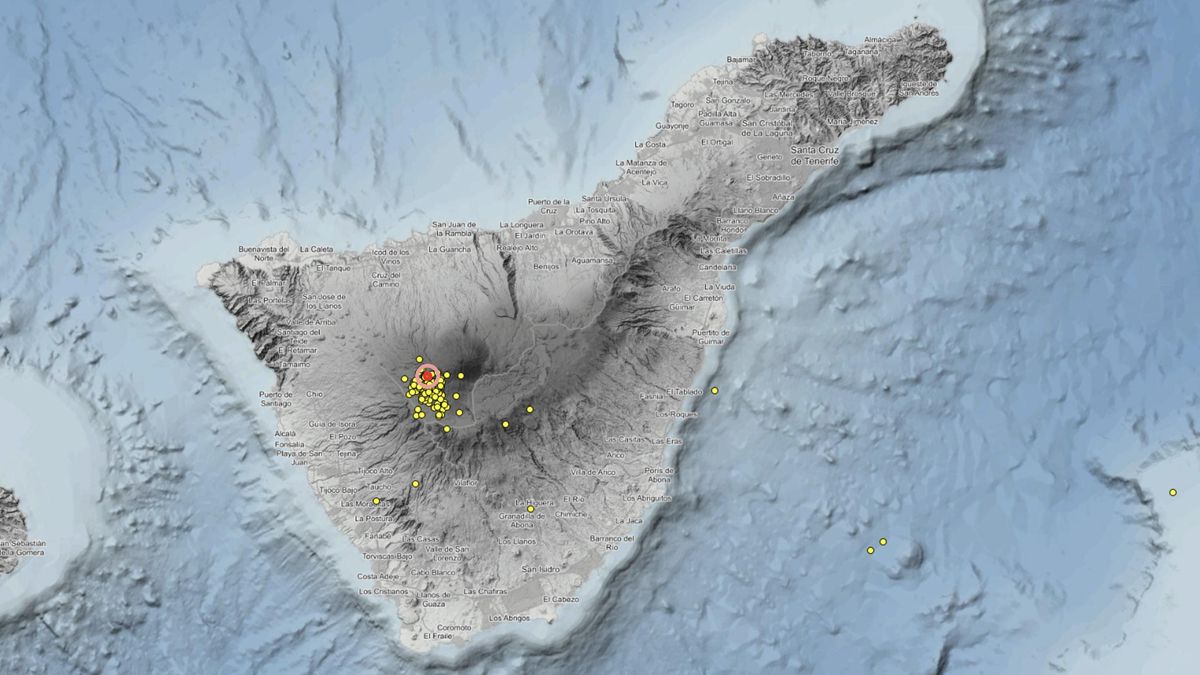
The National Geographic Institute (IGN) has issued a notification to the Canary Islands Government’s Civil Protection Service regarding an increase in the frequency of seismic activity in Tenerife over recent hours, though it stresses that the risk of an eruption in the short or medium term has not risen. This follows the detection of an intensification in volcano-seismic activity beneath the island, mainly west of Las Cañadas del Teide, with 221 low-frequency events recorded in the last 48 hours.
Activity concentrated in early morning hours
From the early hours of Saturday into Sunday, and particularly during the early hours of Sunday into Monday at 2:07am, several pulses of low-frequency seismic activity have been detected in the same area where regular activity has been recorded in recent months. It was at this time that, following standard protocols, the alert was sent to Civil Protection. Sources from the IGN consulted by EFE noted that similar notifications have been sent previously, but this is the first time the public has been informed.
Types of seismic events identified
During this intensification, the IGN has identified ordinary volcano-tectonic events, hybrid events, and LP (long-period) events. All of these have shown a high degree of correlation with each other since Saturday afternoon, although none have been felt by the population. Between last Thursday and Friday, the IGN had already recorded 79 earthquakes in the same location. The detected seismic events are all very similar: their magnitudes are below 2 MbLg, and most epicentres are located in the western area of Las Cañadas, as has occurred previously, primarily within the municipal districts of Guía de Isora, Vilaflor de Fasnia, and Santiago del Teide. Depths are mostly around 10–15 kilometres below sea level.
Comparison with previous activity
The IGN emphasises that this activity is similar to that observed in February and March of this year. Finally, it clarifies that due to the low amplitude of the signals analysed, the data on the number of events, as well as the range of their magnitudes and depths, remain provisional. When a more detailed analysis is carried out, the number of events could increase, and specific magnitude ranges will be provided in the IGN’s official catalogue.
Involcan confirms uptick in micro-earthquakes
Meanwhile, the Canary Islands Seismic Network (Involcan) reported this weekend an increase in seismic activity in Tenerife, with more than 200 volcano-tectonic (VT) micro-earthquakes of very low magnitude recorded in the southwestern sector of the Las Cañadas caldera, at a depth of approximately 10 kilometres. It noted that the maximum magnitude recorded so far was Ml 1.1 on the Richter scale. However, Involcan added that, based on currently available information, ‘no evidence has been identified to indicate an increased probability of a volcanic eruption in the short or medium term in Tenerife.’
Part of ongoing seismic activity since 2017
According to Involcan, this episode is part of the recurring seismic activity that the island has experienced since June 2017. ‘As on previous occasions, its origin is associated with a pressurisation process of the island’s volcanic-hydrothermal system, caused by the injection of fluids of magmatic origin,’ it states. This process has been observed repeatedly since 2016 and is supported by various independent geochemical and geophysical indicators. ‘Among these are the sustained increase in diffuse CO2 emissions in the area of the Teide crater and the slight ground deformation detected since 2024 in the northeastern sector of the Teide-Pico Viejo volcanic complex,’ it adds.
What’s happening in the Canaries – straight to your phone
News, weather alerts and practical updates – direct from the islands, in English. We live here and know what’s going on – before the international media catch up. Everything lands on our WhatsApp channel – no middlemen, no algorithm. Curated for families, expats and travelers.

Canary Islands sea hits second-hottest year on record

Legal bid to halt tree felling in Santa Cruz’s La Salud

Fiesta del Charco: A journey through La Aldea’s past

Corralejo dunes power line set for removal

ULPGC launches 14 research projects at Las Canteras

TMT will never be built, says Canary Islands astrophysics chief

Pedro Duque: Canarias is the “ultimate dream” for rockets

Court blow to Tenerife motor circuit project
La Palma faces new volcanic risk planning deadline
