Ambitious plan for an Atlantic aerospace hub
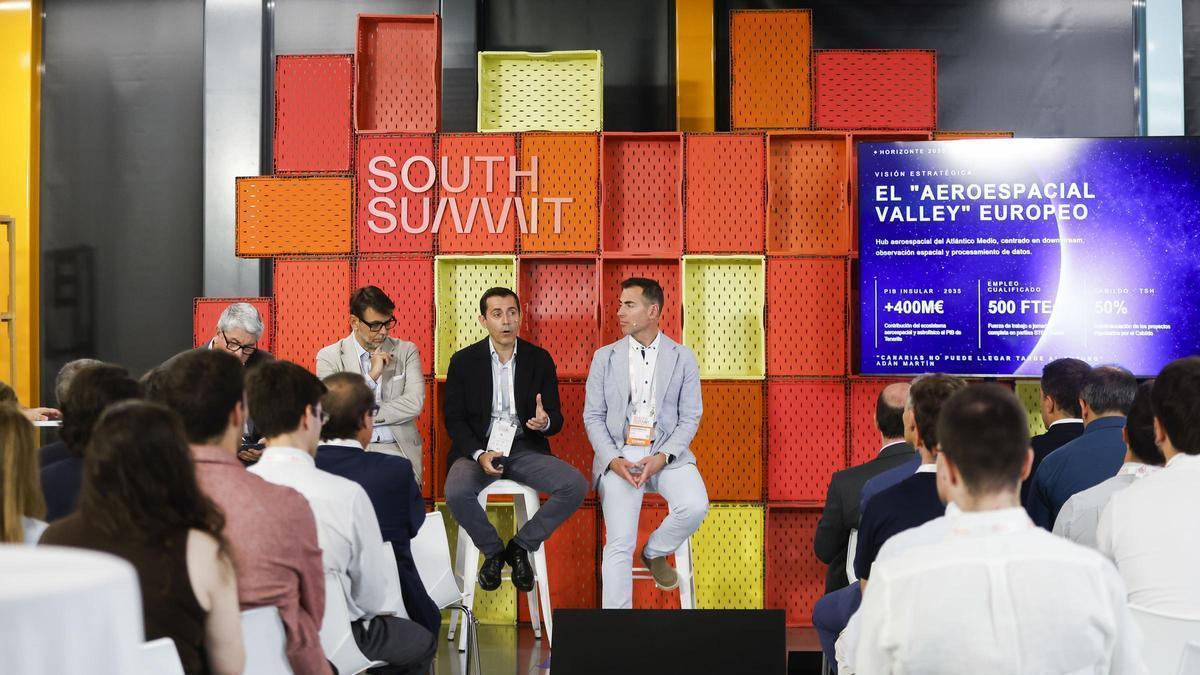
The Cabildo of Tenerife is aiming to establish the island as a major Atlantic aerospace hub. The island’s governing body presented the Tenerife Space Horizon strategy on Wednesday at the South Summit Madrid, a plan backed by 79 million euros of investment and hopes of generating an economic impact of 400 million euros over the next five years. The initiative seeks to position Tenerife within a high-value-added sector, linked to Earth observation, satellite communications, data analysis, supercomputing, and the creation of skilled jobs.
Science and technology at the core
The project is built upon Tenerife’s scientific and technological ecosystem, with the Institute of Technology and Renewable Energy (ITER) playing a key role. “In the first year of the strategy, we have achieved all the milestones set for a much longer period,” said Juan José Martínez Díaz, the Cabildo’s Councillor for Innovation, during the presentation. He highlighted the growth of the island’s innovative ecosystem, which has expanded from 26 to 56 companies in recent years.
The Canary Islands constellation flagship
One of the cornerstones of the plan is the Canary Islands Constellation, considered the flagship project of Tenerife Space Horizon. The first phase has an investment of 21 million euros and involves the design, manufacture, and launch of a network of small satellites. The goal is to achieve daily observation of Tenerife, La Palma, La Gomera, and El Hierro, providing valuable data for land management, environmental monitoring, risk prevention, natural resource management, and emergency response. The company Telespazio Ibérica will lead the construction of three satellites, as well as their operation and the commercialisation of the data they generate. Its CEO, Carlos Fernández de la Peña, argued during the presentation that this constellation could offer a “unique service in the world” and open the door to expansion into other countries and regions.
CanarySat and the new teleport
The aerospace strategy also includes the development of infrastructure related to satellite communications. A key role here is played by CanarySat, which involves the deployment of a low-orbit constellation and the creation of a teleport on Tenerife alongside ITER. The CEO of CanarySat, Antonio Abad, explained that this infrastructure, with an investment of over 18 million euros, will connect space networks with the archipelago’s submarine cable network and the island’s supercomputer. The Cabildo and ARQUIMEA had previously announced the deployment of a satellite communications teleport on Tenerife as part of the CanarySat project, with two main elements: the construction and operation of the teleport in the Canary Islands and the deployment of a communications satellite constellation.
Supercomputing power for data demands
The vast amount of data generated by aerospace activity requires storage and processing capacity. Consequently, the strategy also includes a new version of Tenerife’s supercomputer. The German company Bechtle will work on this technological evolution. Its commercial director, Juan Manuel Bernal, explained that the aim is to provide an infrastructure capable of storing, processing, analysing, and managing data from the aerospace sector. ITER already has a supercomputing centre and other technological infrastructure linked to research, renewable energy, the environment, and new technologies.
Competitive advantages and early success
The Cabildo’s Councillor for Innovation, Juan José Martínez Díaz, highlighted during the presentation that milestones planned for a longer period have already been achieved in the first year of the strategy. He focused on the growth of the island’s innovative ecosystem, which has gone from 26 to 56 companies in recent years. He also pointed to competitive advantages such as the presence of the Institute of Astrophysics of the Canary Islands and the Canary Islands’ tax regime, which offers incentives for R&D+i that, he stated, can reach up to 90%, double those of the rest of Spain.
Venture capital fund and economic vision
The Cabildo also announced that it will launch a venture capital fund this week linked to aerospace initiatives developed on Tenerife. The intention is to attract projects, companies, and specialised talent. The Tenerife Space Horizon strategy aims to promote a more diversified, knowledge-based economy capable of generating skilled jobs and new opportunities for professionals in engineering, data analysis, telecommunications, programming, research, and technology management.
Global space market context
The global space market reached 613 billion dollars in 2024, with a compound annual growth rate of 7.4 per cent since 2019, according to data presented at the event. This context explains Tenerife’s interest in entering an expanding sector with the capacity to generate economic activity beyond tourism. The Cabildo maintains that the island has the conditions to compete in this field: scientific centres, technological infrastructure, connectivity, a differentiated tax system, and an ecosystem of emerging companies.
What’s happening in the Canaries – straight to your phone
News, weather alerts and practical updates – direct from the islands, in English. We live here and know what’s going on – before the international media catch up. Everything lands on our WhatsApp channel – no middlemen, no algorithm. Curated for families, expats and travelers.

Tenerife faces huge tourism expansion despite moratorium calls
El Bejeque in Las Canteras adds sea to its fire
Siam Park Gran Canaria must build its own desalination plant
Fuerteventura’s biggest resort to open on 1 November
Gran Canaria to teach tourism history in schools
Canary Islands see 0.3% rise in foreign tourists in August
Row over 368-bed hotel project in La Gomera
Spanish astronaut trains in Lanzarote for Moon mission

Tivoli La Caleta hosts first red tuna Kaitai in Canarias