
First Visitor Decline in Five Years for Canary Parks
Teide, Timanfaya, Garajonay and La Caldera de Taburiente received a total of 8.2 million visitors last year, which is 166,750 fewer than the year before. The Canary Islands National Parks have thus reduced the human pressure for the first time in five years. In cases like the Teide National Park, this pressure is one of the circumstances threatening an imminent collapse of its ecosystem. The scientific community considers the decline “hopeful”, but reminds us that this reduction, of barely 2%, must continue and be much greater to avoid the degradation of these natural jewels of the Archipelago.
Teide: Still the Most Visited, Still Under Pressure
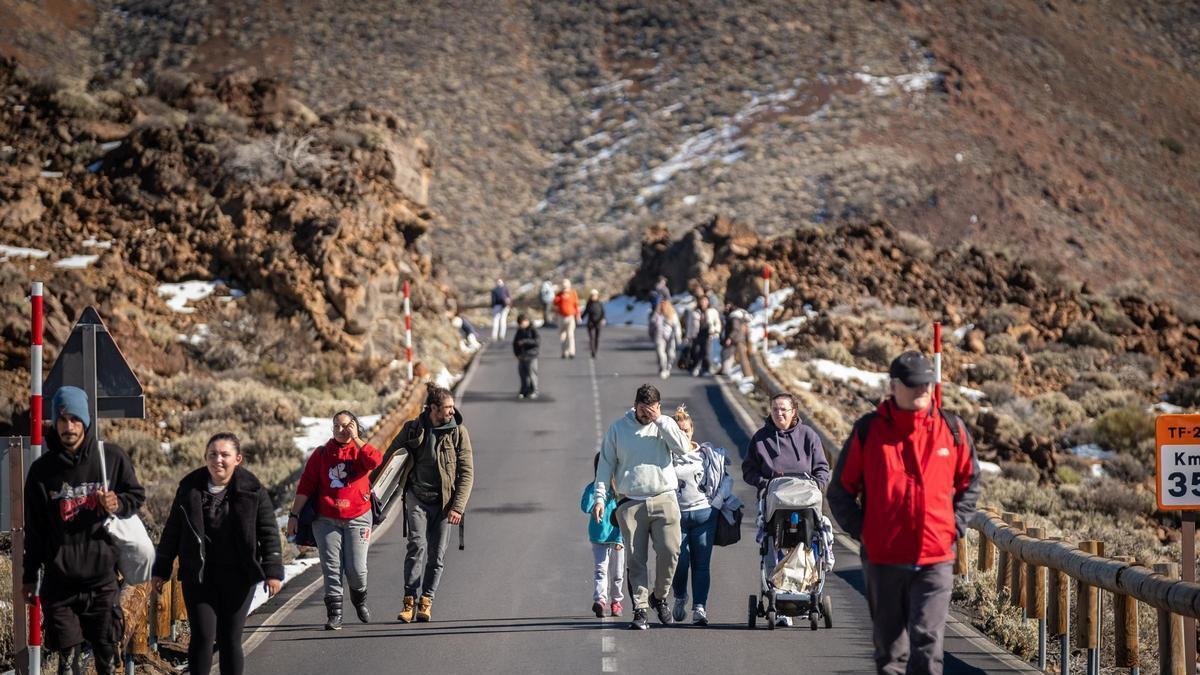
As can be seen from the updated data provided by the Ministry for Ecological Transition referring to the year 2025, this drop in visitors has been particularly noticeable at Teide. Having withstood the pressure of 5.1 million people in just one year, it has lost 129,444 visitors. Nevertheless, and despite this decrease, the fragile ecosystem of Teide still endures the daily visit of 14,000 people, a flow that peaks in August when more than 15,000 people can traverse the slopes of the great volcano every day. In fact, today, Teide is visited as much as all four Canary Islands National Parks were a decade ago. “It is the most visited National Park in Spain and one of the most crowded in the world,” recalls forestry engineer Jaime Coello.
Experts Call for Drastic Reduction in Numbers
For this reason, for Coello, who is also the director of the Telesforo Bravo-Juan Coello Foundation, these figures – however much they have decreased – are “exorbitant”. In his view, a very significant reduction in the influx would be needed to lessen the impact that these visits, combined with the effects of climate change and invasive species, are having on this high-mountain ecosystem. For the delegate of the Spanish National Research Council (CSIC) in the Canary Islands, Manuel Nogales, the reduction of human pressure on Teide National Park is good news, but he also considers the volume of daily visitors to still be “too high”.
In this sense, and although neither would venture to give a concrete figure for what the optimal number of visits to Teide would be – for that a study on carrying capacity would be needed – Coello would dare to say that this number should be reduced by at least half. In an interview with Canarias Radio, the current director of Teide National Park, José Luis Esquivel, warned that the number of daily visitors must be reduced by at least half. “With half we would be in a better situation,” he stated in that interview.
Timanfaya: Losing Visitors for a Second Consecutive Year
Timanfaya National Park in Lanzarote is the second most visited in the Canaries. The volcanic route was visited by 1.4 million people. The route of the volcanoes thus loses visitors for the second consecutive year. In the case of the volcanic route, this last year it lost 88,500 visits, which added to those of 2024 makes 226,000 fewer than in 2023. In fact, Timanfaya has not recovered the visitor numbers from before the pandemic, when it received 1.6 million visits. “This Park is preparing its new Master Plan for Use and Management (PRUG),” reveals Nogales, who insists that one of the challenges of this new directive is “organising the visits.”
And while Lanzarote has been a pioneer in restricting private vehicle access to its National Park, it has not done so with its ticketing. “The bus service is very good, but long queues form at the entrance, which diminishes the quality of the visit,” insists Nogales.
Garajonay and Caldera de Taburiente: Mixed Trends
The third most visited park is Garajonay, on La Gomera, which this year sees an increase in visitors, although at a lower rate than in previous years. Specifically, in 2025 it received 1.3 million visitors, 14,000 more than the year before. “What is surprising is how close it already is to Timanfaya’s figures,” notes Nogales, who highlights the good management being carried out at Garajonay. “This year they want to put the PRUG out for public consultation and it is very good, very ambitious and has a model to follow,” he emphasises.
In Garajonay and Teide, not only have pre-pandemic figures been recovered, but today they are more visited than before the coronavirus crisis erupted. Teide receives 600,000 more people per year, which means an increase of 1,800 more people per day. Garajonay now receives 300,000 more people per year, corresponding to 950 more per day.
For its part, La Caldera de Taburiente, on La Palma, grows by 37,000 visitors and nears pre-pandemic figures. In 2025, this National Park welcomed 401,117 visitors, the highest number since 2019. “The fact that it is the least visited invites us to reflect on mobility management,” stresses Coello. For the director of the Telesforo Bravo Foundation, it is precisely the ease of entering the Park by private vehicle that is behind this fluctuation in numbers. It is worth remembering that access to the heart of La Caldera de Taburiente is difficult and must practically be done on foot.
The Solution Lies in Mobility Management
For this reason, Coello argues that the model to follow to achieve an improvement in the health of the National Parks – and especially Teide’s – lies in mobility management. “That is where the pressure can be reduced the most,” insists the forestry engineer. In his opinion, the optimal way to achieve a lower number of visits to Spain’s highest peak would be to organise the flow of visitors with four interchange hubs: in Guía de Isora, Vilaflor, La Orotava and La Esperanza. “It would be much more effective than centralising everything at Portillo Alto,” he insists.

Iberdrola plans Tenerife’s biggest battery storage plant

The wild canary that gave its name to the Canary Islands

Canary Islands sea hits second-hottest year on record

Legal bid to halt tree felling in Santa Cruz’s La Salud

Fiesta del Charco: A journey through La Aldea’s past

Corralejo dunes power line set for removal

ULPGC launches 14 research projects at Las Canteras

TMT will never be built, says Canary Islands astrophysics chief

Pedro Duque: Canarias is the “ultimate dream” for rockets
