
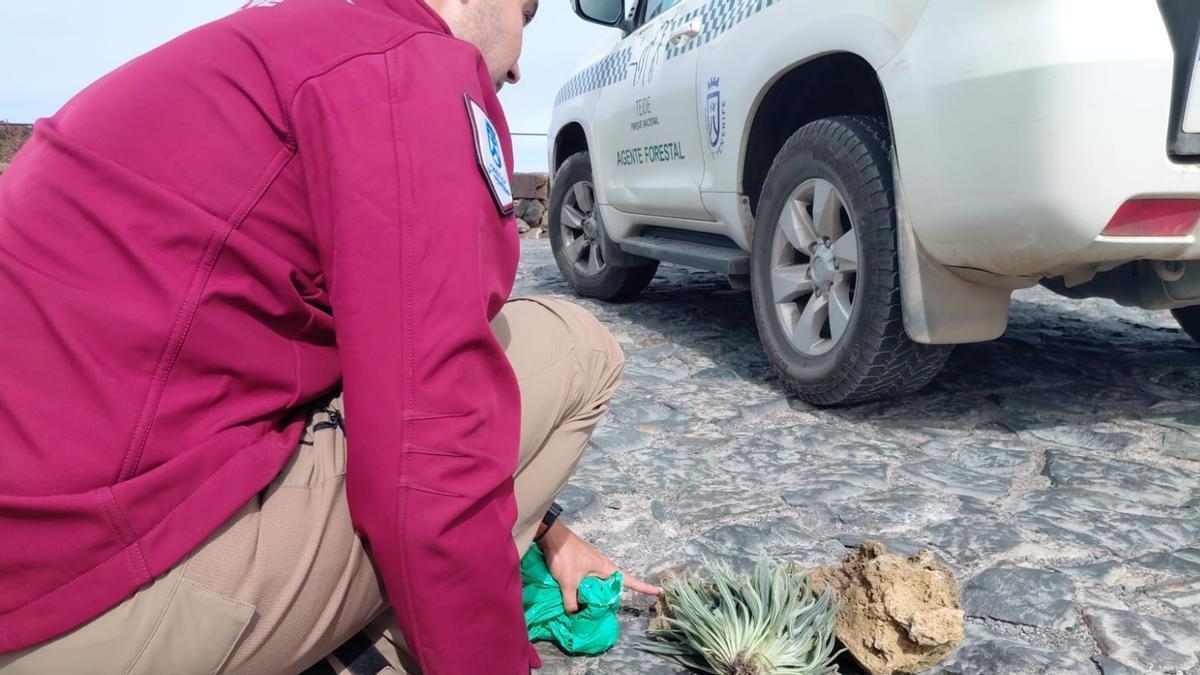
Two tourists have been caught removing a specimen of an endemic plant and a large volcanic rock from Teide National Park, in a breach of the site’s strict conservation rules. The pair, both German nationals, were intercepted by rural guards who had recently joined the park’s surveillance team.
Protected species found in car boot
The guards discovered the plant and the rock in the boot of the vehicle the tourists had used to enter Tenerife’s most protected natural space. The plant in question was a red tajinaste (Echium wildpretii), a species that grows only in the island’s highlands and is one of the most emblematic flowers in Tenerife’s flora. Known for its towering flower spike, the tajinaste is among the park’s most biologically valuable species.
Once the intervention was completed, an official file was opened which could result in a fine of €1,500. Uprooting plants and taking rocks from Teide National Park is strictly forbidden under conservation rules at the site, which is designated a UNESCO World Heritage site. Despite the ban, such incidents are relatively common in protected areas of the island.
Security reinforcement pays off
The interception came less than a month after surveillance in the park was significantly strengthened. Security in the national park went from just two staff members in mid-April to 27. The team now comprises 14 environmental agents – 12 of whom have just joined the Cabildo de Tenerife after passing a competitive exam – along with 13 private security staff, specifically rural guards.
The reinforcements were approved by the Cabildo’s Governing Council yesterday and will be deployed for round-the-clock surveillance within just two weeks. The Cabildo de Tenerife allocated €3.4 million to enhance control measures at this flagship of Canary Islands nature. The contract will run for three years, and Blanca Pérez, the Cabildo’s councillor for Natural Environment, described it as “a milestone” in the management of Teide’s security.
New service targets overcrowding hotspots
The new service will focus on prevention and protection of the national park and several surrounding areas affected by tourist overcrowding, including the viewpoints at Chipeque, Ayosa, Lomo del Retamar, and Los Poleos. Its main functions include rapid response to emergencies, accidents, fires and other incidents; surveillance of areas both inside and outside the park; and coordination of preventive measures and contingency plans.
Penalties for vandalism and anti-social behaviour in Tenerife’s natural spaces can be severe. In Teide National Park, fines for serious environmental infractions can reach as much as €600,000. Standard penalties for causing damage in natural areas, such as removing volcanic rocks or sand, typically range from €600 to €1,500.
The queen of Teide’s flora
The tajinaste is currently putting on its spectacular spring bloom. Known as the “flower of a thousand flowers”, the red tajinaste of Teide has a “guaranteed” future. This star endemic of Tenerife’s flora and the largest flower in the Canary Islands has left behind the period when it was on the brink of disappearing. This spring, it is again displaying enough vitality to confirm that its conservation programme has been a success.
The tajinaste is just one of 58 endemic species found in Teide National Park. Its large size – it can exceed two metres in height – and its rosette of tiny, spear-shaped flowers make it one of the most remarkable plants in the protected area. Given its exceptionally high biological value, it is among the most protected species on the island’s summit.
What’s happening in the Canaries – straight to your phone
News, weather alerts and practical updates – direct from the islands, in English. We live here and know what’s going on – before the international media catch up. Everything lands on our WhatsApp channel – no middlemen, no algorithm. Curated for families, expats and travelers.

Canary Islands sea hits second-hottest year on record

Legal bid to halt tree felling in Santa Cruz’s La Salud

Fiesta del Charco: A journey through La Aldea’s past

Corralejo dunes power line set for removal

ULPGC launches 14 research projects at Las Canteras

TMT will never be built, says Canary Islands astrophysics chief

Pedro Duque: Canarias is the “ultimate dream” for rockets

Court blow to Tenerife motor circuit project
La Palma faces new volcanic risk planning deadline
