Meet Santi, the Star Pupil
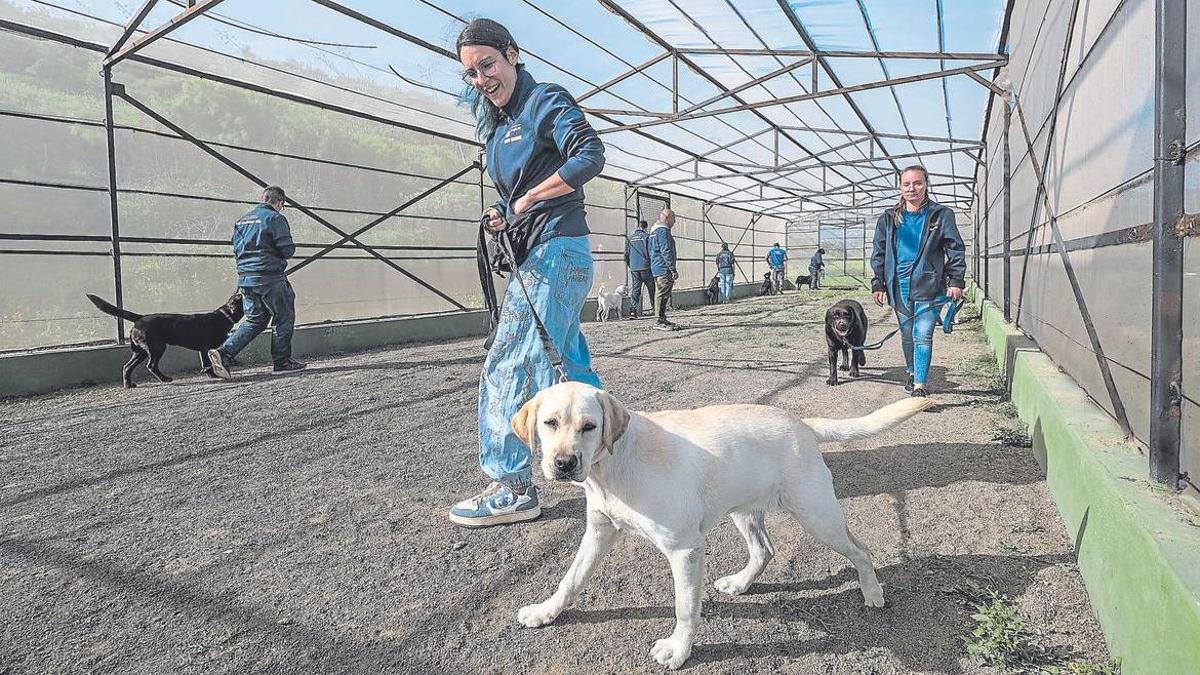
Santi the Labrador has the nose for the job, if not always the manners. He is the cleverest of a lively bunch of eight-month-old pups, who are sharper than a tack. Santi is also the neatest when executing his tasks: three repetitions and he’s got it. This is well known to the 20 human students sharing a training day with him and the rest of the canine crew at the El Viso estate. They are learning, with great patience, positive reinforcement, and plenty of treats—following the principles of Ivan Pavlov’s experiment—to become something the Canary Islands has never had before: assistance dogs trained locally by instructors from the islands, to stay in the islands.
A Training Ground With a View
This is happening on a seven-hectare estate built on the slopes of the Montaña de Las Palmas in Telde, 446 metres above sea level. ‘El Viso’ means just that—a high place from which a great expanse can be seen. The panorama from this enclave, equipped with adapted huts for classes, shows the ravine of Barranco de San Roque below and, beyond it, the deep blue Atlantic. It is part of the municipal land leased by Telde Town Council to the Terapican Association project, which since October has been producing the first generation of assistance dog instructors on this hillside.
Filling a Critical Gap
The first accredited assistance dog in the Canaries, Yogui, a golden retriever now around five years old, was trained at the school of Meritxell Arias, the teacher of these 20 human apprentices. An assistance dog instructor since 2004, with 22 years in the trade, she is the technical lead for this training work, assisted by Ona and Bubu, the instructor’s own dogs, who serve as assistant teachers. “The problem is there are no instructors here, so outside organisations have to come to deliver dogs,” she explains. The initiative focuses on specialised training for assistance dogs—animals trained to directly support the autonomy of people with disabilities or specific medical needs.
From Unemployment to a New Profession
The 20 students arrived in October knowing little, or nothing at all. Some, like future instructor Xenia, were already involved in dog work. Most were not. What they all shared was being unemployed. The professional certificate they are pursuing, fully funded by the Canary Islands Employment Service, is designed to open a career path in a sector that did not exist in the islands until now. The fact that it is also the first time nationally a course of this type has been set up in this format is of significant importance. The Canaries are getting their act together and taking the lead in this training, composed of three parts: animal selection, basic training, and speciality learning.
More Than Just Guide Dogs
If you ask the average person what an assistance dog is, they will most likely describe a Labrador in a harness guiding a visually impaired person along the pavement. That is a guide dog, which is just one of the five types recognised by law, working specifically with blind or partially sighted people. It is the most recognisable because it has been on the streets for decades, and the ONCE (Spanish National Organisation of the Blind) has done unparalleled awareness work. But a guide dog is not a generic assistance dog; it is a speciality within a much broader field. Confusing them all is like thinking a GP is the only type of doctor that exists.
There are four other legally recognised types, each with its user, function, and way of working, unknown to most people. Royal Decree 409/2025 of 27 May came to order the regulatory framework. It repealed a 1983 decree that only spoke of guide dogs for the visually impaired—all that existed then—and replaced it with a rule recognising all five types. It also regulates how they must be trained, who can train them, the required paperwork, and where they can enter. “When they see a child with autism, who doesn’t have a visibly recognisable disability, and they see a dog anchored to that child, they say it can’t come in because it’s a pet. And you say: no, it’s an assistance dog, but it doesn’t work with visual impairment,” notes Meritxell. This problem repeats in shops, restaurants, schools…
Celebrity Sponsors for Awareness
To tackle this visibility problem, the project has incorporated a line of celebrity sponsors, public figures from the Canaries who are photographed with the dogs in training. The photos are taken by photography students from the Gran Canaria School of Art and Design and shared on social media with an awareness message. Already confirmed are, among others, the Canary Islands Government’s Minister for Tourism and Employment, Jessica de León; the Director-General of the Canary Islands Tourism and Employment Service, María Teresa Ortega; the Mayor of Telde, Juan Antonio Peña; and several familiar faces from Canarian television like Paco Luis Quintana, Vitorio Pérez (presenter of ‘Una hora menos’), Mercedes Martín, Kiko Barroso, and Mari Carmen Sánchez. Each with their assigned dog.
The Canine Class of El Viso
The dogs have been sniffing around the estate since they were four or five months old. Nine Labradors and a golden retriever named Suggar entered El Viso as jobless puppies. Among them are also Soto and Sara, who are white; Estela and Emilio, who are black; and Suso, Santi (the sharpest pencil in the box), Lolo, Lúa, and Lisa, all five tinted chocolate. And although during the morning of this report they are a bit adolescent and occasionally distracted by the camera, by now they know how to walk at the user’s pace without pulling ahead, turn when required, and stay immobile if the lead drops to the ground.
The Final Handover and a Bittersweet Goodbye
The handover of this canine decalogue, once training is complete, will be coordinated with the Ministry of Social Welfare. They will be assigned free of charge to users who apply, and the public ceremony could take place in September, according to the team’s forecast. Before that, the plan reserves about a month for the dog and user to get to know each other. Ideally, this would be done one by one, but the course schedule forces several to be fitted in parallel. During those three or four weeks, the instructor goes from protagonist to supporting actor and then to extra. They will be well supported by the canine educators working on this course, Joaquín Duro and Tamara Dejuana.
Training works with classical and operant conditioning and errorless learning. And there are lots of rewards. “We try to ensure they don’t fail so we only reinforce good behaviour,” says the instructor, who follows the same method as Pavlov, with treats and patience. Between exercises, there is learning psychology, behaviour analysis, disability studies, and communicative mediation sessions. This is where Arminda Vega, a communicative mediator, comes in. If the dog learns to read human signals, the human team learns to read each other.
The bonding period is that stage where the instructor learns the dog was never really theirs—it was only on placement. For months, the dog sleeps at the student’s home, learns their routines, recognises their voice, their walk, even their quirks. “We’re not interested in them living at the estate because they wouldn’t bond with the instructor, and it makes no sense for the dogs to be outside an urban environment when they need to know how to cope in one,” assures Meritxell. And just when the bond is working like clockwork, it’s time to let go. “There is a grieving process for the instructors. It’s hard, I tell you. I always find it hard,” admits Meritxell. It’s the unwritten rule from the first day of class: you must also learn to say goodbye.
Preparing for the Real World
In one exercise with a timer, the dog locates the source of a sound and guides the student to the kitchen—a specific test for future teams working with deaf people. In another round, the squeaker serves as a call until the human-dog pair learns to communicate. Next Thursday, it will be time to hit the streets again. The dogs already know what to expect on their field trips to the Las Terrazas Shopping Centre to learn how to use escalators: they cannot be petted, they are working dogs. Santi, for now, remains the cleverest in the class. Also the most insistent; the one who quickly points his snout at the treat pocket when he knows he’s done well.

Canary Islands approves new €1.6bn development fund

Mogán mayor says her €65,000 salary is too low
Abandoned cars in Canary Islands: hundreds left to rot

Work resumes on 27 affordable rental homes in Las Palmas

Los Realejos residents fight on against propane gas plant

Canarias among Spain’s poorest regions as 36.2% live on low incomes

Canary Islands bananas lose ground to imported bananas
Canary Islands bottom of Spain’s social housing table

Three migrant boats reach Canary Islands in 24 hours