
The future of wine is digital
Artificial intelligence has crept into every corner of daily life – even among the vines and the wine. A clear example of this can be found at the Viñátigo winery in La Guancha, in the north of Tenerife. Juan Jesús Méndez Siverio, owner of one of the Canary Islands’ most important wine producers, continues his innovative and pioneering approach by using this tool to optimise his harvest.
A decade of data, a leap into AI
More than four years ago, when talking about artificial intelligence was still “science fiction”, Viñátigo had already implemented the technology. In fact, for the last twenty years they have been working with sensors that have provided them with a historical dataset, which now feeds the AI. This is a fundamental aspect because the technology works “with that entire database. If you don’t have Big Data, it’s useless,” Méndez Siverio stresses. Since then, they have created mechanistic algorithms that are much simpler because they “make decisions based on inputs, resources and data. This set of information spanning several decades trains the artificial intelligence,” he explains.
Now, they combine all of this with various weather forecasting models. It is a ‘stew’ that helps them be more efficient and more respectful of the environment. This latter characteristic is fundamental for the wine producer: “We practise regenerative agriculture. It’s a step beyond organic,” he defines. The development of this agricultural model is easier thanks to artificial intelligence, as it helps predict potential problems. This allows them to act with preventive products that are less aggressive for the environment.
Sustainability through technology
“AI is a very important tool for the transition towards sustainable and organic models,” he maintains. “It allows us to save water, avoid releasing chemicals into the ecosystem, maintain and protect biodiversity, and be more careful about the health of the people who drink our wine. It is very positive and in line with what agricultural trends should be,” he declares. All advantages, with just one drawback: it has a very high energy consumption. Viñátigo compensates for this with plant cover in the vineyards that are “genuine carbon sinks. Our carbon footprint is negative,” he admits.
Furthermore, the Viñátigo winery runs 100% on solar energy and regenerates its water with a treatment plant. Added to this is the fact that the application of artificial agents, although still in its early stages, is capable of “predicting with great accuracy the levels of fungal diseases, such as powdery mildew or downy mildew, and irrigation needs,” he points out. This helps save both water and the application of products.
Planning the harvest with precision
He notes that they are now working on parameters for other types of diseases and pests, production forecasting, timing of the harvest and the year’s weather conditions. “This is going to be very useful. It is a very powerful tool for planning the grape harvest, organising the market and managing everything related to the sector,” says the winery director. Once again, he emphasises the breadth of data: “We have 30 years of Viñátigo history for predicting oenological data and production. On top of that, we add the historical records from the Regulatory Council, so the range of information is much larger.”
Sensors and servers: the vineyard’s digital nervous system
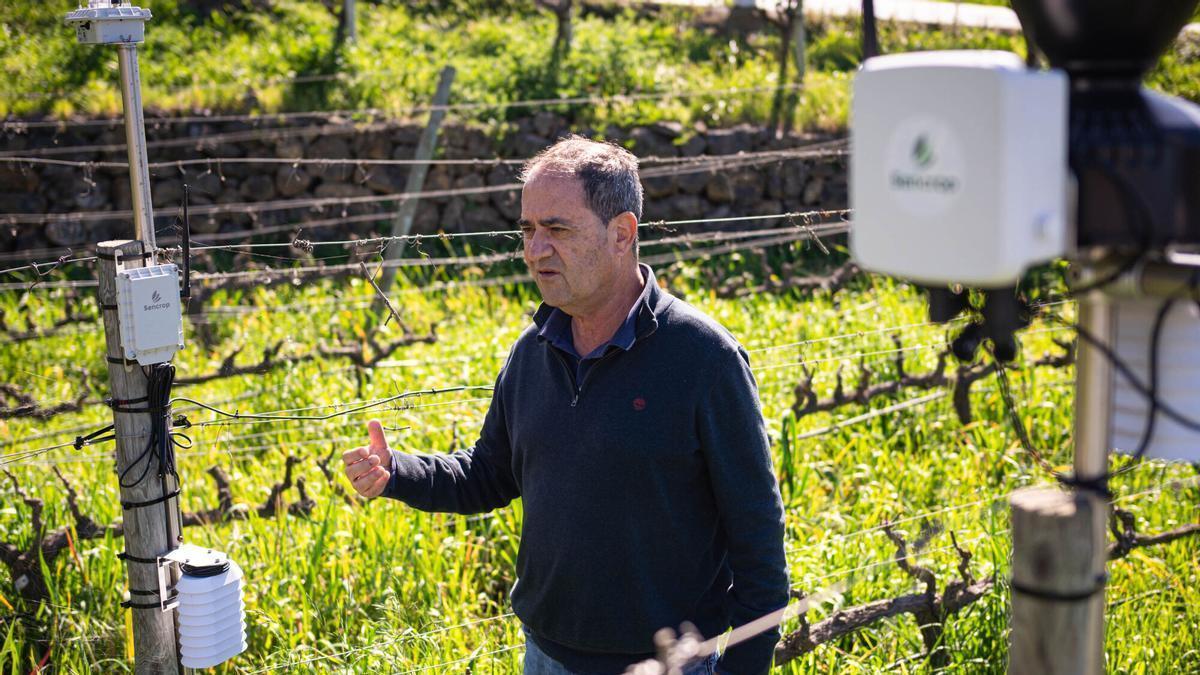
Méndez Siverio enthusiastically explains the entire series of devices that collect the necessary information and feed it into their database. Wind direction and strength, telemetry, ambient humidity, solar radiation – fundamental for indicating the level of photosynthesis – the level of moisture inside the plant – key for knowing the development of fungi – and information on temperature and humidity at different soil depths. These sensors transmit the data to the servers, and from there you access the winery to check, on a computer screen, what is happening in the vineyard outside.
There, Jorge Méndez, winemaker and the new generation of Viñátigo viticulturists, is waiting. He manages the field notebook. But it is not a physical notebook, covered in soil or dirty from the crops. It is an application that can be carried on a mobile phone or kept open on a computer. “I spend more time here than on Instagram,” he assures, laughing. The digital field notebook uses graphs to display the information that the AI has collected. All the winery’s plots are represented, and using a kind of balloon icon, which changes colour, they know the status of each one.
Colour-coded alerts for every vineyard
“You can geolocate the crops by any category you want: irrigation, grape varieties, or terraces. From there, you get your production units. In this case, each balloon is linked to each of the varieties that exist on the plot,” he says, pointing at the screen. “Below the balloon we have a small icon. These are the irrigation needs,” he clarifies. This data is obtained thanks to sensors buried in the ground that tell them “what the real infiltration rate of irrigation and rainwater is, or what the evaporation rate is, for example.” It is pure magic.
They also warn of disease risks using “little diamonds of different colours. If it’s green, there’s no risk. If it’s red, there is a risk. If it’s orange, it means there’s no risk but you have carried out a treatment, so the plot is covered,” he explains. The interface changes depending on the time period you want to view: a week, 15 days, or 21 days. All of this mutates according to “the weather forecast,” he highlights. What is truly interesting is “having a tool to discipline the technician or the farmer, something visual that makes your job easier.”
Bridging apps to predict the perfect moment
The winemaker now moves on to Sencrop, another tool that uses weather stations to forecast the weather. There are more than 38,000 of them across Europe. Viñátigo designed an API, a bridge between applications, to connect the forecast with the digital field notebook they showed initially. He gives an example: “If a red balloon appears in the field notebook, which means a risk, I then go to the weather forecasting programme and in the agronomy section it will say ‘spraying’, which means treatment. This vineyard is in a specific location and I know, thanks to the apps, that I can treat that spot between 6pm and 9pm. Not at other times, because it will be raining or it will be too windy. It tells you exactly when to do the work.”
Tradition and technology, hand in hand
Viñátigo is a clear example that agricultural activity is not at odds with technology. That it is not necessary to keep working as Méndez Siverio’s grandparents did, or even as his son’s grandparents did. Life in the countryside can be easier if, along with planting vines, you ‘water’ them with a digital imprint and a pioneering spirit.
What’s happening in the Canaries – straight to your phone
News, weather alerts and practical updates – direct from the islands, in English. We live here and know what’s going on – before the international media catch up. Everything lands on our WhatsApp channel – no middlemen, no algorithm. Curated for families, expats and travelers.

Vivanta shuts all dental clinics including six in Tenerife

Civil Guard warns of digital skimming threat to online shoppers

Tenerife shifts FDCAN funds from roads to housing

PSOE warns Arrecife plan could ‘bury’ El Cable beach in concrete

Canary Islands faces loss of 20% of self-employed workers

Canary Islands to get 26 new substations by 2030

Canary Islands poverty rates stuck since pandemic

Court backs eviction over verbal room rental in Arona

Canary Islands pushes for 10-year residency rule for foreign buyers
