Peaceful protest outside Loro Parque
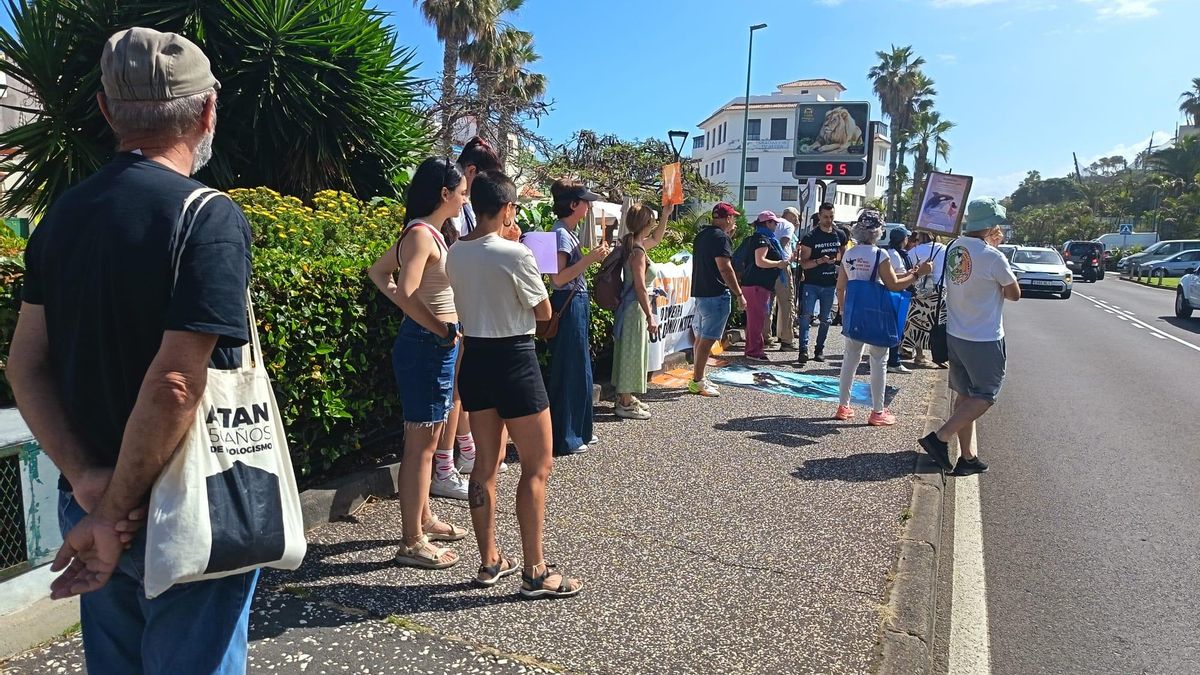
It is far from the first, but this Saturday morning’s protest outside the grounds of Loro Parque zoo in Puerto de la Cruz – the main tourist town in northern Tenerife – had a special feel to it. Called by Empty the Tanks, which coordinates similar actions at other zoos around the world that display and commercially exploit cetaceans, it brought together around 50 people from 11.00 to 13.00. It also mobilised two National Police vehicles with a dozen officers, something unusual and which protesters attribute to incidents at previous demonstrations on various other issues. Another protest is scheduled for this same Saturday afternoon. But what most characterised this gathering was its total pacifism.
The organisers stressed from the outset that participants should not censure visitors, Loro Parque workers, or anyone passing by on the adjacent road; on the contrary, they should understand them too, because they may not know about the suffering of cetaceans in such businesses. Hence the importance of raising awareness and spreading truly revealing facts.
Insults and silence
That said, in the first few minutes there were those who insulted the protesters: two elderly men, one walking directly past and another using a crutch on the parallel street, with comments such as: “Get a job” and “Don’t they protest against murderers or rapists?” Later, an hour into the event, some teenage girls returning from a visit to Loro Parque defended the zoo from the famous little tourist train that runs through the centre of Puerto de la Cruz. In all three cases, the reply was immediate and perfectly delivered by the protesters: silence and indifference, no response at all, simply more emphasis on their own arguments.
Why fewer people turned out
Some of the organisers, such as Teresa García from Imagine Canarias and Aurelio Rodríguez from Océanos de Vida Libre, explained to Canarias Ahora that the seemingly low turnout was because many people justify this business for the jobs it provides and the influence of this company across the whole island. Besides, with two calls to action on the same day, some people preferred the afternoon session (the day coincided with activities for the Mueca street art festival).
Nevertheless, supported by some passing vehicles that honked their horns in agreement – including a large fire engine whose crew raised clenched fists – those present made their voices heard and, above all, presented numerous arguments against this form of animal exploitation.
‘Dolphins don’t smile’
Among the most telling truths, unknown to many, was this: “Dolphins don’t smile – they can’t move their facial muscles. Their smiles are the biggest lie in history.” The protesters urged people not to be fooled, because in reality the animals are suffering captivity, imprisonment and exploitation. “No more water prisons – we demand free lives for cetaceans,” shouted some of those using the megaphone. “Enough animal abuse” was chanted at various points.
In the same vein, they emphasised that dolphins, like orcas and other cetaceans, are not clowns: “They have a right to freedom, they are not tourist attractions or machines for making bloody money – they are sentient beings, emotionally and socially.” They also recalled that, in many places, marine sanctuaries already exist, “but here we’re still stuck, we can’t do better,” they lamented.
‘No tank can replace the ocean’
They stressed that no tank can replace the ocean, and no applause or souvenir photo can justify imprisonment. Instead, they called for “empathy, respect and education.” Another slogan chanted by everyone was: “Oceans yes, tanks no.” It was also stated that each orca costs Loro Parque €500,000 a year, questioning the organisation’s conservation work and highlighting its profit motive. They accused the zoo of sending letters to schools and secondary schools across the island to “indoctrinate children and young people,” and pointed to the company’s connections with Ashotel, restaurants, media groups, and advertising companies – “the only company that advertises on traffic signs in Tenerife”. This contrasted, they said, with the fact that major US sponsors have already dropped the zoo due to international pressure.
“While ocean refuges for these animals are growing and being promoted, here we’re still stuck – it’s shameful,” they said. This global pressure has mobilised people with the same awareness at zoos across North America, South America, Africa, Europe, Asia and Australia, both yesterday and today.
Horrific consequences of captivity
Among other terrible consequences for cetaceans, the protesters cited: stress from transport; the small size of the pools, which limits their space and freedom; interactions between individuals leading to attacks by stronger animals on the rest; a diet based on frozen fish, less nutritious than fresh, supplemented with medication; and the separation of mothers from their calves when the latter are transferred to other facilities. They also explained that cetaceans suffer behavioural disorders due to imprisonment, such as swimming in repetitive circles, sharp and constant exhalations caused by anxiety, abruptly opening and closing their mouths, violently shaking their heads from side to side, or slapping with their fins, as well as begging for food because they are sometimes kept hungry to perform certain exercises.
Furthermore, they pointed to instances of voluntary beaching – coming out of the water – as has happened with the orca Morgan at Loro Parque, something “not at all normal in the wild lives of orcas.” This leads to depression, loss of appetite, psychological disorders, self-harm, aggression between individuals or towards trainers, and a weakened immune system that makes them more vulnerable. “They are highly intelligent and sensitive beings, and some specialists believe they even try to kill themselves by hitting the walls of the pools, aside from suffering from cataracts and excessive exposure to the sun due to the small size of the pools compared to the oceans.”
What’s happening in the Canaries – straight to your phone
News, weather alerts and practical updates – direct from the islands, in English. We live here and know what’s going on – before the international media catch up. Everything lands on our WhatsApp channel – no middlemen, no algorithm. Curated for families, expats and travelers.

Canary Islands tourism chief offers dialogue on residentialisation

Canary Islands office helps small councils ditch the peseta

Two tonnes of illegal tropical fruit seized at Tenerife port

Canary Islands approves new €1.6bn development fund

Mogán mayor says her €65,000 salary is too low

Abandoned cars in Canary Islands: hundreds left to rot

Work resumes on 27 affordable rental homes in Las Palmas

Los Realejos residents fight on against propane gas plant

Canarias among Spain’s poorest regions as 36.2% live on low incomes