
Compiled with the help of artificial intelligence, based on Spanish-language information. Source below the article.
Vineyards offer a reprieve after years of drought
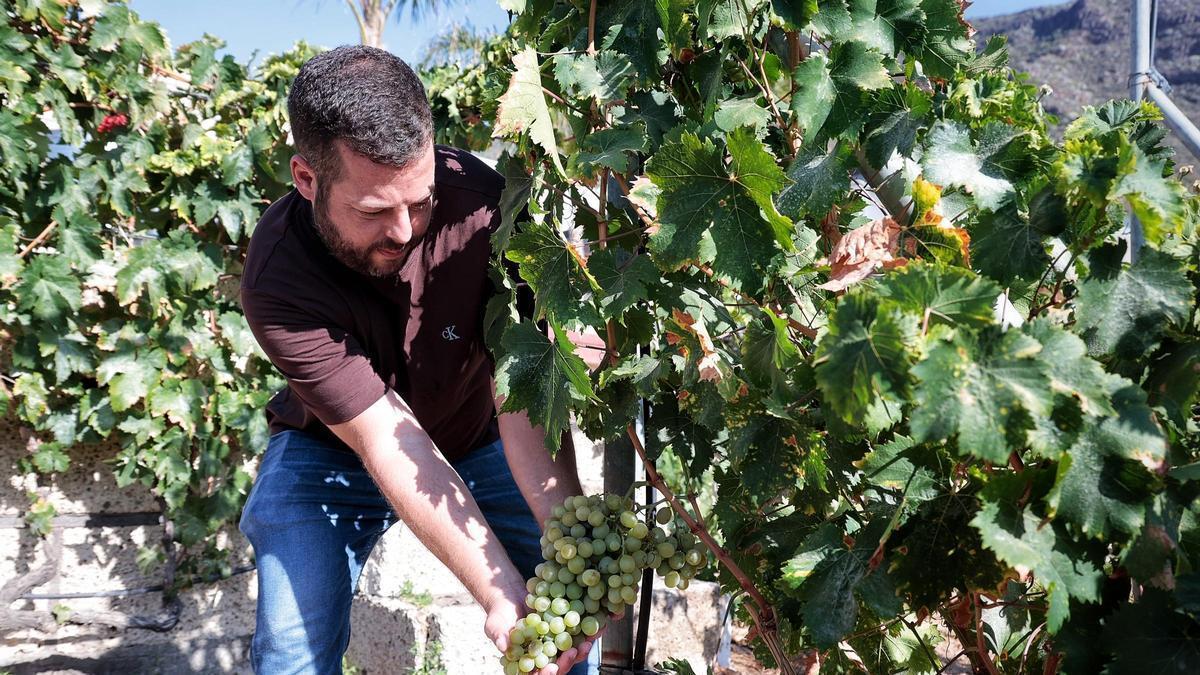
After several years of drought, abandoned plots and disappointing harvests, the vineyards are finally offering a reprieve this summer. At El Rebusco Bodegas in Candelaria, the first grapes of the vintage have already arrived at the winery with far better prospects than last year. The harvest still has its most significant stretch ahead, but Javier Luaces and Deborah Díaz, the married couple behind the project, are once again looking at their plots with hope of recovering production levels – and with it, a crop that has been losing ground in the Valle de Güímar every year.
And this recovery does not appear to be exclusive to these particular plots. Narvay Quintero, the Canary Islands Government’s Minister for Agriculture, described a more favourable scenario for wine growing across the whole of the Canary Islands during a visit to El Rebusco, with a “forecast increase in production” that will “double the number of kilos” compared with recent campaigns. This improvement is partly thanks to the abundant rainy seasons recorded in the first half of the year, which broke the run of droughts that had been dragging on from previous years.
Extreme heat poses new challenges
However, as the minister himself pointed out, “the extreme and prolonged heat” being recorded during these summer months “can be detrimental to the grape harvest, even though this used to be a rain-fed crop that required no irrigation.” Year after year, changing weather cycles and rising temperatures have meant that wine growers now have to “get used to guaranteeing supplementary irrigation systems so as not to lose hectares of vines.”
But the recovery of the harvest and adaptation to temperatures do not clear up all the problems facing the sector. Phylloxera – which last year forced restrictions on the movement of grapes and plant material in Tenerife – added to what was a particularly complicated campaign. A year on, Quintero assures that the situation is under control and that restrictions have been relaxed thanks to the eradication plan. “Right now all the outbreaks are under control and all the outbreaks have been eliminated,” said the minister, who puts the number of surveys carried out across the Canary Islands at more than 12,000 and insists that “no new outbreaks have been detected outside the zero zone.”
Abandoned plots and an ageing workforce
This problem is compounded by another, more structural one: the abandonment of plots and the lack of generational renewal. The age of many wine growers and the difficulty of making a holding profitable threaten the continuity of a crop that needs more than a good harvest to survive. “Nowadays it has to be a business, it has to be professional, but it also has to generate economic profits to cover all the costs and so that the owners have their income,” said Quintero.
The minister cites El Rebusco as an example of this change of model, having reinvented itself after several lean years and transformed wine production into a project that combines winemaking with diversification and wine tourism. It is a holding located in the mid-altitude slopes of Candelaria, where vines coexist with the typical conditions of south-eastern Tenerife: high temperatures, scarce rainfall and the constant influence of the wind that sweeps through the valley.
A long-term bet pays off
At the helm of these lands are Javier Luaces and Déborah Díaz, two young people trained in wine growing and connected to the countryside since childhood through their respective families – a relationship with the vine that they have now turned into their profession and a plot that, besides being family-run, serves to understand the extent to which recovering a vineyard can become a long-term bet.
In that small, traditional place, they first worked with merlot vines, which produced good results, until the couple decided to tear them up and replace them with muscatel. The new planting, however, did not respond as they had hoped. “Muscatel is a very capricious variety that bursts wherever and whenever it wants to, and it gave us a lot of problems,” recalls Javier Luaces. The first planting accumulated a high proportion of failures and then soil analysis revealed the presence of nematodes following treatment with chicken manure. It was time to tear up again, clean the soil and replant.
But they did not give up, and since 2019 they have been investing in a plot that is still far from offering its full potential. This year, for the first time, they have been able to harvest grapes from these vines, although they only reached 600 kilos compared with the nearly 5,000 that the plot can produce when fully developed. “We have been burying money here ever since to get this plot going,” explains Díaz. Patience is now beginning to bear its first fruit: with next year’s forecasts, they expect to reach at least 1,000 kilos and, within a couple of campaigns, get close to 5,000.
Wine tourism and underwater ageing
Now it is a small plot within a much larger project, as for the past seven years they have allowed visitors to tour the winery and organise experiences linked to the primary sector and the traditions of the region. El Rebusco also works with plots in the mid-altitude zones of Candelaria, Arafo and Güímar, where it grows different grape varieties at different elevations. Most of its production is white wine, although it also makes reds and rosés, and is already preparing new additions for this campaign, such as olive oil.
Diversification has even led the winery to experiment with underwater ageing: it has an installation at a depth of 18 metres with capacity for 5,000 bottles, where the conditions of temperature, pressure, humidity and the movement of the tides accompany the evolution of the wine. Because there, off the coast with views of the valley, those first 600 kilos have a special meaning: after years of work and several replantings, the plot is finally beginning to resemble the vineyard its owners imagined.
What’s happening in the Canaries – straight to your phone
News, weather alerts and practical updates – direct from the islands, in English. We live here and know what’s going on – before the international media catch up. Everything lands on our WhatsApp channel – no middlemen, no algorithm. Curated for families, expats and travelers.

Canary Islands sea hits second-hottest year on record

Legal bid to halt tree felling in Santa Cruz’s La Salud

Fiesta del Charco: A journey through La Aldea’s past

Corralejo dunes power line set for removal

ULPGC launches 14 research projects at Las Canteras

TMT will never be built, says Canary Islands astrophysics chief

Pedro Duque: Canarias is the “ultimate dream” for rockets

Court blow to Tenerife motor circuit project
La Palma faces new volcanic risk planning deadline
