
Bureaucracy and population growth hinder Tenerife’s €4.5bn infrastructure plans
Improving the quality of laws, simplifying administrative procedures, setting realistic and enforceable deadlines for public authorities, and prioritising strategic projects are the key milestones that would help resolve the delays in executing the works the island desperately needs. The provincial president of the Spanish Confederation of Business Organisations (CEOE), Pedro Alfonso, believes the line of work must be to “resolve the projects we already have and continue adding new ones.”
A decade to deliver major projects
Tenerife suffers from an investment deficit of more than €4.5 billion in fundamental works whose execution is slowed down, in the planning stage, paralysed, or under debate. The island’s Second Vice-President, José Miguel Ruano, acknowledges that Tenerife will take a decade to see these major projects completed, with a few exceptions that will arrive sooner.
One such exception is the Tren del Sur (Southern Train). Ruano announced that work on the route between San Isidro (Granadilla de Abona) and Adeje will begin in 2028 and last five years. This is an example of the acceleration of some pending projects which the current island government maintains is achievable “by opting to divide its execution into phases.” The same cannot be said for the Tren del Norte (Northern Train), on which “there is no definitive decision” considering the conditions of the region. For now, it is merely “a ideas competition.”
The unavoidable red tape and demographic pressure
The legislative and bureaucratic tangle is an irrefutable fact, though its role in providing safeguards is notable. The environmental impact assessment is a case in point: “We complain about it, but it is important and part of the process.” Ruano highlighted this study as essential “in a territory as sensitive as ours.” While mandatory, it introduces a slowing factor because “if it is a simplified assessment, its preparation takes 18 months; if it is an ordinary one, it is no less than 24.”
The CEOE president pointed to another consequence of construction delays: “Every year a project is delayed, the economy loses activity, competitiveness, and opportunities.” Pedro Alfonso called for commitment from Europe and the Spanish state, as “many of the pending projects have to do with state-level administrative simplification, funds from the General State Budget, or extraordinary financing from the European Union.”
The population growth recorded in Tenerife is another factor to consider. Within the framework of the planning advance being carried out by the island council, Vice-President Ruano clarified that in the Island Territorial Planning Plan (PIOT)—whose modification is underway—”the demographic factor that has occurred was not foreseen, much more accelerated than projected.” It is an element that “must be managed because it puts pressure on infrastructure and services.”
Accelerated road projects and the TF-5 challenge
The third lanes from San Isidro to Oroteanda and from there to Playa de las Américas in the south, as well as the one from Guamasa to Tenerife North Airport, are projects accelerated by the island council, defended Ruano. He stated that in terms of infrastructure, “very little progress was made in the last term,” with regional and island governments led by the PSOE.
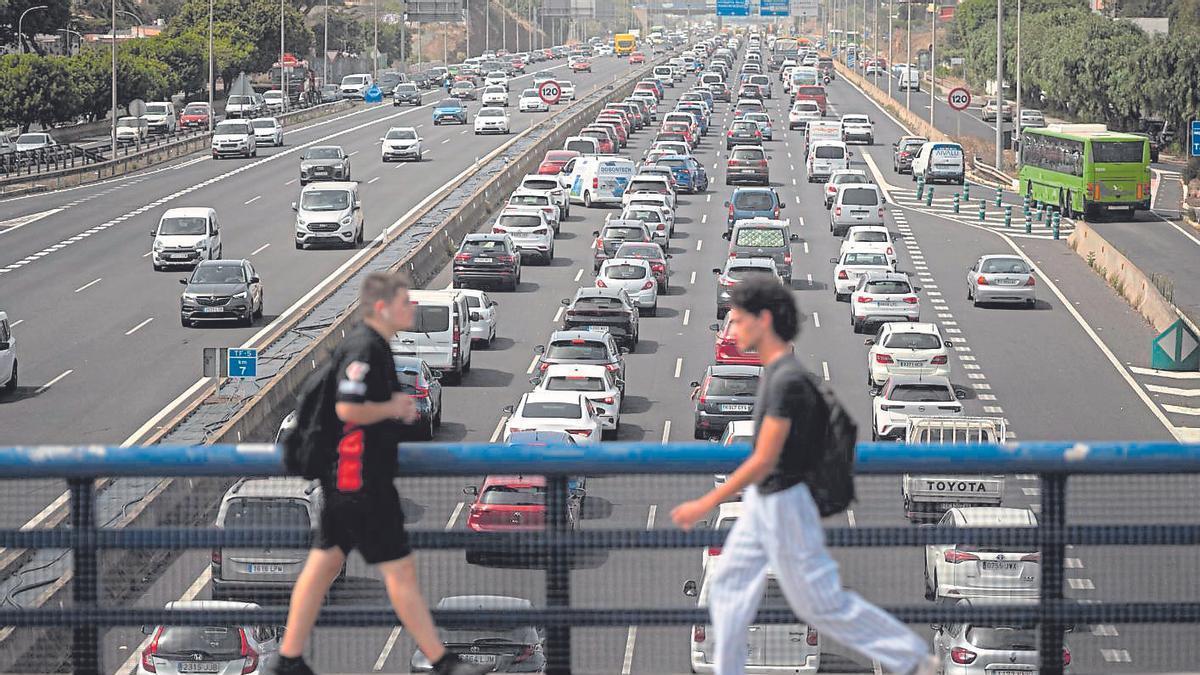
He did not hide that “resolving the La Laguna junction” is fundamental on the TF-5 motorway, a road with sections that have a traffic density “equivalent” to Madrid’s M-30 ring road. He advocated “looking for alternatives” to the proposed outer ring road “which La Laguna rejects” and considered it feasible to extend the tram to Los Rodeos (Tenerife North Airport) as it has the approval of La Laguna town council.
Fonsalía port scrapped, focus on sustainable connection
In his analysis of pending actions, he mentioned the port of Fonsalía, one of those projects that falls off the list as its construction has been ruled out. The question José Miguel Ruano poses is “how to resolve the connection of Tenerife with the Islas Verdes (La Palma, La Gomera and El Hierro).” He highlighted the “underground solution” for road communication with the port of Los Cristianos as a better bet than Fonsalía.
While the president of CEOE Tenerife, Pedro Alfonso, warned that “we have to integrate all this development into a sustainability that generates wealth and employment,” the island’s Second Vice-President considered that “we are on the right course and at cruising speed for all these major infrastructures to be possible.” Ruano also recalled that the island president, Rosa Dávila, has stated the aim is to carry them out “with the lowest possible environmental cost.”

Canary Airports Set New Winter Passenger Record

Canary Islands Airports See Passenger Growth in February 2026

Canary Islands Airports See Passenger Growth in February

New Air Deal Connects Canaries to Beijing, Havana & São Paulo

Tenerife Tourists Stranded in Thailand Amid Flight Chaos

Tenerife Flight Diverted to Santiago for Medical Emergency

60 Migrants Rescued in Rough Seas Off Fuerteventura

Land Expropriations Begin for Fuerteventura’s Major North-South Motorway

Flight to Tenerife Diverted to Lanzarote Over Unruly Passengers
