
Compiled with the help of artificial intelligence, based on Spanish-language information. Source below the article.
From roads to homes and social care centres
The Fondo de Desarrollo de Canarias (FDCAN), the strategic financial instrument designed by the Canary Islands Government to drive economic, social and territorial cohesion, is changing its priorities for the coming decade after ten years in which infrastructure, mainly roads, absorbed the bulk of investment in Tenerife. The new programme will give prominence to protected housing and social and healthcare provision, with an estimated one billion euros for the island.
The shift coincides with this week’s approval of the regulations that will govern the FDCAN until 2036, and with a meeting convened by Rosa Dávila, president of the Cabildo de Tenerife, with representatives of the island’s 31 municipalities. Public housing, the expansion of social and healthcare places and research are among the priorities, although there is not yet a definitive list of actions. The meeting allowed town halls to set out their needs before the first investment programmes are drawn up.
Around €2.6 billion across the Canary Islands
The new fund is expected to mobilise around €2.6 billion across the Canary Islands, of which €1.626 billion will come from the regional government. Tenerife hopes to gather around one billion, with regional and island funding split equally.
The FDCAN was created in 2016 to finance economic development projects, improvements to public services and the creation of job opportunities. Its origin lies in the resources linked to the suspension of the compensation the Canary Islands paid to the Spanish state for the now-defunct General Tax on Business Traffic.
A decade of spending laid bare
Tenerife’s balance sheet offers an X-ray of its priorities. According to the evaluation presented in June by the economist José Miguel González, between 2016 and 2024 some €1.139 billion was mobilised to finance 2,734 projects and carry out 4,912 actions. These are figures covering nine years, not the close of the first FDCAN, whose execution is still ongoing. Nor do they correspond exclusively to the regional government’s contribution: they include funding from other administrations.
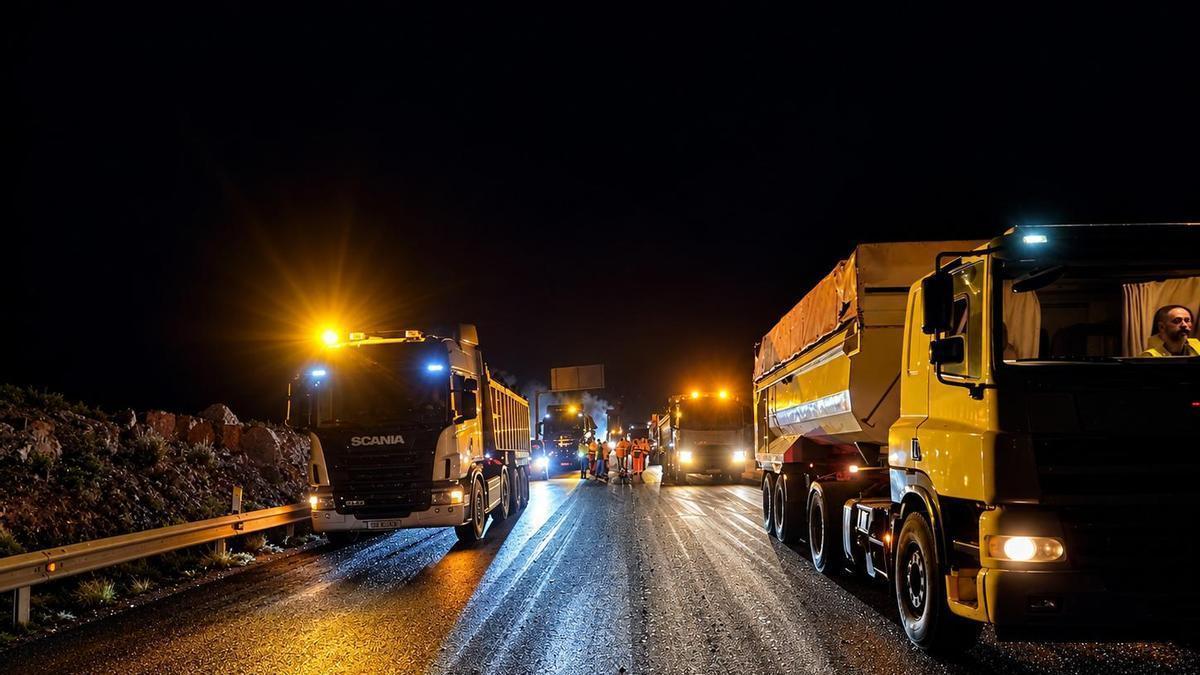
Infrastructure accounted for €801 million, 70% of the total. Within that block, transport actions received €429 million, 38% of all investment mobilised. Almost four out of every ten euros from the fund went on improving mobility and communications. The money reached both main roads and secondary routes, with work on busy traffic corridors and access roads to rural communities.
Among the actions identified is the improvement of the TF-1 southern motorway between Arico and Fasnia, at a cost of around €30 million over a stretch of approximately 24 kilometres. There were also works on the TF-82, the old general road in the south-west linking Santiago del Teide with Guía de Isora and other towns in the area, for more than €3 million, and on the TF-436, the winding road connecting Santiago del Teide with Masca, for around €1 million.
Transport investment represented just over half of the money allocated to infrastructure. The remaining €372 million funded facilities, public installations and water works. Supply, water distribution and sewerage networks formed part of that effort, alongside improvements to municipal spaces. It also extended to local tracks. The improvement of the El Batán track, in the municipality of La Laguna and in the surroundings of the Anaga massif, received around €2 million. Another action was the Camino del Tomadero, with around €265,000.
Employment, innovation and the island-wide reach
The second major destination was employment. Job placement programmes, training and improvements to career opportunities received €190 million, 17% of the resources mobilised. The third largest allocation went to innovation and the knowledge economy: €148 million, 13% of the total. It financed research, digitalisation and technological modernisation initiatives, with the aim of encouraging higher value-added activities and diversifying an island economy heavily dependent on services.
Another significant figure is the territorial reach. A total of €707 million corresponded to island-wide actions, roughly six out of every ten euros. Many of these sustained programmes and services covering different localities or benefiting Tenerife as a whole. The Cabildo organised these investments through the Marco Estratégico de Desarrollo Insular (MEDI), which made it possible to coordinate projects with other institutions.
What the new regulations change
The new regulations retain investment in infrastructure but expressly incorporate needs that have become more urgent: access to affordable housing and care for dependent people. The distribution for the Canary Islands reserves 50% of regional resources for infrastructure and facilities, including protected housing; 35% for social and healthcare centres and places, and 15% for research, development and innovation. Employment becomes a cross-cutting objective across all three strands.
At the meeting with the municipalities, it was proposed that around 30% of island funds be allocated to social and healthcare resources and 15% to innovation, leaving the rest for public works, with particular attention to housing. Roads and water works do not disappear from the list of fundable projects, although they will now compete with other needs for the available resources. Planning will be organised into three-year programmes, which may be reviewed annually.
Town halls will have to submit proposals, justify their needs and coordinate with the Cabildo the investments they hope to include in the first period. At this week’s meeting, Dávila identified access to housing, an ageing population and economic diversification as the challenges that should guide decisions. The 31 municipalities must now specify which projects they consider priorities, their budgets and the timeframes needed to carry them out. That selection will produce the first list of homes, facilities and services bidding for funding over the next three years.
What’s happening in the Canaries – straight to your phone
News, weather alerts and practical updates – direct from the islands, in English. We live here and know what’s going on – before the international media catch up. Everything lands on our WhatsApp channel – no middlemen, no algorithm. Curated for families, expats and travelers.

Civil Guard warns of digital skimming threat to online shoppers

PSOE warns Arrecife plan could ‘bury’ El Cable beach in concrete

Canary Islands faces loss of 20% of self-employed workers

Canary Islands to get 26 new substations by 2030

Canary Islands poverty rates stuck since pandemic

Court backs eviction over verbal room rental in Arona

Canary Islands pushes for 10-year residency rule for foreign buyers

Canary Islands public websites locked down over PHP security flaw

Supreme Court next stop for illegal Arguineguín homes
