
Compiled with the help of artificial intelligence, based on Spanish-language information. Source below the article.
New faces on the mountain
Until recently, spotting an environmental officer in Teide National Park was almost as difficult as catching a glimpse of a mouflon, the park’s most elusive species. But the situation has been transformed. “Excuse me, smoking isn’t allowed here,” recalls one of the new female wardens, in her sand-coloured trousers and deep red shirt, addressing a domestic tourist in the newly refurbished Roques de García car park. The woman drops her cigarette on the ground, stubs it out, and makes to leave it there. “Pick it up, if you’d be so kind.” She complies, then looks for a bin to deposit the butt.
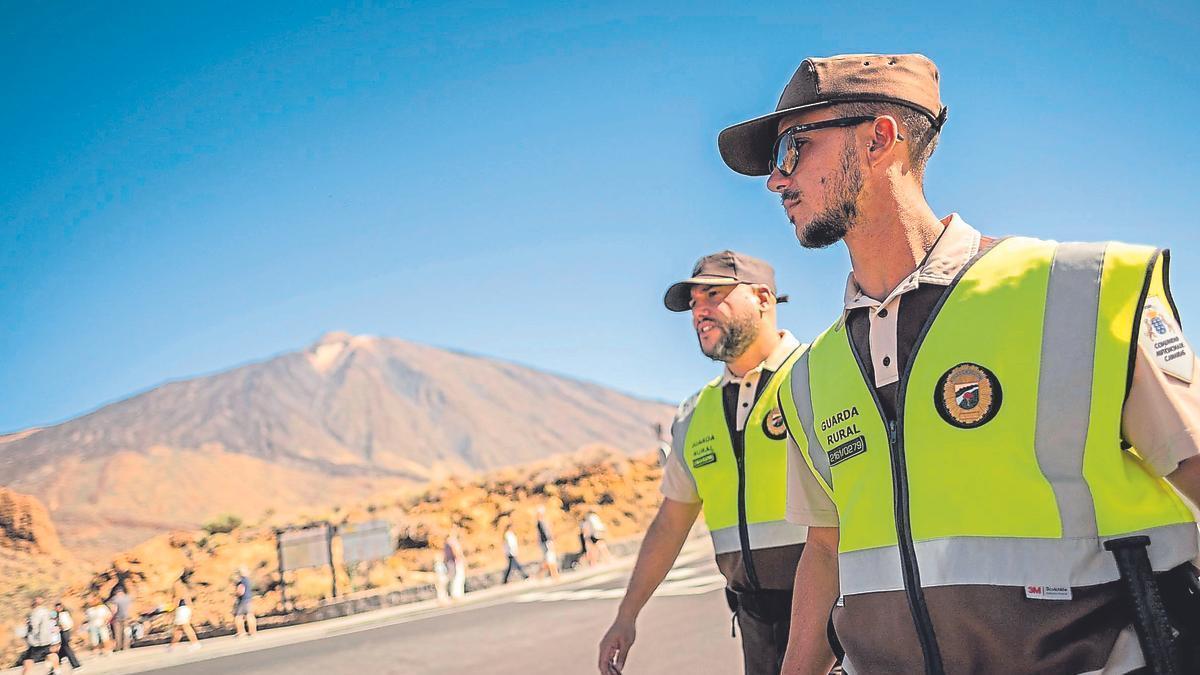
Since May, the team protecting this World Heritage Site has grown from just two officers to 32. And the difference is noticeable. The addition of 14 environmental agents to the national park, alongside 16 rural guards, plus a heightened presence from other security forces, has brought an end to the sense of chaos that once prevailed at Spain’s busiest protected area, which welcomed 5.1 million visitors in 2025.
Stationed at the most frequented spot in this open-air volcanic museum, Yésica Concepción, 45, and Sara Cabello, 35, keep a watchful eye to ensure nobody strays from the paths, pockets a stone, leaves litter behind, or lights up a cigarette. “This is the best office you could ask for,” says Yésica, casting a panoramic glance over the island’s most photographed landscape, with the famous “finger of God” – as the Roque Cinchado rock formation is known – in the foreground and the majestic Teide rising behind.
New powers, new penalties
Yésica Concepción and Sara Cabello are two of the newly appointed environmental officers. They are the authority on Teide, with powers to report offences and issue fines under the park’s new Master Plan for Use and Management (PRUG), which came into force on 4 December 2025. Indeed, the team has already issued more than a hundred penalty notices since its implementation. In just three months, they have carried out 1,300 interventions, leading to 120 formal complaints.
The coercive function, however, is not the priority. Their focus is on “prevention and environmental education,” the officers agree. The most repeated infringements in recent weeks, Yésica and Sara explain, relate to the latest ban. Since 19 June, smoking has been prohibited across the entire natural area. But despite signs being placed at strategic points, many people remain unaware of the rule.
Other recurring breaches include leaving the marked trails, parking incorrectly, removing geological and biological materials – stones, sand, plants – and even overnight camping, particularly in campervans. Nearby, at the entrance to the Roques de García car park, with the Parador National Hotel across the road, it’s clear peak time is approaching: 1pm. To prevent traffic gridlock, rural guard Daniel Padilla and a colleague, dressed in brown uniforms topped with reflective green vests, attempt to bring order to a suddenly accumulating line of cars – mostly hire vehicles – and coaches. “Where do I park?” asks a driver struggling with the heat. “There’s no space right now,” Padilla replies. “Try the car park opposite, but you can’t stop here.”
The rural guards, skilled in navigating the wilderness, have been recruited to support the environmental officers, primarily for checks at the main access points. Gone are the days of vehicles abandoned in the middle of the road, quad bikes invading car parks and flouting the ban on entering trails, cars damaging protected species, and even open-air drinking parties at the viewpoints on the north-west side – overlooking Arona, Adeje, Vilaflor, Guía de Isora, Santiago del Teide, and La Gomera – where crowds still gather to watch the sunset, but now with a modicum of order and control.
A new chapter for a world treasure
Following the reinforcement of surveillance and the renewal of the PRUG, the Cabildo of Tenerife assumed full responsibility for managing Teide National Park. On 7 May 2026, the Government of the Canary Islands completed the formal transfer of conservation duties for this jewel of Canarian nature to the island corporation. Declared a UNESCO World Heritage Site in 2007, it stands out for its extraordinary landscape, one of the most spectacular in the world. It is a geological monument where volcanic cones and lava flows form a unique array of colours and shapes. It also boasts great biological richness, thanks to its high percentage of endemic plant species and the significance of its invertebrate fauna, both in number and exclusivity.
Teide is home to 168 plant species. Of the 50 endemic plant species, 15 are practically unique to the area. But above all, the main volcano shines brightest – the highest point in the Canary Islands and Spain, at 3,715 metres. It is the third-largest volcano in the world measured from its base, and the highest peak of any land rising from the Atlantic Ocean.
Blanca Pérez, the Cabildo’s Minister for the Natural Environment, is unequivocal: “There is no longer impunity on Teide.” She makes this statement while overseeing the operation of the various control teams alongside Pedro Millán, the island’s director for the area. Pérez notes that it’s not just the new environmental officers and rural guards providing 24/7, year-round cover. She points out that other bodies have also stepped up their presence in this high-mountain landscape. Indeed, during their inspection visit, units of the Canarian Police, the Civil Guard, and the Brifor (Forest Fire Reinforcement Brigade) appeared at various viewpoints and car parks.
The head of environmental policy agrees with Yésica Concepción and Sara Cabello that the challenge is “by no means about raising revenue or being restrictive.” “The mere presence of officers has a preventive and deterrent effect, and doesn’t necessarily have to result in a higher number of sanctions,” explains the Natural Environment Minister. “Fewer infractions don’t necessarily mean less surveillance; rather, surveillance prevents certain infractions from occurring in the first place.” She cites parking as an example: “When there’s a police presence, people avoid parking badly.”
Hunting checks and invasive species
There are many other duties beyond those already mentioned. On the day of this report – last Thursday – one task in particular absorbed much of the attention of these sentinels of the abode of Guayota, the demon the Guanches believed lived inside Echeyde, as the island’s first inhabitants called Teide. The hunting season on Tenerife began on 2 August, and Thursday is one of the authorised days. Hence the numerous four-wheel drives and pick-up trucks with dog cages scattered across the landscape. There are areas where hunting is permitted within Teide.
Yésica and Sara ask hunters for their licences, check authorisations, and verify that rabbit captures with dogs – shotguns are not permitted for rabbits on the island – are within the rules. It’s a necessary activity. And the park allows hunting not just rabbits but also another invader: the mouflon. This species, related to sheep, was introduced under Franco in 1971 to open the island’s summit to big-game hunting. Alongside rabbits, it has become a serious threat to Teide’s fragile natural balance. The new Master Plan has set a target of eliminating the remaining 200 or so mouflons within five years.
Pérez acknowledges the challenge is formidable. “But we’re going to try.” She recalls that many more challenges lie ahead following the security reinforcement, the approval of the new PRUG, and other measures that have changed the face of this lava-sculpted world. Since November 2024, access to the summit of Teide has required a permit, non-residents must pay an eco-tax of up to €25, and a daily visitor cap of 300 has been set. Furthermore, last July, the Altavista refuge reopened after six years of closure, following a thorough renovation. Visitors can once again spend the night at over 3,200 metres in a refurbished facility, ready to tackle the final stretch to the summit of Spain in the early hours.
Looking to a sustainable future
The Cabildo is now working on drafting the park’s new sustainable mobility plan, which will prioritise collective transport – with paid shuttle buses for non-residents covering the main points of interest – over private vehicles. The aim is to reduce the excessive pressure the site has been under, with the consequent risk to its geological and botanical wealth. “We’ll have it ready in a few months,” stresses Blanca Pérez. She makes clear, however, that the intention is for “the majority of people who go up to Teide, once the mobility plan is approved, to do so via collective transport, enjoying a comfortable, efficient and sustainable service that offers a unique experience.”
Another objective is to maintain and improve special operations for days of mass attendance, such as those organised during snowfall or the recent solar eclipse and the Perseid meteor shower. After explaining to a visitor outside the Parador why smoking is prohibited – fire risk, and the need for extreme caution given the delicate natural balance – Sara responds when asked about curious situations she has observed in these first three months of patrolling the park: “I remember a positive one: a woman who, during her walk, collected all the rubbish she came across along the way.”
Both she and Yésica Concepción, who gained extensive experience in environmental care while living in La Palma, are clear that “education achieves far more than a thousand fines.” That’s why they never miss an opportunity, when they spot someone smoking or pulling up a plant, to explain that Teide’s species – such as the characteristic Teide broom – cannot survive fire. Many of those shrubs seen all around play a fundamental role in this space and are found nowhere else in the world. That’s why every single specimen must be cared for, however withered it may look.
What’s happening in the Canaries – straight to your phone
News, weather alerts and practical updates – direct from the islands, in English. We live here and know what’s going on – before the international media catch up. Everything lands on our WhatsApp channel – no middlemen, no algorithm. Curated for families, expats and travelers.

Canary Islands sea hits second-hottest year on record

Legal bid to halt tree felling in Santa Cruz’s La Salud

Fiesta del Charco: A journey through La Aldea’s past

Corralejo dunes power line set for removal

ULPGC launches 14 research projects at Las Canteras

TMT will never be built, says Canary Islands astrophysics chief

Pedro Duque: Canarias is the “ultimate dream” for rockets

Court blow to Tenerife motor circuit project
La Palma faces new volcanic risk planning deadline
