President arrives in Lanzarote
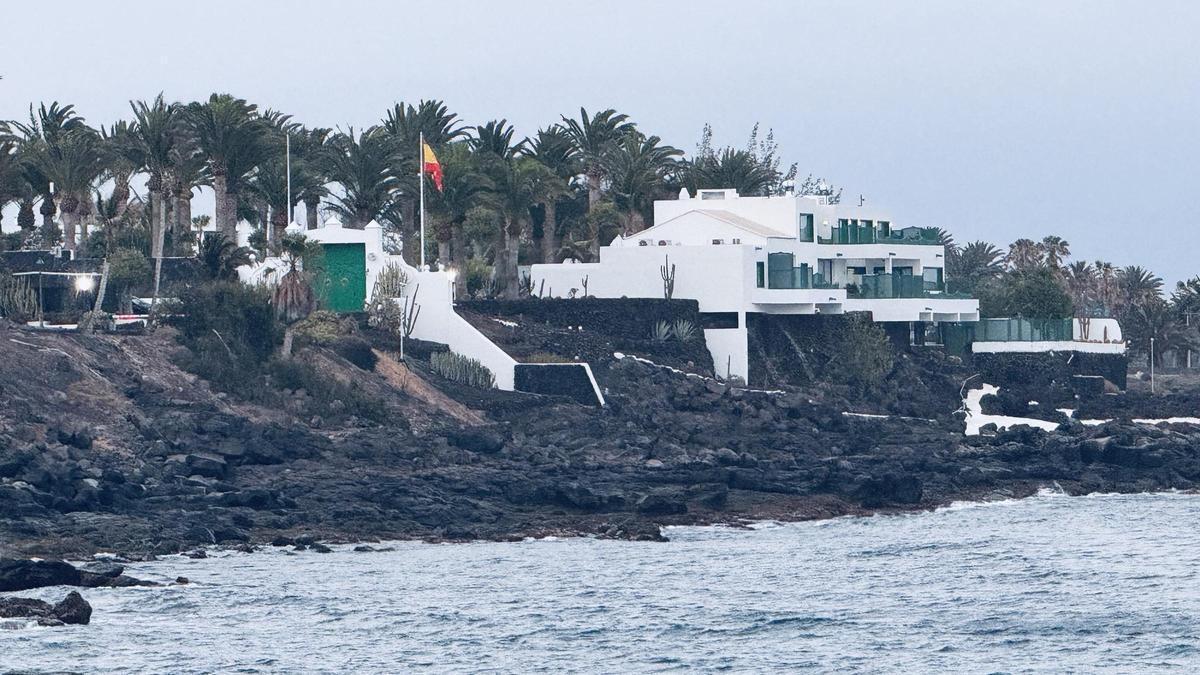
Spain’s Prime Minister, Pedro Sánchez, and his wife, Begoña Gómez, arrived on Lanzarote at midday on Saturday, 1 August, to begin their summer holidays at the La Mareta residence in the resort of Costa Teguise. The Falcon jet carrying the couple touched down at around 13:10 at César Manrique-Lanzarote Airport, taxiing from the runway to the parking area adjacent to the Military Aerodrome.
Sánchez and his wife are expected to remain on the island of volcanoes until 24 August, barring any last-minute changes. The Prime Minister’s arrival coincides with a moment of particular political significance, coming just a day after his trip to Ceuta, where Sánchez reviewed the situation arising from the serious migration crisis in the autonomous city.
Arrival amid migration crisis fallout
The move to Lanzarote follows an intense week marked by rising migration pressure on the border between Morocco and Ceuta. According to figures released by the Ministry of the Interior, around 50,000 people entered the autonomous city from Morocco during the week. Of those, more than 48,000 returned voluntarily to the neighbouring country. The episode also left 67 people dead, making it one of the most serious migration events recorded in the area in recent years.
Enhanced security operation
As with every holiday period for the Prime Minister, the stay at La Mareta will involve a significant security deployment. This summer, however, the operation will be larger than in previous years. In addition to the personnel who usually accompany the president, including the seven service staff listed in information published by the Transparency Portal, specialised agents responsible for his protection will also take part.
A contingent of between 30 and 50 Civil Guard officers from the Reserve and Security Group (GRS), a rapid intervention unit specialising in high-security operations and the protection of authorities, will join this deployment. The aim of the operation is to guarantee both the president’s safety during his stay and the surveillance of the surroundings of the official residence in Costa Teguise.
Union criticism over allowances
The arrival of the extraordinary deployment has also reignited criticism from the Unified Association of Civil Guards (AUGC) union, which has for years denounced the financial conditions faced by officers temporarily assigned to Lanzarote during the president’s holidays. The union claims that the daily allowances have not been updated since 2005, remaining at €49 for accommodation and €28 for meals. According to the AUGC, these amounts are insufficient to cover the real cost of lodging on the island during the summer season, when high tourist occupancy also makes finding available accommodation difficult.
The union also maintains that, in many cases, officers have to pay for their hotel out of their own pockets in advance, a situation it considers incompatible with the service they provide in ensuring the security of the State.
Maritime navigation restrictions
The Maritime Captaincy of Las Palmas has imposed a temporary restriction on maritime navigation in a stretch of the Costa Teguise coastline, Lanzarote, between 1 and 24 August 2026, coinciding with Sánchez’s planned holiday period on the island. The measure, which was also adopted last summer during Sánchez and his family’s time at La Mareta, affects the maritime area facing the residence.
The resolution, disseminated by means of a maritime safety broadcast, prohibits navigation within a specific perimeter defined by several geographical coordinates and the Lanzarote coastline. The restriction remains in force until 00:00 on 25 August. The broadcast issued on 29 July 2026 states that the temporary exclusion is for security reasons in the maritime space facing La Mareta, in the municipality of Teguise. The resolution references an agreement by the Maritime Captaincy of Las Palmas dated 28 July and delimits the affected area using official geographical coordinates. It specifies that the prohibition is limited to the maritime space between the coordinates indicated and the Lanzarote coast. The information is primarily aimed at vessels and maritime professionals, who must respect the temporary navigation limitations while the measure remains in force.
History of the La Mareta residence
The La Mareta residence is a complex owned by Spain’s National Heritage body since 1989. Over the years, this Lanzarote enclave has been chosen on various occasions as a holiday destination by prime ministers José María Aznar, José Luis Rodríguez Zapatero and Pedro Sánchez, as well as by the Spanish Royal Family during the period when Juan Carlos I held the position of Head of State.
It was built at the behest of King Hussein of Jordan in the late 1970s and designed by architect Fernando Higueras, with input from Lanzarote-born artist César Manrique. Hussein of Jordan transferred La Mareta to Juan Carlos I on 22 June 1989, and the property became part of the National Heritage on 18 July that same year.
La Mareta takes its name from a pre-existing cistern carved into the ground, a traditional construction known on the island by that name. It covers a land area of 30,900 square metres and sits close to the shoreline facing south. The complex consists of a group of single and two-storey buildings with a total built area of 1,900 square metres, reinterpreting traditional Canarian architecture: white walls and flat roofs, with chimney tops adorned with dome-shaped decorations. It also features references to colonial architecture, visible in its wooden balconies and lookouts. The exterior woodwork contrasts with its green colour. The buildings are linked by landscaped gardens totalling 9,850 square metres.
Further updates to follow.
What’s happening in the Canaries – straight to your phone
News, weather alerts and practical updates – direct from the islands, in English. We live here and know what’s going on – before the international media catch up. Everything lands on our WhatsApp channel – no middlemen, no algorithm. Curated for families, expats and travelers.

Los Realejos residents fight on against propane gas plant

Canarias among Spain’s poorest regions as 36.2% live on low incomes

Canary Islands bananas lose ground to imported bananas
Canary Islands bottom of Spain’s social housing table
Three migrant boats reach Canary Islands in 24 hours

Canarias proposes 10-year residency rule to buy property
Gran Canaria hotel maid arrested over stolen gold necklace
Canary Islands plan 10-year residency rule to buy a home

Canary Islands launches empty homes rental scheme